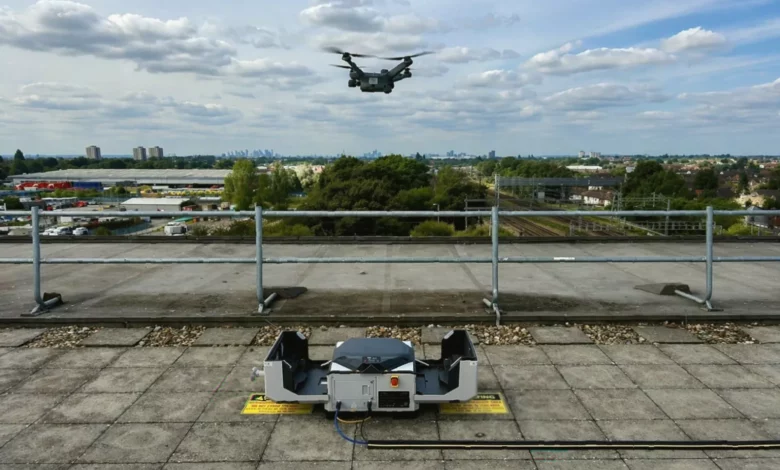
Drones will soon patrol the railways around Romford to deter trespassers and identify infrastructure faults, as part of a new trial announced by GBR Anglia. The scheme, which has been approved by the UK Civil Aviation Authority, will see beyond visual line of sight (BVLOS) drone technology deployed from late summer 2026, offering Network Rail teams live aerial coverage up to 400 metres from Romford Rail Operating Centre.
Purpose of the trial
The trial is designed to tackle the persistent problem of trespass, vandalism and cable theft, which Network Rail data shows accounted for more than 143,000 delay minutes across the Anglia route in the 2025/26 period alone. Nationally, trespass incidents caused over 908,000 delay minutes in 2023/24, with the performance delay costs estimated at £55 million annually before the Covid-19 pandemic. By providing faster access to real-time aerial imagery than standard drone systems, the BVLOS technology will allow railway staff to assess incidents more quickly and reduce the need for personnel to enter high-risk areas. The initiative is part of Anglia’s integrated railway approach, bringing together Network Rail, c2c and Greater Anglia, and follows 16 months of development work.
Technology in focus
The drones will be operated on Network Rail’s behalf by the specialist provider Heliguy, whose pilots will control the aircraft remotely from a Remote Operations Command Centre in Newcastle, hundreds of miles away from the tracks. The system uses automated “drone-in-a-box” technology, with the aircraft housed in DJI Dock 3 units and the flights themselves using DJI Matrice 4TD models. This set-up enables the drones to be deployed quickly and operated beyond the pilot’s line of sight, a capability that requires specific CAA Operational Authorisation and is assessed under the UK Specific Operations Risk Assessment (SORA) framework. The CAA has published a roadmap aiming for routine BVLOS operations by 2027, signalling a strategic push to integrate advanced drone capabilities into UK airspace. A similar trial is already under way on Network Rail’s Western route in Gloucester, where Simon Gillibrand, operations director for that route, is overseeing the work.
Thermal imaging and predictive maintenance
A key feature of the drones is their high-resolution thermal imaging cameras, which allow Network Rail teams to detect early signs of wear or damage across track, drainage, structures and lineside equipment before faults develop into service-disrupting failures. This early identification is central to the trial’s benefit case: rather than relying on routine patrols or waiting for a defect to become visible, engineers can analyse thermal data to spot overheating components, damp areas indicating drainage problems, or structural stress that is invisible to the naked eye. Thermal imaging drones are increasingly being adopted across industries for infrastructure inspection, offering safety, efficiency and data accuracy advantages over traditional methods. The technology aligns with a broader industry shift towards predictive maintenance, where interventions are planned based on actual asset condition rather than fixed schedules. Ken Durling, asset engineer for track renewals on Network Rail’s Anglia route, has been involved in the development work that underpins the Romford trial.
Beyond infrastructure monitoring, the thermal cameras also enhance incident response. When trespassers or vandals are active, the drones can locate individuals even in poor light or hiding in vegetation, giving route crime teams a tactical advantage. Richard Barke, Network Rail’s route crime and security manager for Anglia, said: “Trespass, vandalism and cable theft are some of the biggest causes of delay for passengers across the East of England. The learning from Romford will help us understand how this technology could support faster and more effective incident response across the Anglia route in the future. That means better coordination between route crime teams, operations and response teams, so we can deal with incidents more quickly and keep disruption to a minimum for passengers.”
Broader impact and safety context
The trial comes amid heightened awareness of the dangers of railway crime. Trespassing is illegal and extremely dangerous, with the potential for life-changing injuries or fatalities. Network Rail and train operators run safety campaigns and install physical deterrents such as fencing and gates. Data shows that trespass is almost twice as likely during summer months, often involving young people, and there is a trend of increasing youth involvement. US statistics suggest that trespassers are predominantly white males, often under the influence of alcohol, and that 70 per cent of trespass occurs within 100 metres of a train station. Romford station itself has undergone significant upgrades in preparation for the Elizabeth line, including platform extensions, refurbishment and the deployment of blue studs on platform surfaces to reduce anti-social behaviour and improve safety.
The long-term aim for the Romford trial is to expand BVLOS drone operations across strategic locations in Anglia, with flights extending up to 4 kilometres from the control centre. This ambition mirrors earlier Network Rail BVLOS work in Birmingham and Wolverhampton, where the focus was on navigation systems and broader network monitoring. The Romford scheme represents a concrete step towards routine use of advanced drones on the railway, combining real-time surveillance, predictive maintenance and safer working practices in a single operational model.