Dior moved its Paris menswear show from the afternoon to 9am this week, a last-minute decision taken after temperatures in the French capital were forecast to reach 40°C on Wednesday. The shift offered a rare dose of pragmatism in the world of high fashion, and the brand doubled down on guest comfort with cool towels handed out on arrival, umbrellas to block the sun and personalised fans at each seat.
Heat, history and hedonism
The show unfolded in the grounds of the Musée Nissim de Camondo, a historic house museum on the edge of Parc Monceau built between 1911 and 1914, which closed for renovation in August 2024 and is currently scheduled to reopen in 2030 – though more recent plans suggest early 2027. Those seated in the garden benefited from the occasional breeze, a small mercy on a day when the city sweltered.
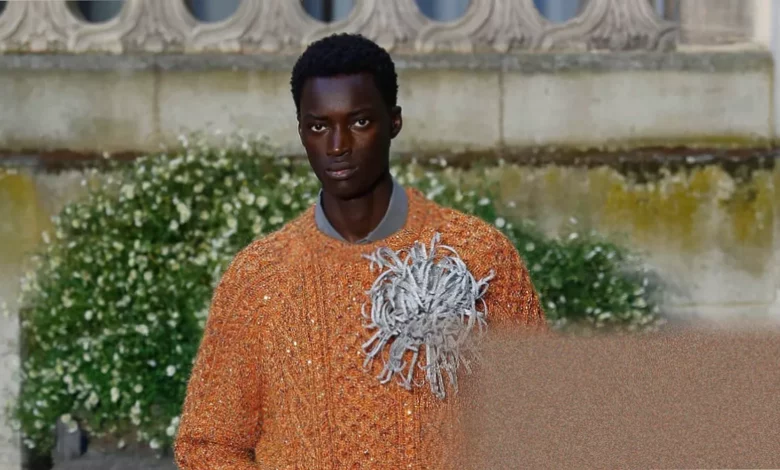
The soundtrack came from Fred Again, the British producer and DJ whose music blends UK electronic, house and garage with ambient and classical influences, often using sampled voice messages and conversations. The invitation was a black disco ball, setting the tone for a collection that embraced a kind of luxury hedonism. Trousers were coated in hologram sequins, jeans were ripped, and oversize metallic brooches punctuated the looks. Some suits were deconstructed and remade in chiffon, giving an ultra laid-back feel. The overall effect was one of elegant dishevelment: an overcoat worn with metallic shorts, a monogram quarter-zip paired with a bow tie – the wardrobe of someone who treats going out after dark as a central lifestyle pursuit.
Indie sleaze and rave revival
The collection draws heavily on what has been termed “indie sleaze”, a style that dominated from roughly 2006 to 2012 and is characterised by a messy, lethargic take on vintage fashion, particularly from the 1970s, mixing punk, rock, clubbing culture and new wave. Ripped jeans, hole-filled t-shirts, smudged eyeliner and a general sense of chaotic spontaneity are its hallmarks. The aesthetic has seen a resurgence on Instagram and TikTok, embraced by Gen Z, with figures such as Kate Moss, Sienna Miller, Alexa Chung and Amy Winehouse among its original icons.
Jonathan Anderson, speaking after the show in a blue chambray shirt, pointed directly to this cultural shift. “Especially in London at the moment, there’s a whole new movement of kids going out. Rave culture is starting back up again – you see it in the suburbs, you see it outside of the city. I see it on the Seine at seven o’clock in the morning. Something is changing – it’s more loose in terms of approach.”
Anderson’s balance: existing customer, new recruit
Anderson’s position at Dior is unique. In April 2025 he was appointed the sole creative director for menswear, womenswear and haute couture – the first designer to hold all three roles since Christian Dior himself. This is his third menswear outing, and he has already demonstrated a clear method for navigating the tension between heritage and reinvention.
“I have an interesting job, as I have to talk to an existing customer and loyal client, and I have to go about recruiting customers,” he said. “For me, in a weird way, I enjoy screwing with that, because that’s where you find tension, within that character.”
That balancing act is evident in his previous collections. His first menswear show, presented on 27 June 2025, featured plain knitted jumpers and jeans – a deliberately stripped-back starting point. His January 2026 collection leaned into indie sleaze, signalling a shift towards a younger, more rebellious audience. Since then, Dior has staged a show in Los Angeles and opened a restaurant in Saint-Tropez, ensuring the brand maintains a presence in the hotspots frequented by wealthy clients. This latest collection fits into that masterplan, using pop culture as a bridge between established buyers and new ones.
Anderson’s track record across broader markets is formidable. He has designed collections for Uniqlo under the JW Anderson line since 2017, a partnership known for blending British heritage with Japanese quality. At Loewe, also owned by LVMH, he spent 11 years as creative director, increasing revenue from approximately €230 million in 2014 to nearly €900 million in 2024 – a rise of more than four times. In its 2024 financial year, Loewe reported revenues of €885.2 million, a 9.17% increase from 2023, though net profit declined by 24.26%. His work there, including iconic pieces such as the Puzzle bag, established a reputation for playful yet sophisticated design.
Analysts expect a similar effect at Dior. A February 2026 HSBC report suggested that Jonathan Anderson could deliver a 10% growth in the brand’s fashion and leather goods division across 2026, partly by attracting new clients and revitalising a womenswear line that, according to HSBC, had become “stale and repetitive”. The luxury market is banking on a recovery driven by wealthy US consumers, and Anderson’s ability to create designs that feel both innovative and commercially viable is central to that forecast.
The show’s timing, moved to avoid the worst of the heatwave, may have been a practical concession, but it also served as a reminder of the pressure on fashion weeks to adapt to a changing climate. For Anderson, the collection is another piece of the puzzle – one that, as he put it, is “more loose in terms of approach”. The ripped jeans, the hologram sequins, the deconstructed chiffon suits: all point to a designer who understands that the line between a loyal customer and a new recruit is often drawn at the edge of the dancefloor.