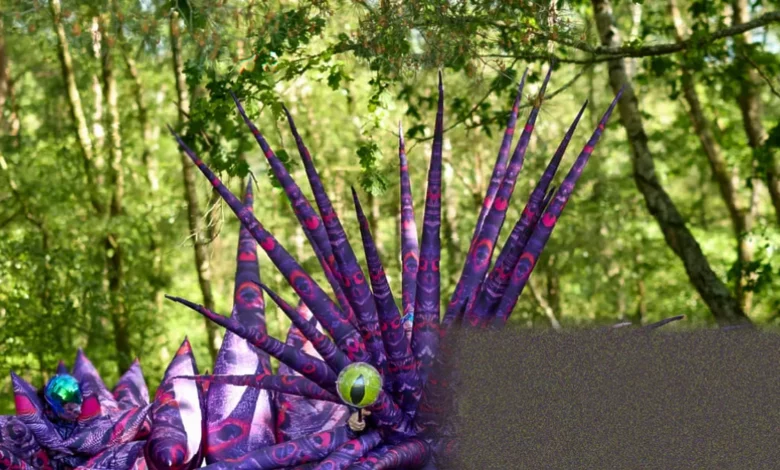
A shapeshifting creature named Poppet is enchanting schoolchildren in Ashdown Forest, East Sussex, as part of a bold effort to reconnect a new generation with the natural world that inspired Winnie-the-Pooh. The puppet, designed by costume designer Jack Irving and brought to life by a team of ten award-winning puppeteers, moves sinuously through the bracken, emitting strange cooing and purring noises. With a huge tubular nose, eyes inspired by adders, iridescent patches and the psychedelic purple of flowering heather, it transforms before the children’s eyes from caterpillar to bird to munching monster.
“What is it?” “It’s an alien!” “They are dinosaurs.” “Dragons.” “We’re going to die!” – the primary school class squeal with delighted fear, though Poppet is more interested in devouring gorse and bracken than the young humans who are all‑too‑rarely found playing in the forest in the modern era. The puppet is operated by ten people simultaneously, an ambitious feat of live performance, and its design draws directly from the Ashdown Forest landscape and its endangered species – heather, gorse, the adder’s eyes, the Purple Emperor butterfly and the green tiger beetle. Irving, known for colliding technology with live performance and for his work with global pop icons including Lady Gaga, Katy Perry and the Spice Girls, has created an “open‑ended character” onto which children can project their own fantasies, encouraging improvisation and imagination.
Angie Bual, creative director and joint chief executive of the outdoor arts charity Trigger, which created both Poppet and the wider festival, says the puppet is intended as a new gateway to nature. “I love these deep mystical ideas that come to you in childhood and you can’t shake and you’re magnetised to visit these places,” she said. “Putting a narrative on to a natural landscape gives it a mystical edge.” Bual, who collaborated with local schoolchildren to devise Poppet, watched the puppet perform in Ashdown Forest for the first time during this event. “Theatre and outdoor arts really can change place, change memory of place and change value of place,” she added. “Having something different in a natural space gives it that magic.”
The Big One Hundred celebrations
Poppet is the centrepiece of “The Big One Hundred”, a free festival of cultural events taking place in Ashdown Forest and across Sussex throughout summer 2026 to commemorate a century of A. A. Milne’s Winnie‑the‑Pooh stories. The programme is curated by Trigger, an outdoor arts charity whose previous work includes “The Hatchling”, a human‑operated dragon the size of a double‑decker bus that led Queen Elizabeth II’s Platinum Jubilee pageant in 2022. The festival was commissioned by Wealden District Council and Ashdown Forest, with support from the Ashdown Forest Foundation. Its aim is to inspire a new generation’s connection with nature and the conservation of the forest, rather than simply recreating a nostalgic yearning for Christopher Robin’s lost 1920s upbringing.
“Young people are ready for a different story and if you really want that to happen, doing a Beatrix Potter style event won’t really captivate these people and get a diverse audience,” Bual said. Alongside Poppet’s performances, the celebrations include a set of badges for children to collect by participating in nature‑based activities such as crafting, storytelling and yoga. Transport is being provided to bring families from global majority groups and disabled‑led groups to the forest, addressing the under‑representation of visitors from deprived inner cities and communities of colour in the British countryside. Research shows that ethnic minorities have significantly less access to green space due to barriers including cultural norms, economic factors, lack of information and a perception of the countryside as unwelcoming or a predominantly white space. Bual, a British Asian, noted that spending time in nature is “just not instilled in everyone’s culture”. She said events like this provide a crucial destination: “Sometimes you need a destination or an event like this and then you can go down a path and remember that there is fun and joy to be had everywhere. That was what Christopher Robin’s original experience was. Will the Christopher Robins of the future protect these precious places? It needs passion. It needs you to feel like the space belongs to you, for you to really want to save it.”
The existing attractions for Winnie‑the‑Pooh fans – the Pooh Corner coffee shop, the Pooh Sticks bridge and guided walks – remain, but Bual and Trigger were determined to create something that looked forwards. Ashdown Forest itself, the real‑life inspiration for the Hundred Acre Wood, was brought to life by Milne’s superlative comic writing and E. H. Shepard’s meticulous illustrations – Shepard’s original map of the Hundred Acre Wood sold for a record £430,000. Milne lived at Cotchford Farm near the forest and roamed the heath with his son Christopher Robin, who later helped save the forest when it came under threat in the 1980s. Today the 2,500‑hectare site, a Site of Special Scientific Interest, is owned by the local council and managed by the Board of Conservators of Ashdown Forest as a common and nature reserve.
Conservation challenges and the puppet’s role
Maintaining the rare lowland heath that supports the forest’s special species – the silver‑studded blue butterfly, adder, nightjar, Dartford warbler and, as the first bird heard on a recent visit, the cuckoo – requires careful management. Since Christopher Robin’s childhood, the forest has changed from 90% open heath to approximately 60%, with a decline in traditional livestock grazing by commoners and an increase in tree growth. Beth Morgan, head of engagement and development at Ashdown Forest, said one of the biggest challenges is cutting down some of the new trees to preserve the heathland habitat. “We often get the question, ‘Where are all the trees? Why are you taking the trees out or the gorse out?’ When you explain to people, they usually understand. That ongoing engagement with visitors so they know why we are doing what we’re doing is so important.”
Poppet’s performances include a gentle educational element: the puppet devours gorse and bracken, and the audience will be able to “feed” it. Bual hopes this will imbue what is a fairly mundane conservation message with “a sense of excitement”. “When you have a playful creature embodying that need to control gorse and bracken, you’ve got the message,” she said. The puppet’s design itself – inspired by the Purple Emperor butterfly, the green tiger beetle, adders’ eyes and the purple of flowering heather – serves as a constant reminder of the fragile ecosystem it represents. Ashdown Forest, which was historically a medieval hunting forest, now receives 1.5 million visitors each year, yet it is widely recognised that families from deprived inner cities and communities of colour are far less likely to visit such landscapes. The Big One Hundred seeks to change that, providing transport and creating a “destination” that sparks curiosity.
Bual, reflecting on the children’s reaction to Poppet, said: “When the puppet came into the forest today, the kids screamed with laughter and emotion. You’re telling kids that nature means happy‑happy‑happy. Culture is a quick way to make sure you all had a great time today. Those kids will now know they love Ashdown Forest. That’s what makes a place like this a natural treasure, a local treasure or ‘this belongs to me’. It’s emotional anchoring.”
And what would Winnie‑the‑Pooh himself make of Poppet? “I think he’d be wise about it,” Bual smiled. “He’d tell Piglet that he knew all about it all along.”