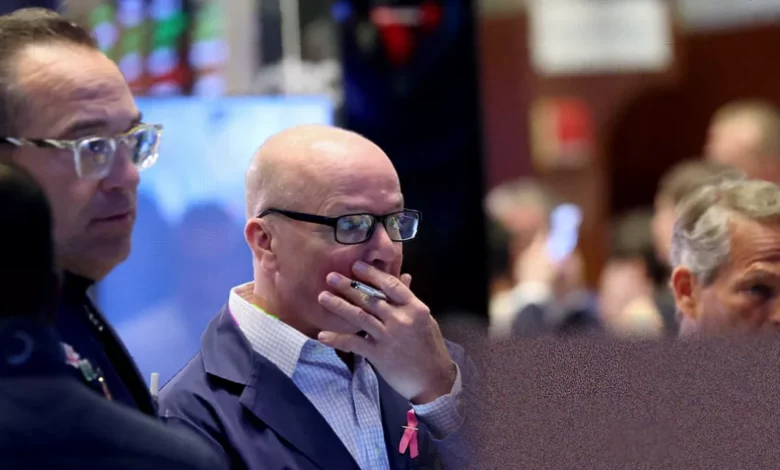
Tech stocks plunged on Tuesday, yanking global markets lower as investor attention pivoted sharply from the US military campaign in Iran to the gathering clouds over the artificial intelligence sector that has powered Wall Street’s recent record run.
The sell-off began in New York and accelerated through the trading day. The tech-heavy Nasdaq Composite opened 2% lower and by midday had deepened its losses to 2.4%. The broader S&P 500 fell 1.6%, while the Dow Jones Industrial Average slipped 0.6%. Should the losses hold, the Nasdaq 100 is on track to shed more than $1 trillion in market value.
For much of this year, the story has been one of relentless gains. All three major US indices have hit successive record highs, riding a wave of funding directed at AI technology and the infrastructure needed to sustain it. The Nasdaq was up 10% for the year before Tuesday’s slide; the S&P 500 had climbed 7.3%, and the Dow had jumped 6%, breaching 51,000 points. But the same concentration that drove those gains is now raising alarms about their durability.
Seven tech companies alone account for 30% of the S&P 500’s total value. That heavy reliance on a single industry and a handful of firms has prompted some economists to warn that the market is inflating a bubble reminiscent of the dot-com era of the late 1990s and early 2000s. The comparison is becoming harder to dismiss as the scale of AI-related borrowing swells.
Debt-fuelled AI spending sparks bubble fears
At the heart of these concerns is a surge in corporate borrowing to finance AI development. Investment bank Morgan Stanley has estimated that global AI-related debt issuance will surpass $570 billion this year. Ipek Ozkardeskaya, senior analyst at Swissquote, noted that AI-linked borrowing has become a go-to tool for tech firms whose capital requirements outpace their earnings. “Morgan Stanley has estimated that AI-related borrowing will surpass $500bn this year,” she said, citing the bank’s projections. The updated figure of $570 billion reflects the accelerating pace.
The scale of spending is staggering. Hyperscalers — the largest cloud and AI infrastructure companies, including Alphabet, Amazon, Microsoft and Meta — are expected to spend a combined $700 billion in outlays this year. Alphabet alone has raised $141 billion in debt and equity since October to fund AI infrastructure, and its total AI capital expenditure is projected to reach between $180 billion and $190 billion in 2026.
Signs of strain are appearing. On Monday, Elon Musk’s SpaceX — which debuted on the market on 12 June to considerable fanfare — dropped 16%. The company announced it is seeking to raise $20 billion in a bond sale, even after it had already raised more than $85 billion through its initial public offering. The move reignited concerns about the enormous cost of the company’s projects and its reliance on debt financing. SpaceX shares continued to slide on Tuesday, falling another 4.8%.
The warnings from economists are sharp. Some analysts, however, argue that the AI cycle differs from the dot-com bubble because the largest tech companies have stronger fundamental earnings and a more disciplined approach to valuations. Nigel Green of the deVere Group countered that the market is shifting from rewarding AI spending to demanding evidence of profitability.
Compounding those concerns, the Federal Reserve last week signalled it may raise interest rates — increasing the cost of borrowing — to combat rising inflation. Nearly half of Fed officials now project at least one rate hike this year, a sharp shift from the previous easing cycle that has forced investors to re-evaluate risk.
Alphabet’s AI talent exodus triggers Monday’s slide
Monday’s market drop began with Alphabet, Google’s parent company, which suffered its worst single-day decline in over a year. Its share price fell between 5% and 7%, erasing approximately $269 billion in market capitalisation. The trigger was the departure of two high-profile AI researchers. Noam Shazeer, co-author of the foundational transformer paper and co-lead of the Gemini project, left for OpenAI. John Jumper, a Nobel Prize winner for his work on AlphaFold, departed for Anthropic. These exits intensified investor fears that Alphabet is losing the war for elite AI talent at a time when competition from rivals such as OpenAI and Anthropic is intensifying.
“Google is losing the war for talent at the frontier of AI,” warned D.A. Davidson analyst Gil Luria. Jefferies, however, maintained a “Buy” rating on Alphabet, arguing that the market overreacted and that Alphabet benefits from deep AI investment and a large talent pool.
The semiconductor sector, the backbone of AI computing power, was hit hardest. The Philadelphia SE Semiconductor index tumbled 7.3%. In South Korea, the country’s largest chipmakers, SK Hynix and Samsung Electronics, both closed more than 12% lower on Tuesday. SK Hynix shares fell after reports emerged of a slowdown in its HBM4 expansion as the company refocuses on conventional DRAM production. Micron Technology slumped 11.4% during trading on Tuesday after an 8% pre-market drop, ahead of its fiscal third-quarter results. Oracle disclosed it had cut about 21,000 jobs, or 13% of its workforce, over the past year as part of an AI-focused reorganisation.
Global markets reel from the fallout
The shockwaves rippled through Asia as soon as US markets closed on Monday. South Korea’s benchmark Kospi index led regional losses, tumbling nearly 10% on Tuesday and triggering a circuit breaker that halted trading. Japan’s Nikkei 225 fell 3.55%, and the broader TOPIX index declined 2.6%. In Europe, the pan-European Stoxx 600 index fell 1%.
The speed and breadth of the sell-off mark a dramatic shift from earlier this year, when geopolitical developments — including the US war with Iran — were the dominant market concern. The US recently waived sanctions on Iranian oil sales for two months, a move that may ease some energy-related price pressures, but it has been overtaken by unease over AI-driven valuations. Investors are now asking not whether a correction will come, but when — and how deep it will be.