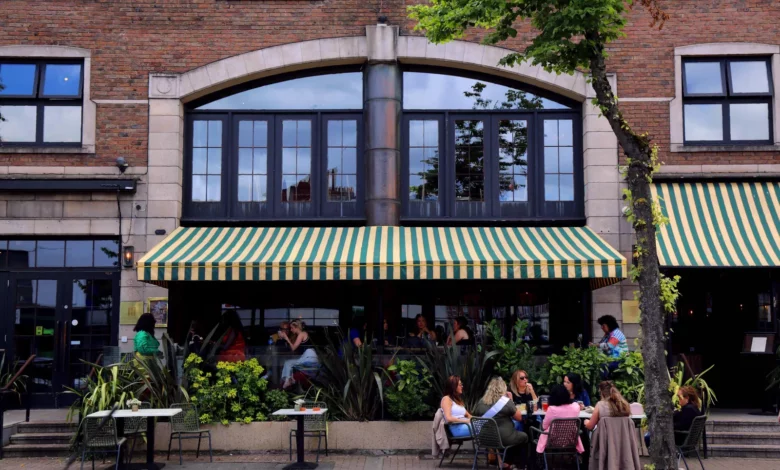
Hospitality businesses in Northern Ireland will not receive a cut in VAT to match the Republic of Ireland, a Treasury minister has confirmed, dashing hopes of a cross-border price advantage for the sector.
From July, the Irish government will reduce VAT on food, catering and hairdressing from 13.5% to 9%, a move that industry bodies in Northern Ireland said would create a significant competitive imbalance for businesses near the border. But Dan Tomlinson, the Treasury minister, told the Commons that the UK would not follow suit, insisting that VAT “is a national tax in the UK at 20% across the country and it is important to have that consistency for businesses operating across the UK as a whole”.
Instead, the government is relying on its temporary Great British Summer Savings programme, which begins on Thursday 25 June and runs until 1 September. The scheme will cut VAT from 20% to 5% on children’s meals served in restaurants, children’s and family tickets for cinemas, theatres and exhibitions, and all tickets to attractions such as theme parks, museums, zoos and soft play centres. While intended to help families with the cost of living and boost footfall, industry representatives have described the measure as limited in scope and complex to administer.
The fiscal argument against a broader cut was laid out in detail by Tomlinson. He warned that “significant cuts to VAT do come with significant fiscal costs”, and revealed that halving the rate on hospitality alone would cost the Exchequer around £11 billion. According to HMRC estimates cited in Treasury responses, reducing the standard 20% rate to 10% for all accommodation and food or beverage services would cost £10.5 billion in 2026-27, while a reduction to 5% would cost an estimated £17 billion. A permanent hospitality VAT rate has been described as a “hugely expensive subsidy”, potentially exceeding £12 billion a year.
The UK’s 20% rate for hospitality is already among the highest in Europe, where many countries apply reduced tourism VAT rates of between 5% and 15%. The divergence with the Republic of Ireland is particularly acute for Northern Ireland’s border counties, where customers can cross easily to take advantage of cheaper meals and services.
Calls for a VAT reduction in Northern Ireland have been mounting. Alex Easton, the independent MP for North Down, pressed the Treasury on whether the Chancellor would “look at a minimum trial or indeed permanently reducing the rate of VAT for the hospitality sector in Northern Ireland to maintain a price competitiveness, safeguard UK jobs and businesses, and make us more competitive with the Republic of Ireland”. Tomlinson acknowledged the different rates across Europe but said consistency across the UK remained the priority.
Robin Swann, the Ulster Unionist MP for South Antrim, tabled an early day motion earlier this month calling for a pilot scheme to reduce the hospitality VAT rate to 10% in Northern Ireland. Easton has supported the move. Swann has described the government’s summer savings announcement on children’s meals as “tokenistic” and argued that a wider VAT reduction is needed.
Industry bodies have also intensified their lobbying. Michael Henderson, chief executive of the Northern Ireland Food To Go Association, said: “Food-to-go businesses, independent cafes, coffee shops, delis and takeaways are the backbone of many local communities, yet they continue to face unprecedented pressures from rising wage costs, National Insurance increases, energy bills, insurance costs and reduced consumer spending.” He noted that more than 200 hospitality and food service businesses had closed across Northern Ireland since the beginning of this year alone.
Data from industry surveys paint a stark picture. Twenty-seven per cent of hospitality operators in Northern Ireland are now operating at a loss, with a further 20% breaking even. Forty-five per cent of respondents had cancelled investment plans in anticipation of cost increases, and 35% had done so since April. Staffing levels have also been hit: 49% of operators reduced staff numbers in anticipation of rising costs, and 33% have done so since April 2025; overall, 51% of operators reported a decrease in their workforce over the past 12 months.
The current VAT position contrasts sharply with the temporary relief offered during the Covid-19 pandemic, when a 5% rate was applied to most tourist and hospitality activities from July 2020 to March 2022. Prior to Brexit, EU VAT law limited member states’ discretion on lower rates, though dispensations existed for certain tourism-related supplies. With the UK now outside the EU, the government retains full control over VAT but has so far resisted calls to use it as a regional lever.
Tomlinson’s response to Easton made clear the Treasury’s stance: “I do understand that there are different rates of VAT in Northern Ireland than in Ireland. There are different rates of VAT across Europe. I think it’s important, though, that we remember that VAT is a national tax in the UK at 20% across the country.” The fiscal cost of any reduction, he reiterated, would be enormous – a permanent cut to 10% alone costing the Exchequer an estimated £10.5 billion annually, a figure that industry critics say is still less than the long-term economic damage of continued closures and lost competitiveness.