
UK Courts and Sentencing Explained
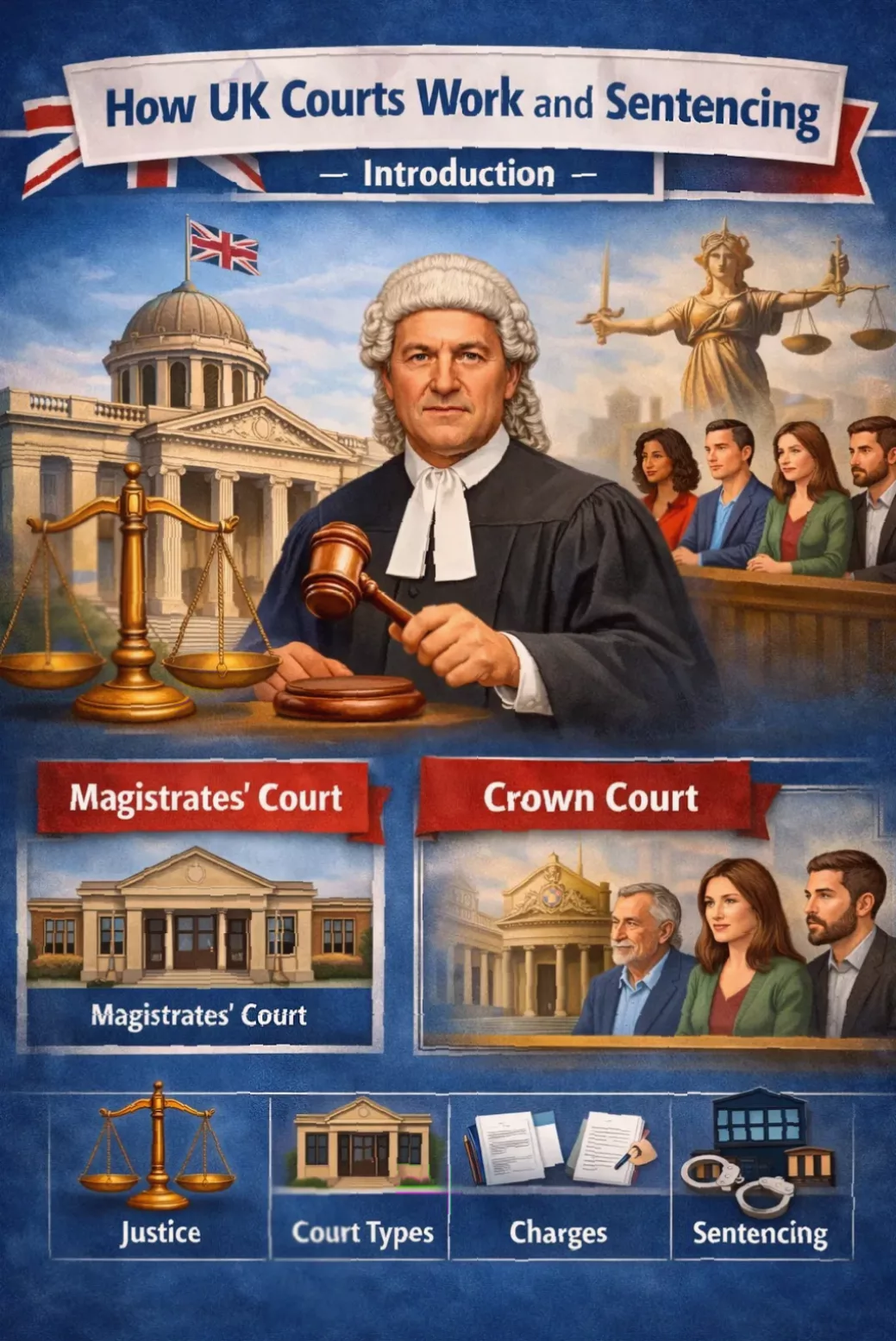
The courts are the institution at the centre of the criminal justice system, where the guilt or innocence of defendants is determined and where sentences are passed on those convicted of criminal offences. The court system in England and Wales is structured as a hierarchy, from magistrates’ courts handling the highest volume of cases to the Supreme Court at the apex, with each level serving a distinct function in the administration of justice.
This guide explains how the criminal courts are structured, how trials are conducted, what sentencing options are available, how the appeals process works and what challenges the courts system faces.
How are the criminal courts structured?
The criminal court system in England and Wales operates at several levels. Magistrates’ courts are the first point of entry for virtually all criminal cases and deal with the full range of summary offences — less serious crimes that carry a maximum sentence of six months’ imprisonment for a single offence. They also conduct initial hearings for more serious indictable offences before sending them to the Crown Court. There are approximately 150 magistrates’ courts in England and Wales, staffed by around 12,000 volunteer lay magistrates (also known as Justices of the Peace) and a smaller number of professional district judges.
Lay magistrates are members of the local community who sit in panels of three (known as a bench) and are advised on points of law by a qualified legal adviser (formerly called a clerk). They receive training from the Judicial College but are not legally qualified themselves. District judges sit alone and typically handle more complex or lengthy cases in the magistrates’ court. The use of lay magistrates is a distinctive feature of the English legal system and reflects the principle that justice should be administered by members of the community.
The Crown Court handles the most serious criminal cases, known as indictable offences, and also hears appeals from magistrates’ courts and deals with sentencing in cases committed from the magistrates’ court. There are approximately 80 Crown Court centres across England and Wales, including major centres such as the Central Criminal Court (the Old Bailey) in London, Manchester Crown Court and Leeds Crown Court. Crown Court trials are heard before a judge and a jury of 12 members of the public.
The Court of Appeal (Criminal Division) hears appeals against conviction and sentence from the Crown Court. It is presided over by the Lord Chief Justice and senior judges of the Court of Appeal. The Supreme Court of the United Kingdom, the highest court in the land, hears appeals on points of law of general public importance from the Court of Appeal and, in some cases, directly from the Crown Court. The courts are administered by His Majesty’s Courts and Tribunals Service (HMCTS), an executive agency of the Ministry of Justice.
How does a criminal trial work?
A criminal trial follows a structured process designed to ensure fairness for both the prosecution and the defence. In a Crown Court trial, the prosecution opens the case by outlining the charges and the evidence it intends to present. The prosecution then calls its witnesses, who give evidence and are cross-examined by the defence. After the prosecution case is completed, the defence may call its own witnesses, including the defendant if they choose to give evidence (the defendant is not compelled to do so). Both sides make closing speeches summarising their arguments.
The judge then sums up the case for the jury, explaining the relevant law, directing the jury on the standard of proof (the prosecution must prove the defendant’s guilt “beyond reasonable doubt”) and summarising the evidence. The jury retires to deliberate in private and returns a verdict of guilty or not guilty. Initially, a unanimous verdict is required, but if the jury is unable to reach agreement after a reasonable time, the judge may accept a majority verdict (at least 10 out of 12 jurors must agree).
In magistrates’ courts, the process is similar but simpler. There is no jury — the magistrates (or district judge) hear the evidence, determine guilt and pass sentence. Trials in the magistrates’ court are generally shorter and less formal than Crown Court proceedings, reflecting the lower seriousness of the offences involved.
Defendants have fundamental rights throughout the trial process, including the right to legal representation (funded by legal aid if the defendant qualifies), the right to challenge the evidence against them through cross-examination, the right to remain silent without adverse inference being drawn in most circumstances, and the right to a fair and public hearing before an independent and impartial tribunal as guaranteed by Article 6 of the European Convention on Human Rights.
How does sentencing work in the UK?
Sentencing is the process by which a court determines the appropriate penalty for a person convicted of a criminal offence. The Sentencing Act 2020 consolidates the law on sentencing and sets out the purposes of sentencing as punishment, crime reduction, reform and rehabilitation, the protection of the public, and the making of reparation by offenders to their victims. The independent Sentencing Council publishes detailed guidelines for each offence category, which judges and magistrates are required to follow unless it would be contrary to the interests of justice to do so.
For each offence, the sentencing guidelines identify the offence category based on the culpability of the offender and the harm caused, a starting point and sentencing range, and a list of aggravating factors (which increase the severity of the sentence) and mitigating factors (which reduce it). Aggravating factors might include premeditation, the use of a weapon, offending while on bail, or targeting a vulnerable victim. Mitigating factors might include the offender’s youth or age, genuine remorse, good character, cooperation with the investigation, or mental health difficulties.
A guilty plea results in a reduction in sentence — typically one third if the plea is entered at the earliest opportunity, reducing on a sliding scale the later the plea is entered. This “credit for a guilty plea” is designed to encourage early resolution of cases, reduce the burden on the courts and spare victims the ordeal of giving evidence at trial.
The main sentencing options available to the courts are custodial sentences (immediate imprisonment or detention for young offenders), suspended sentences (where the custodial term is suspended for a period subject to compliance with conditions), community orders (which can include unpaid work, curfews, drug or alcohol treatment programmes, mental health treatment, supervision by probation and electronic monitoring), fines (the most common sentence in magistrates’ courts), compensation orders (requiring the offender to pay financial compensation to the victim), restraining orders, sexual harm prevention orders and various other ancillary orders.
How do custodial sentences work in practice?
When a court imposes a custodial sentence, the offender does not necessarily serve the entire term in prison. For most determinate (fixed-length) sentences, the offender is automatically released at the halfway point and serves the remainder of the sentence on licence in the community under the supervision of the probation service. Offenders serving sentences of four years or more for certain serious offences may be required to serve two thirds of their sentence before being released. Licence conditions can include requirements such as residing at a specified address, attending appointments with a probation officer, participating in programmes and observing curfews.
If an offender breaches their licence conditions or commits a further offence while on licence, they can be recalled to prison to serve some or all of the remainder of their sentence. Life sentence prisoners are eligible for parole after serving the minimum term (tariff) set by the sentencing judge. The Parole Board, an independent body, assesses whether a life sentence prisoner can be safely released, considering factors such as the risk they pose to the public, their behaviour in prison and the arrangements for their supervision in the community.
The sentencing and release framework has been the subject of significant political debate and frequent legislative change. Public concern about offenders being released “too early” has led to several reforms increasing the proportion of sentences that must be served in custody. Conversely, the chronic overcrowding of prisons has sometimes required the government to introduce early release schemes to manage the prison population, creating tension between public protection and operational capacity.
How does the appeals process work?
A defendant who has been convicted or who considers their sentence to be excessive can appeal. Appeals from the magistrates’ court can be heard in the Crown Court (which rehears the case in full) or in the High Court (on a point of law by way of case stated). Appeals from the Crown Court are heard by the Court of Appeal (Criminal Division), which can quash a conviction if it considers it to be “unsafe,” order a retrial, reduce or increase a sentence, or dismiss the appeal.
The prosecution can also appeal. The Attorney General has the power to refer sentences to the Court of Appeal that appear to be “unduly lenient” under the Unduly Lenient Sentence scheme, which applies to certain serious offences. The Court of Appeal can then increase the sentence if it agrees that it was unduly lenient. The Attorney General can also refer points of law to the Court of Appeal following an acquittal, though this does not affect the acquittal of the defendant in the specific case.
The Criminal Cases Review Commission (CCRC) is an independent body that can refer cases back to the appeal courts if new evidence or arguments emerge that may render a conviction unsafe. The CCRC was established in 1997 following a series of high-profile miscarriages of justice, including the cases of the Guildford Four, the Birmingham Six and the Maguire Seven. Since its establishment, the CCRC has referred hundreds of cases to the appeal courts, many of which have resulted in convictions being quashed.
How does the youth justice system work?
Young people aged 10 to 17 who are accused of criminal offences are dealt with through the youth justice system, which operates separately from the adult system with a greater emphasis on welfare, rehabilitation and diversion from the criminal justice process. The Youth Justice Board (YJB), an arm’s-length body of the Ministry of Justice, oversees the youth justice system and sets standards for youth offending teams (YOTs), multi-agency partnerships at local level that work with young offenders and their families.
Youth courts, a specialised division of the magistrates’ court, hear the majority of cases involving young defendants. Youth court proceedings are conducted in a less formal manner than adult courts, and are not open to the general public. The identity of young defendants is protected by automatic reporting restrictions. Youth court magistrates receive specialist training in child development, welfare and the particular considerations that apply to sentencing young offenders.
Sentencing options for young offenders include referral orders (requiring the young person to attend a youth offender panel and agree a programme of reparative activities), youth rehabilitation orders (community sentences with a range of requirements), detention and training orders (a custodial sentence served partly in a young offender institution and partly in the community), and in the most serious cases, long-term detention under Section 250 of the Sentencing Act 2020. The age of criminal responsibility in England, Wales and Northern Ireland is 10 — one of the lowest in Europe. In Scotland, the age of criminal responsibility was raised to 12 in 2019, and children under 18 are dealt with primarily through the Children’s Hearings System rather than the courts.
How do the Scottish and Northern Irish court systems differ?
Scotland has a distinct court system rooted in Scots law. Criminal cases are heard in Justice of the Peace Courts (comparable to magistrates’ courts), Sheriff Courts (which handle the majority of criminal cases under both summary and solemn procedure) and the High Court of Justiciary, which is the supreme criminal court in Scotland and hears the most serious cases including murder, rape, armed robbery and drug trafficking. Scottish juries consist of 15 members, and Scotland uniquely offers three possible verdicts — guilty, not guilty and not proven. The not proven verdict results in acquittal but carries no formal finding of innocence, and its continued use has been the subject of long-running debate.
In Northern Ireland, the court system reflects its particular history and the legacy of the Troubles. Criminal cases are heard in Magistrates’ Courts, the Crown Court and the Court of Appeal. Diplock courts — non-jury courts used for terrorism-related offences during the Troubles — have been largely phased out but remain available in limited circumstances. The Northern Ireland judiciary is appointed through a process overseen by the Northern Ireland Judicial Appointments Commission, and the Director of Public Prosecutions for Northern Ireland makes independent prosecution decisions through the Public Prosecution Service.
What challenges does the courts system face?
The criminal courts in England and Wales face severe pressures. The Crown Court backlog — the number of cases awaiting trial — grew dramatically during the COVID-19 pandemic, when jury trials were suspended for several months and courts operated at reduced capacity due to social distancing requirements. As of 2025, tens of thousands of cases remain outstanding, and average waiting times for Crown Court trials have increased significantly, causing distress for victims and defendants and undermining confidence in the justice system.
The physical estate of the courts system has deteriorated, with many court buildings in poor condition after years of underinvestment. The closure of over 200 courts since 2010, as part of a programme to reduce costs and consolidate the estate, has increased travel distances for court users in some areas and contributed to concerns about access to justice. HMCTS has pursued a programme of digital reform — including video hearings, online plea entry and digital case management — which has the potential to improve efficiency but which has also raised concerns about the quality of justice and the exclusion of defendants who lack digital skills or access to technology.
Legal aid — public funding for legal representation — has been significantly reduced since the Legal Aid, Sentencing and Punishment of Offenders Act 2012 (LASPO), raising concerns about the ability of defendants, particularly those facing serious charges, to receive adequate legal representation. The availability and quality of defence lawyers willing to undertake legal aid work has been a growing concern, with the Criminal Bar Association and other professional bodies warning of a crisis in the sustainability of criminal legal aid practice.
Why do the courts and sentencing matter?
The courts are where the principles of justice, fairness and the rule of law are applied in practice. The quality of the courts system — its speed, fairness, accessibility and consistency — determines whether victims receive justice, whether defendants are treated fairly, whether the public is protected and whether confidence in the legal system is maintained. Sentencing decisions reflect society’s judgement about the appropriate response to criminal behaviour and must balance the competing demands of punishment, deterrence, rehabilitation and public protection. Understanding how the courts and sentencing work is essential for anyone seeking to engage with the justice system or to hold it to account.
Related guides
These guides explain related topics in more detail:
- How the UK Criminal Justice System Works
- How Policing Works in the UK
- Cybercrime and Fraud in the UK Explained
- How the UK Government Works
- How UK Government Policy Is Made
Related coverage:
Read our latest UK crime and courts news
Prepared by:
