UK Local and Devolved Elections Explained
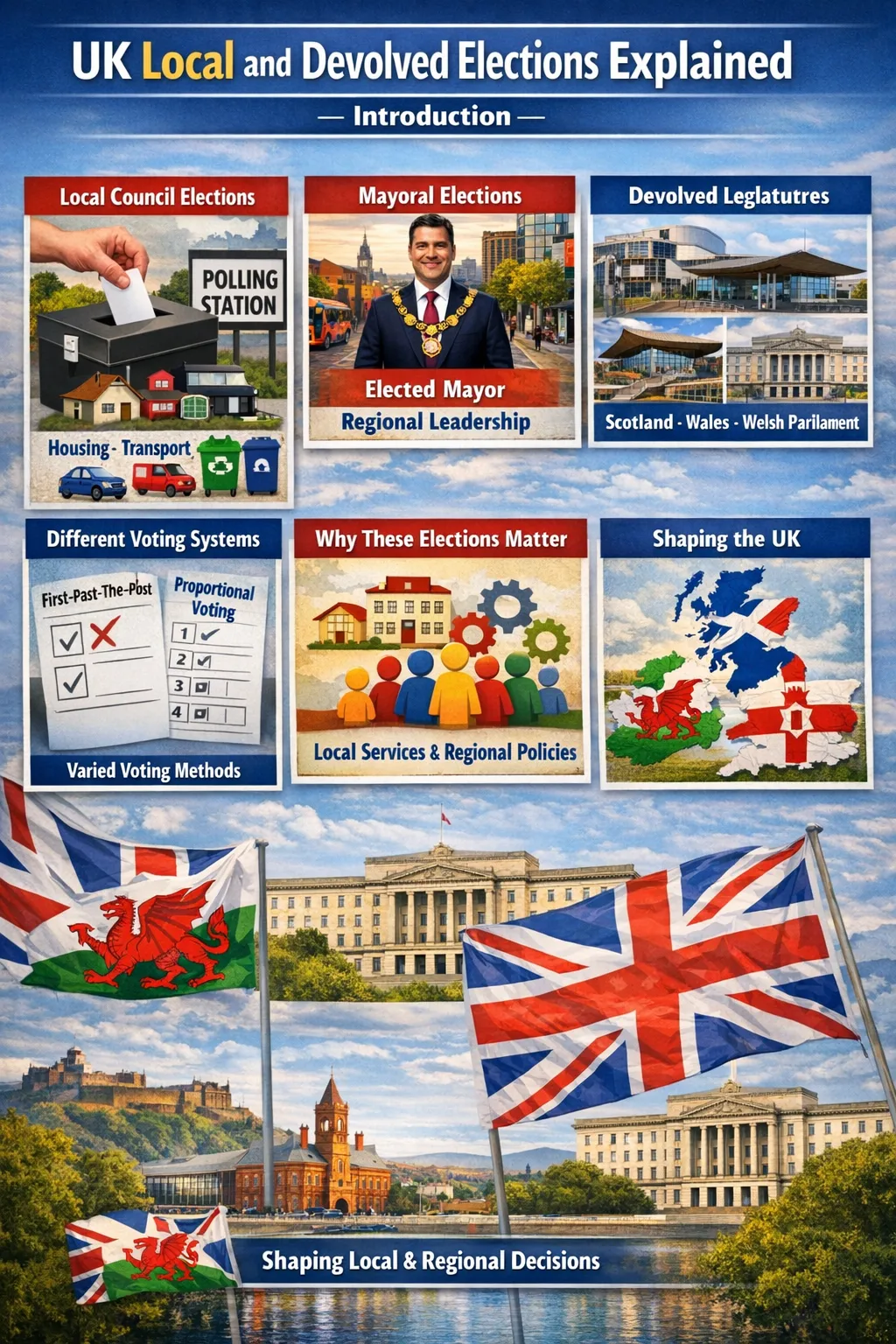
In addition to general elections for the House of Commons, the United Kingdom holds a wide range of elections for local councils, directly elected mayors, devolved parliaments and assemblies, and police and crime commissioners. These elections determine who governs at the local and regional level and have a direct impact on public services, planning, transport and policing across England, Scotland, Wales and Northern Ireland.
This guide explains the different types of local and devolved elections in the UK, how they work, what voting systems are used and why they matter.
What are local council elections?
Local council elections are held across England, Scotland and Wales to elect councillors who represent wards — geographic areas within a local authority. Councillors are responsible for decisions on local services including housing, planning applications, waste collection, local roads, parks, libraries and social care. In England, local elections typically take place on the first Thursday in May, though not all councils hold elections in the same year.
There are several types of local authority in England: county councils, district councils, unitary authorities, metropolitan borough councils and London borough councils. Each has a different combination of responsibilities depending on the structure of local government in that area. In Scotland, local elections are held every five years for all 32 council areas. In Wales, elections are held every five years for 22 principal councils.
In England, most local council elections use the first-past-the-post system, the same as general elections. Some councils elect all their councillors at the same time every four years (known as “all-out” elections), while others elect a proportion of their councillors each year in a cycle of “elections by thirds.” The pattern depends on the type of council and decisions made by the local authority.
Scotland uses the Single Transferable Vote (STV) for local elections, which allows voters to rank candidates in order of preference and is designed to produce more proportional results. Wales introduced STV as an option for local elections from 2022 onwards, though individual councils can choose whether to adopt it. In Northern Ireland, local council elections also use STV, consistent with the electoral systems used for the Northern Ireland Assembly.
Local councils are funded through a combination of central government grants, council tax (a property-based local tax paid by residents), business rates and fees for services. The balance of funding between central and local sources has shifted significantly over the past two decades, with local authorities becoming increasingly dependent on council tax revenue and locally retained business rates as central government grants have been reduced. Council decisions on local taxation and spending priorities are among the most direct ways that local elections affect residents’ daily lives.
What are mayoral elections?
Several areas in England have directly elected mayors who hold significant executive powers over regional or city-wide issues. The Mayor of London is the most well-known, overseeing transport (through Transport for London), policing, housing strategy, planning and economic development across Greater London. The Greater London Authority, which includes the London Assembly, scrutinises the Mayor’s decisions and approves the annual budget.
Outside London, combined authorities in areas such as Greater Manchester, the West Midlands, Liverpool City Region, South Yorkshire, West Yorkshire, the North East, East Midlands and the Tees Valley also have directly elected metro mayors. These mayors have powers over transport, housing, skills, economic development and in some cases policing, as set out in individual devolution deals negotiated with the UK government.
Mayoral elections in England previously used the Supplementary Vote system, in which voters chose a first and second preference. Following the Elections Act 2022, all mayoral elections in England now use the first-past-the-post system, bringing them into line with general and most local council elections. Critics of this change argue that FPTP is less suitable for single-winner executive elections where voters may wish to express a broader range of preferences.
The powers of metro mayors vary depending on the terms of the individual devolution deal agreed between the combined authority and the UK government. Some mayors have control over significant budgets and transport networks, while others have more limited powers. The government has signalled its intention to expand devolution further through new deals with additional regions, and the role of directly elected mayors in English governance is expected to grow in the coming years.
In addition to metro mayors, some individual towns and cities have directly elected mayors who serve as the political leader of their local council. These are distinct from the largely ceremonial role of a traditional council mayor or Lord Mayor, and the decision to adopt a directly elected mayor model is made through a local referendum or council resolution.
How do devolved parliament and assembly elections work?
Scotland, Wales and Northern Ireland each have their own devolved legislature with powers over significant areas of domestic policy. Elections to these bodies are held on separate cycles and use different voting systems from Westminster general elections.
Scottish Parliament
The Scottish Parliament at Holyrood has 129 members (MSPs) elected every five years using the Additional Member System (AMS). Voters cast two ballots — one for a constituency MSP elected by first-past-the-post in 73 constituencies, and one for a regional list, from which 56 additional MSPs are allocated across eight regions to produce a more proportional overall result. The Scottish Parliament has extensive powers over health, education, justice, transport, the environment, housing, local government, agriculture and some taxation, including the ability to set Scottish income tax rates and bands that differ from those set by the UK government for England and Northern Ireland.
The Scottish Government, led by the First Minister, is accountable to the Scottish Parliament. Since devolution was established in 1999, Scottish politics has diverged significantly from the rest of the UK in many policy areas, including free university tuition for Scottish students, the abolition of prescription charges and a distinct approach to social care. The question of Scottish independence has been the dominant political issue in Scottish elections, particularly since the 2014 independence referendum.
Senedd Cymru (Welsh Parliament)
The Senedd currently has 60 members (MSs) elected every five years using the Additional Member System, similar to Scotland — with 40 constituency members and 20 regional members. The Senedd has powers over health, education, local government, transport, the environment, housing and Welsh language policy. The Welsh Government, led by the First Minister of Wales, is responsible for an annual budget of approximately £20 billion.
Significant reforms are planned for the 2026 Senedd elections, which will expand the Senedd to 96 members elected through a closed-list proportional representation system based on 16 multi-member constituencies. This represents the most fundamental change to the Welsh electoral system since devolution began and is intended to strengthen the Senedd’s capacity to scrutinise the Welsh Government and hold it to account.
Northern Ireland Assembly
The Northern Ireland Assembly at Stormont has 90 members (MLAs) elected every five years using the Single Transferable Vote (STV) system. Voters rank candidates in order of preference in each of 18 constituencies, each electing five MLAs. The Assembly has powers over areas including health, education, justice, agriculture, the environment and economic development.
The power-sharing arrangements established by the Belfast (Good Friday) Agreement of 1998 require the Northern Ireland Executive to include representatives of both the largest unionist and nationalist parties. The First Minister and deputy First Minister hold equal power and must be drawn from different community designations. This consociational model of governance is unique within the UK and reflects the particular political dynamics of Northern Ireland. The Assembly has been suspended on several occasions when power-sharing arrangements have broken down, most recently from 2022 to 2024, during which time Northern Ireland was governed without a functioning Executive.
What are police and crime commissioner elections?
Police and Crime Commissioners (PCCs) are directly elected officials responsible for overseeing policing in each police force area in England and Wales (excluding London, where the Mayor holds this role). PCCs set local policing priorities, appoint and hold the chief constable to account, and manage the police budget. PCC elections were previously held using the Supplementary Vote but now use first-past-the-post following the Elections Act 2022.
What are parish and community council elections?
At the most local level, parish councils in England and community councils in Wales and Scotland provide a tier of governance closest to residents. Parish councils have powers over local amenities such as allotments, public footpaths, village halls, war memorials, bus shelters and community grants. They can also comment on planning applications and raise a small local tax called the parish precept, which is collected alongside council tax.
Parish council elections are held every four years using first-past-the-post. In many cases, the number of candidates matches or is fewer than the number of available seats, meaning that councillors are elected unopposed without a poll taking place. Turnout in contested parish elections is typically low compared to other types of election, but parish councils play an important role in community life, particularly in rural areas.
What voting systems are used across the UK?
The UK uses several different voting systems depending on the type of election. First-past-the-post is used for general elections, most English local elections, and now all mayoral and PCC elections in England. The Additional Member System is used for the Scottish Parliament and (currently) the Senedd. The Single Transferable Vote is used for the Northern Ireland Assembly, Scottish local elections and some Welsh local elections. Closed-list proportional representation will be used for the Senedd from 2026.
This patchwork of voting systems means that UK voters may use different methods of casting their ballot depending on which election they are participating in. In some cases, a voter may use FPTP for their local council, STV for their devolved assembly and a different system again for a mayoral election, all within the same area. The choice of voting system has a significant impact on the relationship between votes cast and seats won, the number of parties represented, the likelihood of coalition government and the nature of political competition. Electoral reform — and specifically whether FPTP should be replaced for some or all elections — remains a subject of ongoing political debate across the UK.
The 2026 Senedd elections will mark the first time a UK legislature uses closed-list proportional representation, which will be closely watched as a potential model for electoral reform elsewhere. Under this system, voters choose a party rather than an individual candidate, and seats are allocated in proportion to each party’s vote share within multi-member constituencies. Supporters argue this produces fairer representation, while critics express concerns about reduced accountability of individual members to their constituents.
What is voter turnout like in local and devolved elections?
Turnout in local and devolved elections in the UK is generally lower than in general elections. Local council elections in England typically see turnout of around 30-35 per cent, rising to the mid-40s when they coincide with other elections or high-profile contests. Turnout for mayoral elections varies but has generally been modest — the 2024 London mayoral election saw turnout of around 40 per cent, while some combined authority mayoral elections have attracted turnout below 30 per cent.
Devolved elections tend to see higher turnout than local elections but lower than general elections. Scottish Parliament elections have seen turnout ranging from around 49 per cent in 2003 to 63 per cent in 2021, when the question of Scottish independence drove high engagement. Senedd elections in Wales have consistently had the lowest turnout of any UK-wide or devolved election, typically around 45-46 per cent. Northern Ireland Assembly elections have seen turnout between 55 and 64 per cent, reflecting the particular intensity of political engagement in Northern Ireland.
The gap between local and national election turnout raises questions about democratic engagement and the perceived relevance of local government. Various factors contribute to lower turnout, including less media coverage, lower awareness of candidates and issues, the dominance of national party brands over local concerns, and the perception that local government has limited power compared to central government. Efforts to increase engagement include same-day voter registration in some devolved nations, lowering the voting age to 16 in Scotland and Wales, and the introduction of postal voting on demand.
How are local and devolved elections funded and regulated?
The administration of local and devolved elections is managed by local authorities, with the costs met from a combination of local authority budgets and, for devolved elections, funding from the relevant devolved government. Returning officers — usually senior local authority officials — are responsible for the conduct of elections in their area, including managing polling stations, overseeing the count and declaring results.
Campaign spending in local elections is subject to limits set by electoral law, though these limits are typically much lower than for general elections. The Electoral Commission oversees the regulation of campaign finance for all elections in the UK, and candidates must submit spending returns after each election. In devolved elections, the relevant electoral management body works alongside the Electoral Commission to ensure that elections are conducted in accordance with the applicable rules and standards.
Why do local and devolved elections matter?
Local and devolved elections determine who controls the services that most directly affect people’s daily lives — schools, healthcare, local roads, planning, housing, policing and waste collection. Devolved governments in Scotland, Wales and Northern Ireland make decisions on major policy areas that differ from those made at Westminster, meaning that the experience of public services can vary significantly across the United Kingdom.
Local and devolved elections also serve as an important barometer of political opinion between general elections. Gains or losses by the major parties in local elections are closely analysed by politicians, media commentators and pollsters as indicators of the national mood. The results of local elections can influence party leadership decisions, policy direction and the timing of general elections. By-elections for devolved parliaments and local councils also attract attention when they are seen as reflecting broader political trends.
Understanding how local and devolved elections work is essential for anyone seeking to engage with democracy in the United Kingdom. These elections provide opportunities for citizens to shape the services and priorities that most directly affect their communities, and they ensure that political accountability operates at every level of governance across the country.
Related guides
These guides explain related topics in more detail:
- How UK General Elections Work
- The UK Electoral Commission and Election Rules Explained
- How the UK Government Works
- How UK Government Policy Is Made
- UK Government Departments and Public Bodies Explained
Related coverage:
Read the latest UK political news
Prepared by: