The UK Electoral Commission and Election Rules Explained
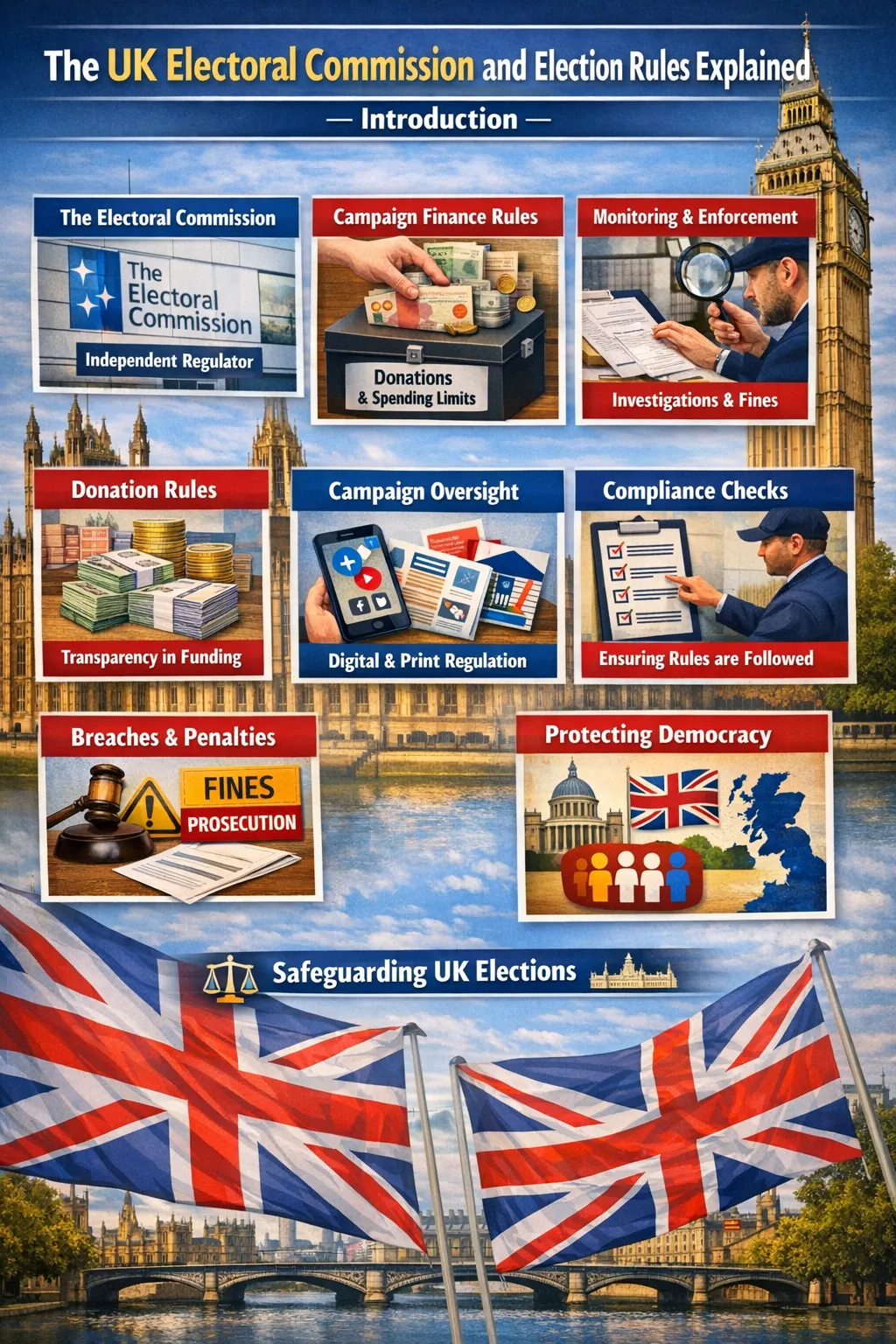
Free and fair elections are fundamental to democracy in the United Kingdom. To ensure that elections are conducted with integrity, transparency and public confidence, the UK has a system of independent regulation overseen by the Electoral Commission. This body monitors political finance, sets standards for electoral administration and works to ensure that voters can participate in the democratic process.
This guide explains the role of the Electoral Commission, how election rules work in the UK, how campaign finance is regulated and why election regulation matters for British democracy.
What is the Electoral Commission?
The Electoral Commission is an independent body established by the Political Parties, Elections and Referendums Act 2000 (PPERA). It is responsible for regulating political party and election finance across the United Kingdom, maintaining the standards of electoral administration, registering political parties and third-party campaigners, and producing guidance for candidates, parties and electoral administrators.
The Commission is independent of government and reports directly to the UK Parliament through the Speaker’s Committee on the Electoral Commission. Its board is appointed through a process overseen by the Speaker of the House of Commons. The Commission’s independence is considered essential to maintaining public confidence in the electoral process.
The Elections Act 2022 introduced a new power for the UK government to set a Strategy and Policy Statement for the Commission, which has been the subject of debate about the potential impact on the Commission’s independence. The Commission and opposition parties have raised concerns that this mechanism could allow the government of the day to influence the priorities of the body responsible for regulating it.
How is campaign finance regulated?
Political parties, candidates and third-party campaigners in the UK are subject to rules on how they raise and spend money during election campaigns. These rules are designed to prevent any individual, organisation or foreign entity from having a disproportionate influence on the outcome of elections.
Donations to political parties must come from permissible sources — broadly, individuals on the UK electoral register, UK-registered companies, trade unions and certain other UK-based organisations. Foreign donations are prohibited. Parties must report all donations above £500 to the Electoral Commission on a quarterly basis, and donations above £7,500 are published on the Commission’s online register, which is publicly accessible.
During a general election campaign period, national spending limits apply to each political party. The limit is based on the number of constituencies the party is contesting. For a party contesting all 650 seats, the national spending limit has historically been around £19–20 million for the regulated campaign period. Individual candidates also have separate spending limits in their constituency.
Third-party campaigners — organisations or individuals who campaign on issues relevant to the election but are not standing as candidates — must register with the Electoral Commission if their spending exceeds certain thresholds. They are subject to their own spending limits and reporting requirements. Examples of third-party campaigners include trade unions, business groups, charities, campaign organisations and individuals who spend significant sums promoting or opposing particular parties or policies during an election period.
What rules govern campaign activity?
Electoral law sets out detailed rules about how campaigns may be conducted. All printed campaign materials must include an imprint identifying who is responsible for producing and distributing them. Since the Elections Act 2022, digital campaign materials must also carry an imprint, requiring online political advertisements and campaign communications to clearly identify who paid for them.
Broadcasting rules prohibit political advertising on television and radio in the UK, a significant difference from many other democracies. Instead, parties are allocated Party Election Broadcasts on the basis of their electoral support, distributed across the main broadcasters. Broadcasters are also required by Ofcom’s Broadcasting Code to maintain due impartiality in their news coverage of elections.
During the formal election period — known as the “purdah” or pre-election period — the government is expected to observe restrictions on making major policy announcements, spending commitments or other decisions that could be seen as influencing the outcome of the election. Civil servants follow specific guidance during this period to maintain political neutrality.
How does the Electoral Commission monitor and enforce the rules?
The Electoral Commission monitors compliance with political finance rules through the reporting data submitted by parties, candidates and third-party campaigners. It publishes this data online, making it available for public and media scrutiny. The Commission has the power to investigate potential breaches of electoral law and can impose civil sanctions, including fines of up to £20,000 per offence for certain breaches.
For more serious offences — such as knowingly making false declarations, exceeding spending limits or accepting impermissible donations — the Commission can refer cases to the police and the Crown Prosecution Service for criminal investigation and prosecution. Criminal offences under electoral law can result in fines, imprisonment or disqualification from holding office.
The Commission also works proactively, publishing guidance for parties and campaigners ahead of elections, training electoral administrators and conducting post-election reviews to identify areas where the regulatory framework could be improved.
How is voter registration managed?
The Electoral Commission has a statutory duty to promote voter registration and participation. It runs public awareness campaigns before elections to encourage eligible citizens to register and to inform them about changes to voting procedures. Local authorities are responsible for maintaining the electoral register, processing registration applications and sending out annual canvass forms to verify that existing entries are up to date.
The UK moved to individual electoral registration in 2014, requiring each person to register individually rather than through a household return. This was intended to improve the accuracy of the register and reduce the risk of fraud, but it also raised concerns about a potential drop in registration rates, particularly among younger voters, private renters and people who move frequently.
What changes did the Elections Act 2022 introduce?
The Elections Act 2022 was the most significant piece of electoral legislation in the UK for over two decades. Its main provisions include the introduction of mandatory voter photo ID at polling stations in Great Britain, the change of mayoral and PCC elections from the Supplementary Vote to first-past-the-post, the introduction of the government’s Strategy and Policy Statement for the Electoral Commission, new rules on digital campaign imprints, and changes to the rules on overseas voters and postal voting.
The Act has been the subject of significant debate. Supporters argue that voter ID strengthens the integrity of elections and that the reforms modernise the regulatory framework. Critics, including civil liberties organisations and opposition parties, argue that voter ID risks disenfranchising eligible voters who lack suitable identification, particularly older people, disabled people and those from lower-income backgrounds, and that the Strategy and Policy Statement undermines the independence of the Electoral Commission.
How has electoral regulation developed in the UK?
The regulation of elections in the United Kingdom has evolved significantly over more than a century. The Corrupt and Illegal Practices Prevention Act 1883 was one of the earliest pieces of legislation to address electoral fraud and impose spending limits on candidates. Throughout the twentieth century, electoral law was updated incrementally to address issues such as the extension of the franchise, the introduction of postal voting and the regulation of political broadcasting.
The modern regulatory framework was established by the Political Parties, Elections and Referendums Act 2000 (PPERA), which created the Electoral Commission as an independent oversight body and introduced comprehensive rules on party registration, donation reporting and campaign spending. PPERA was a response to growing concerns about the influence of large donations on political parties and the need for greater transparency in political finance. It was followed by the Political Parties and Elections Act 2009, which strengthened the Commission’s enforcement powers, and the Transparency of Lobbying, Non-Party Campaigning and Trade Union Administration Act 2014, which introduced new rules on third-party campaigning and created a register of consultant lobbyists.
The Elections Act 2022 represented the most significant reform of electoral law since PPERA. In addition to introducing voter photo ID and changing voting systems for some elections, it established new provisions for digital campaign imprints, reformed overseas voting rights, updated postal and proxy voting rules and introduced the government’s Strategy and Policy Statement for the Electoral Commission — a provision that has been the subject of intense debate about the balance between democratic accountability and regulatory independence.
How are digital campaigns regulated?
The growth of digital campaigning has presented significant new challenges for electoral regulation. Political parties and campaigners now spend substantial portions of their campaign budgets on online advertising, particularly on platforms such as Facebook, Instagram, Google, YouTube and X (formerly Twitter). Digital advertising allows campaigns to target specific groups of voters based on demographics, interests and geographic location with a precision that was impossible in the era of print, television and radio.
The Elections Act 2022 introduced a requirement for digital campaign materials to carry an imprint identifying who paid for them and who authorised their publication. This brought online campaigning into line with the long-standing requirement for printed materials to carry an imprint, and was intended to increase transparency about who is behind the political messages that voters see online.
However, concerns remain about the adequacy of digital campaign regulation. Issues include the use of micro-targeted advertising that may deliver different messages to different voters without public scrutiny, the spread of misinformation through social media, the role of algorithms in amplifying political content, the potential for foreign interference through online channels, and the difficulty of monitoring spending on platforms that operate globally. The Electoral Commission, parliamentary committees and civil society organisations have called for further reforms to ensure that digital campaigning is transparent, fair and subject to effective oversight.
How does UK election regulation compare internationally?
Compared to other major democracies, the UK’s system of election regulation has both strengths and weaknesses. The UK’s ban on paid political advertising on television and radio is unusual — most democracies, including the United States, allow parties and candidates to purchase broadcast airtime. This ban is widely regarded as having helped to limit the cost of UK election campaigns and reduce the influence of wealthy donors compared to countries where broadcast advertising is unrestricted.
The UK’s campaign spending limits are also relatively modest compared to the United States, where campaign finance is governed by a different legal framework following the Supreme Court’s Citizens United decision. However, some European democracies such as France and Germany have stricter rules on political donations and provide more substantial state funding to political parties, reducing their dependence on private donors.
The introduction of voter photo ID in Great Britain has been compared to similar requirements in other countries. Many democracies require identification to vote, but the UK’s approach has been criticised for potentially disenfranchising eligible voters who lack suitable ID. The Electoral Commission’s post-election report on the first use of voter ID at the 2023 local elections found that most voters were not significantly affected, but identified concerns about the impact on certain demographic groups and the need for greater public awareness.
What are the future challenges for election regulation?
The regulatory framework for UK elections faces a number of emerging challenges that will require attention in the coming years. The rapid development of artificial intelligence, including generative AI tools capable of producing realistic synthetic images, audio and video, raises concerns about the potential for deepfakes and AI-generated misinformation to be used in election campaigns. The Electoral Commission and parliamentary committees have begun to examine how the regulatory framework should adapt to address these risks, but legislation has not yet caught up with the pace of technological change.
The question of how to fund political parties remains contentious. The UK does not provide substantial state funding to political parties, unlike many European democracies, which means that parties are dependent on private donations from individuals, companies and trade unions. Proposals for state funding have been made by several independent reviews, including the Committee on Standards in Public Life, but none have been implemented. The alternative — relying on private donations — continues to raise questions about transparency, access and the potential for donors to influence policy.
Cybersecurity is an increasing concern for election administration. The protection of voter registration databases, electoral management systems and the infrastructure used to count and report election results from cyber-attacks is a growing priority for the Electoral Commission, local authorities and the National Cyber Security Centre (NCSC). In 2023, the Electoral Commission itself disclosed that it had been the target of a cyber-attack in which hostile actors gained access to copies of the electoral registers. The incident highlighted the need for continued investment in the security of electoral infrastructure.
Finally, the debate about the independence of the Electoral Commission is likely to continue. The Strategy and Policy Statement mechanism introduced by the Elections Act 2022 has created an ongoing tension between the government’s desire to set strategic priorities for the Commission and the principle that the body responsible for regulating elections should be independent of the government that it regulates. How this tension is managed will be an important factor in maintaining public confidence in the integrity of UK elections in the years ahead.
Why does election regulation matter?
Election regulation exists to protect the democratic process. Without rules on campaign finance, there would be no check on the influence of wealthy donors or foreign interests on British elections. Without independent oversight, there would be less public confidence that elections are conducted fairly. Without transparency requirements, voters would have limited information about who is funding political campaigns and what they are spending their money on.
The integrity of elections is essential to the legitimacy of the UK’s democratic system. The Electoral Commission and the wider regulatory framework play a critical role in ensuring that elections in the United Kingdom remain free, fair and transparent, and that public confidence in the democratic process is maintained.
Related guides
These guides explain related topics in more detail:
- How UK General Elections Work
- UK Local and Devolved Elections Explained
- How the UK Government Works
- How UK Government Policy Is Made
- UK Public Finances and Government Spending Explained
Related coverage:
Explore our UK politics coverage
Prepared by: