
UK Digital Economy and Technology Sector Explained
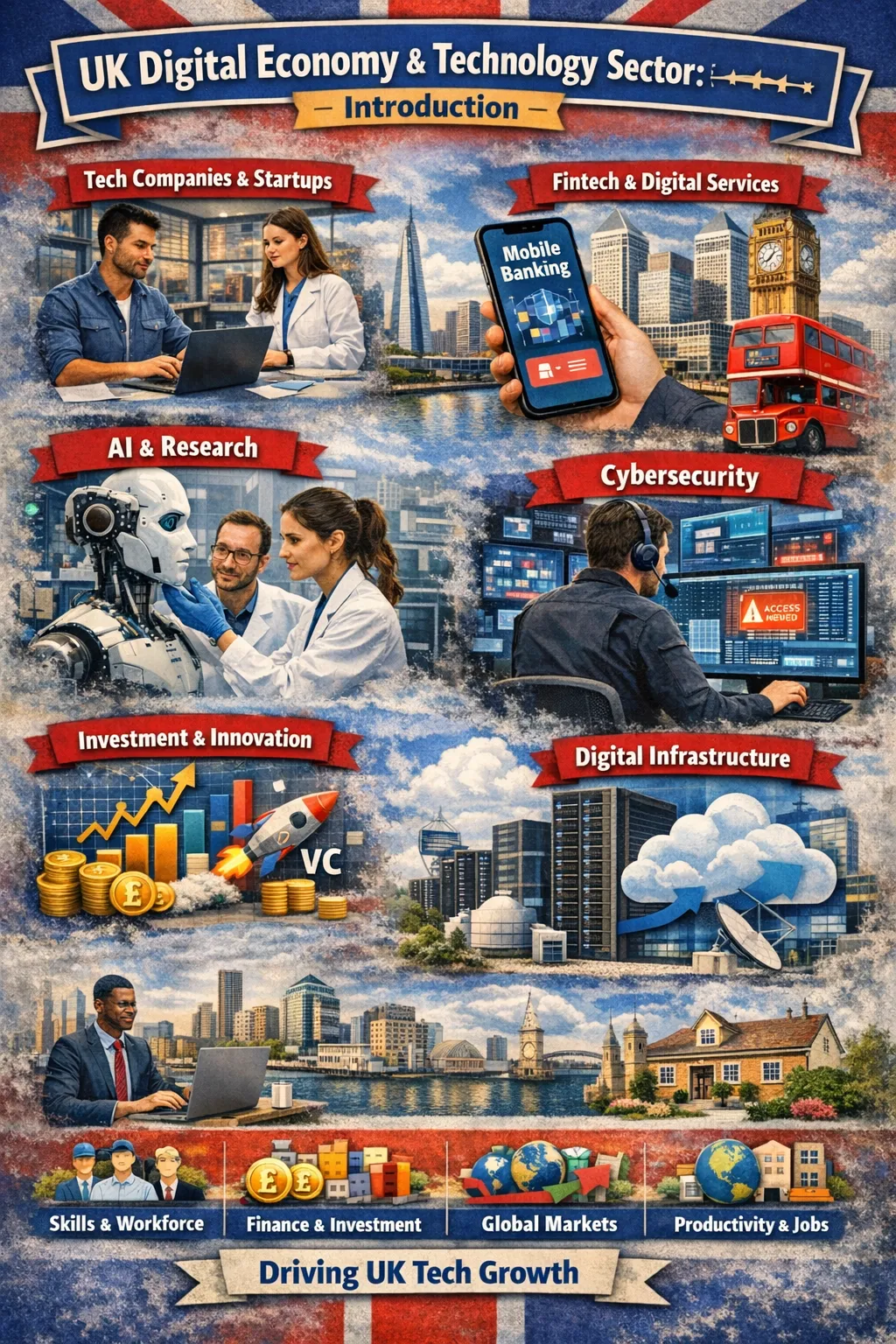
The digital economy is one of the most dynamic and fastest-growing sectors of the United Kingdom’s economy. From technology startups and global platform companies to digital financial services, e-commerce, creative technology and the growing adoption of digital tools across every industry, the UK’s digital sector generates hundreds of billions of pounds in economic output and employs millions of people. Understanding how the digital economy works, how it is measured and how it is supported by government policy is essential for anyone interested in the future of the UK economy.
This guide explains the structure of the UK’s digital economy and technology sector, how it contributes to economic growth, what the key sub-sectors are, how the government supports digital businesses and what challenges and opportunities lie ahead.
What is the UK digital economy?
The digital economy encompasses all economic activity that is either primarily digital in nature (such as software development, cloud computing and digital media) or significantly enabled by digital technologies (such as e-commerce, digital banking, online advertising and platform-mediated services). The UK’s digital sector is estimated to contribute over £150 billion in gross value added (GVA) to the economy, representing approximately 7-8 per cent of total UK GDP. When the broader digital transformation of traditional sectors is included — manufacturing, retail, agriculture, healthcare and professional services that are increasingly dependent on digital tools — the economic footprint of digital technology is significantly larger.
The UK is home to a vibrant technology startup and scale-up ecosystem, with London ranking as one of the world’s top technology hubs alongside San Francisco, New York, Beijing and Bangalore. The UK has produced more technology “unicorns” (privately held companies valued at over $1 billion) than any other European country, in areas including fintech, healthtech, edtech, cleantech, cybersecurity and artificial intelligence. Significant technology clusters also operate in Cambridge (known as “Silicon Fen”), Oxford, Edinburgh, Manchester, Bristol, Leeds and Belfast.
What are the key sub-sectors of the UK tech industry?
Fintech (financial technology) is one of the UK’s strongest digital sub-sectors. The UK is the world’s second-largest fintech market after the United States, with companies such as Revolut, Wise, Monzo, Starling Bank, Checkout.com and GoCardless operating from London. The sector benefits from the UK’s deep financial services expertise, a supportive regulatory environment (including the FCA’s regulatory sandbox, which allows fintech companies to test innovative products in a controlled environment) and strong access to venture capital.
The creative technology and digital media sector — including gaming, visual effects, animation, digital advertising, streaming, music technology and publishing — generates significant revenue and employment. The UK gaming industry is the largest in Europe and the sixth-largest globally, with major studios including Rockstar North, Frontier Developments and Rare alongside a thriving independent development scene. The visual effects (VFX) industry, concentrated in London and supported by tax reliefs, produces work for major international film and television productions.
Healthtech encompasses digital health applications, telemedicine platforms, health data analytics, medical device software and AI-powered diagnostic tools. The COVID-19 pandemic accelerated the adoption of digital health technologies, including the NHS App, remote GP consultations, digital prescriptions and contact tracing. The UK’s combination of the NHS (providing a large, unified health system and rich datasets), strong biomedical research institutions and a growing healthtech startup sector creates a distinctive opportunity for innovation in this area.
Other significant sub-sectors include cybersecurity (see the dedicated cybersecurity guide), edtech (educational technology, particularly strong since the pandemic), cleantech and greentech (digital solutions for energy management, carbon tracking and sustainability), and govtech (technology companies providing digital services to government).
How does the government support the technology sector?
The UK government supports the technology sector through a combination of tax incentives, direct funding, regulatory innovation and trade promotion. Research and development (R&D) tax credits allow companies to claim tax relief on qualifying R&D expenditure, with enhanced rates available for SMEs. The government has reformed the R&D tax credit system to merge the SME and large company schemes into a single merged scheme, and has introduced an enhanced support rate for R&D-intensive SMEs.
Innovate UK, the national innovation agency and part of UK Research and Innovation (UKRI), provides grants, loans and support services to innovative businesses, including through programmes focused on AI, quantum computing, semiconductors, space technology and advanced manufacturing. The British Business Bank provides access to finance for growing businesses, including through venture capital funds, start-up loans and the Future Fund, which provided convertible loans to innovative companies during the pandemic.
The government has also sought to promote the UK as a destination for international technology investment through the Office for Investment, trade missions and bilateral technology partnerships. Free trade agreements and digital trade chapters in international trade deals are intended to reduce barriers to cross-border digital services, protect data flows and establish interoperable regulatory frameworks.
What role does venture capital play in the UK tech sector?
Venture capital (VC) investment is a critical driver of growth in the UK technology sector. The UK attracts more venture capital than any other European country, with total VC investment reaching over £25 billion in peak years. London is the largest VC market in Europe, but investment is increasingly flowing to technology companies across the UK, including in Manchester, Edinburgh, Cambridge, Bristol and Birmingham.
The UK’s VC ecosystem includes domestic funds, international investors (particularly from the United States and increasingly from the Middle East and Asia) and government-backed funds such as the British Patient Capital programme. Tax incentives including the Enterprise Investment Scheme (EIS) and the Seed Enterprise Investment Scheme (SEIS) provide tax relief to individual investors who invest in qualifying early-stage companies, helping to channel private capital into the startup ecosystem.
However, the UK faces a persistent “scale-up gap” — while it produces a large number of successful startups, many of the most promising companies are acquired by foreign buyers or relocate to the United States as they grow, limiting the UK’s ability to develop globally dominant technology companies headquartered domestically. Deepening the UK’s capital markets, improving access to later-stage funding and creating a regulatory environment that encourages companies to list and scale in the UK are key priorities for the government and the financial sector.
What are the workforce challenges facing the digital economy?
The digital economy depends on a skilled workforce, and the UK faces significant challenges in developing and retaining the talent it needs. There are persistent shortages of software engineers, data scientists, cybersecurity specialists, AI researchers, product managers and other technical professionals. The Tech Talent Charter reports that the UK technology workforce lacks diversity, with women, ethnic minorities and people from lower socioeconomic backgrounds significantly underrepresented in technical roles.
The education system plays a crucial role in developing digital skills at every level. Computing became a compulsory National Curriculum subject in England in 2014, and universities and FE colleges offer a growing range of technology-related courses. Apprenticeships in digital and technology have grown significantly, and coding bootcamps and short courses provide intensive retraining for career changers. However, the pace of technological change means that the skills in demand are constantly evolving, requiring continuous investment in workforce development and lifelong learning.
How does e-commerce work in the UK?
The United Kingdom has one of the most developed e-commerce markets in the world. Online retail sales account for approximately 25-27 per cent of total retail sales, one of the highest proportions globally. Major online retailers operating in the UK include Amazon, which has invested heavily in fulfilment centres, delivery networks and its Prime subscription service, alongside established UK retailers such as Tesco, Sainsbury’s, John Lewis, ASOS, Ocado and Argos that have built substantial online operations.
The growth of e-commerce has had a transformative impact on the UK retail landscape. Traditional high streets have experienced significant decline, with store closures, rising vacancy rates and the loss of well-known retail brands. The shift to online shopping has created new forms of employment in warehousing, logistics and delivery, though these jobs are often characterised by lower pay, less favourable working conditions and greater use of gig economy contracts than traditional retail employment. The government has explored measures to rebalance the tax treatment of online and physical retail, including reforms to business rates and discussions about an online sales tax, though no comprehensive solution has been implemented.
How does the UK’s digital infrastructure support the economy?
The UK’s digital infrastructure — broadband networks, mobile networks, data centres and cloud computing services — is the foundation on which the digital economy operates. The government’s Project Gigabit programme aims to deliver gigabit-capable broadband to at least 85 per cent of UK premises by 2025 and nationwide by 2030. The UK’s data centre sector is the largest in Europe, with major facilities concentrated in London, Slough and Manchester, serving both domestic businesses and international clients.
Cloud computing has become essential infrastructure for businesses of all sizes, enabling them to access scalable computing power, storage and software services without the need for large upfront capital investment. The UK cloud market is dominated by global providers including Amazon Web Services (AWS), Microsoft Azure and Google Cloud Platform, with the CMA conducting a market investigation into the competitiveness of the cloud computing sector. The availability of reliable, high-speed digital connectivity is a critical factor in attracting technology investment, supporting remote working and enabling the digital transformation of traditional industries.
How does the platform economy operate?
Digital platforms — online marketplaces and intermediaries that connect buyers and sellers, workers and employers, or content creators and audiences — have become a defining feature of the modern economy. The UK is home to significant platform businesses and is a major market for global platforms including Uber, Deliveroo, Airbnb, Amazon Marketplace, Etsy and Fiverr. The gig economy — work mediated through digital platforms, often on a task-by-task basis rather than through traditional employment contracts — employs an estimated 4-5 million people in the UK.
The legal status of gig economy workers has been the subject of landmark litigation in the UK. The Supreme Court ruling in Uber BV v Aslam (2021) determined that Uber drivers are workers (rather than self-employed contractors), entitling them to minimum wage, holiday pay and other worker protections. This ruling has had significant implications for the platform economy, prompting some companies to reclassify workers and adjust their business models, while others continue to contest the employment status of their workforce. The balance between the flexibility that platforms offer and the protection of workers’ rights remains a key policy challenge.
How does the UK approach digital trade and data flows?
Digital trade — the cross-border exchange of goods and services enabled by digital technologies — is a growing priority for UK trade policy. The UK has included digital trade chapters in its free trade agreements, addressing issues such as the free flow of data across borders, the prohibition of data localisation requirements, the recognition of electronic signatures and contracts, and the protection of source code. The UK-Japan Comprehensive Economic Partnership Agreement and the CPTPP both contain advanced digital trade provisions.
The free flow of personal data between the UK and other jurisdictions is governed by “adequacy” arrangements under data protection law. The UK’s data adequacy decision from the European Union — which allows personal data to flow freely between the UK and the EU — is critical for UK businesses that trade with or provide services to EU customers. The government has also pursued data adequacy arrangements with other countries and is developing a framework of data bridges to facilitate international data sharing while maintaining data protection standards.
Why does the digital economy matter?
The digital economy is central to the UK’s future prosperity, competitiveness and capacity to address the major challenges it faces — from climate change and healthcare to productivity and social inclusion. The technology sector drives innovation, creates high-value jobs, attracts international investment and provides the tools and platforms that enable every other sector of the economy to operate more efficiently. Ensuring that the UK remains one of the world’s leading digital economies — through investment in skills, infrastructure, research and a supportive regulatory environment — is one of the most important economic policy priorities for the country.
Related guides
- UK Technology Policy and Regulation Explained
- Artificial Intelligence and AI Regulation in the UK Explained
- Cybersecurity and Digital Security in the UK Explained
- How the UK Economy Works
- How UK Companies Are Regulated
Related coverage:
Read our latest UK technology and digital economy news
Prepared by:
