
UK Technology Policy and Regulation Explained
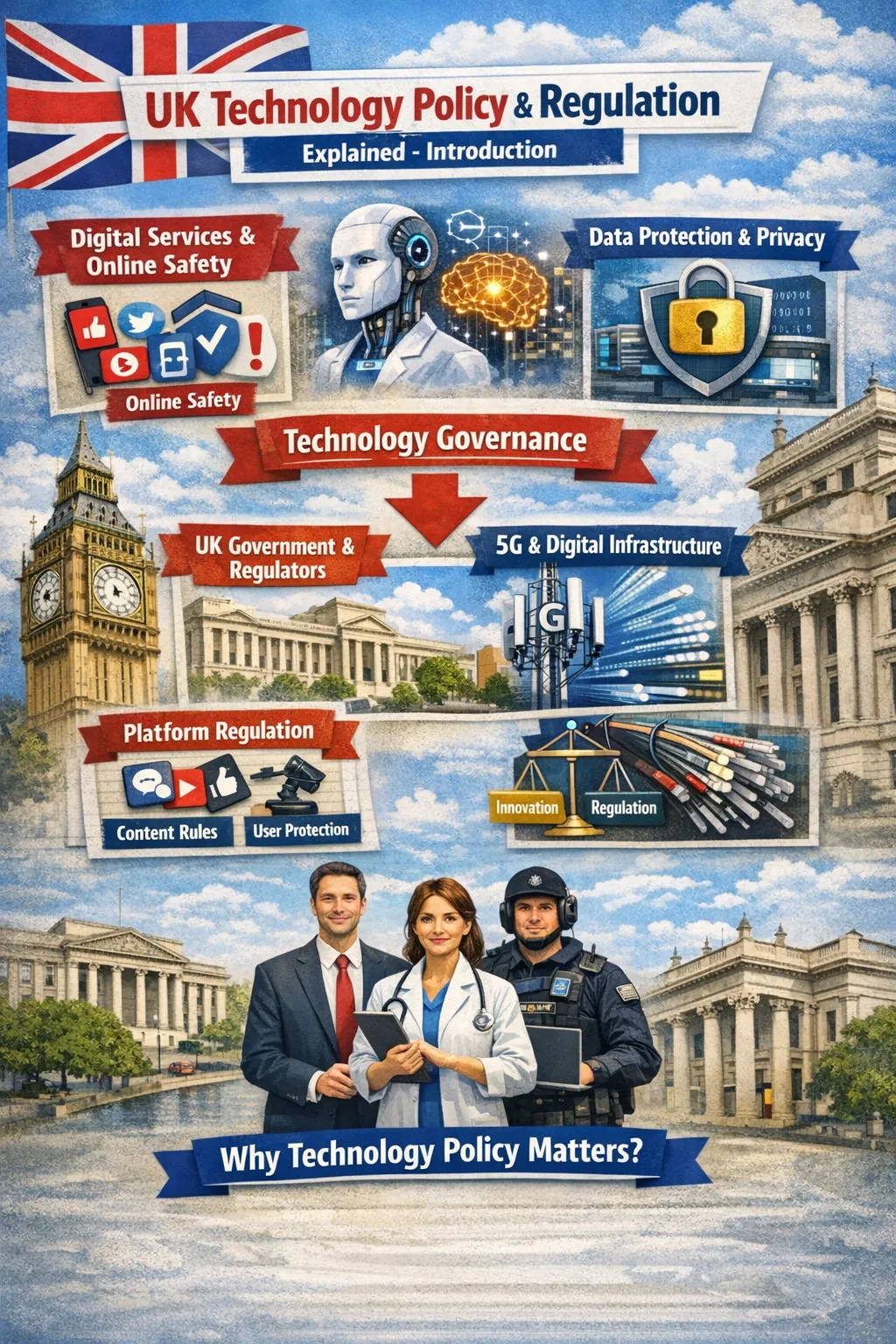
Technology policy has become one of the most important and rapidly evolving areas of government activity in the United Kingdom. As digital technologies transform every sector of the economy and every aspect of daily life, the UK government faces the challenge of creating a regulatory environment that encourages innovation and economic growth while protecting citizens from harm, safeguarding national security and ensuring that the benefits of technology are shared fairly across society.
This guide explains how the UK approaches technology policy and regulation, which bodies are responsible, what the key legislative frameworks are, how the UK’s approach compares internationally and why these decisions matter for businesses, consumers and the public.
What is UK technology policy?
UK technology policy encompasses the strategic decisions that the government makes about the development, deployment, regulation and governance of digital technologies. It covers a broad range of issues including artificial intelligence, cybersecurity, data protection, online safety, telecommunications infrastructure, digital public services, the digital economy, intellectual property, competition in digital markets and the ethical implications of emerging technologies.
The Department for Science, Innovation and Technology (DSIT), created in 2023, is the lead government department for technology policy. DSIT is responsible for the UK’s science and technology strategy, digital infrastructure, AI policy, data policy, telecommunications regulation and research and development funding. The department works closely with other parts of government — the Home Office on cybersecurity and online harms, the Department for Business and Trade on digital trade and competition, the Ministry of Defence on defence technology, and the Cabinet Office on digital government services.
How does the UK regulate online platforms and digital services?
The Online Safety Act 2023 is the UK’s most significant piece of legislation governing online platforms and digital services. The Act imposes duties on technology companies to protect users — particularly children — from illegal content and harmful material online. Platforms are required to conduct risk assessments, implement safety measures proportionate to the risks identified, and take action to remove illegal content such as terrorism material, child sexual abuse material, fraud and incitement to violence.
Ofcom, the UK’s communications regulator, has been designated as the regulator for online safety under the Act. Ofcom has powers to set codes of practice, conduct investigations, require platforms to provide information about their safety systems and, for serious non-compliance, impose fines of up to £18 million or 10 per cent of qualifying worldwide revenue, whichever is greater. In the most extreme cases, Ofcom can apply to the courts for orders to restrict access to non-compliant services in the UK.
The Online Safety Act has been the subject of significant debate. Supporters argue that it is a necessary step to protect vulnerable users, particularly children, from the real harms caused by online content. Critics have raised concerns about the potential impact on free expression, the technical challenges of content moderation at scale, the burden on smaller platforms and the risks of government overreach in regulating online speech. The implementation of the Act is still ongoing, with Ofcom consulting on and finalising codes of practice for different categories of regulated service.
How does data protection regulation work in the UK?
Data protection in the UK is governed by the UK General Data Protection Regulation (UK GDPR) and the Data Protection Act 2018, enforced by the Information Commissioner’s Office (ICO). These laws give individuals rights over their personal data, including the right to know what data organisations hold about them, the right to have inaccurate data corrected, the right to have data deleted in certain circumstances, and the right to object to their data being used for direct marketing or automated decision-making.
Organisations that process personal data must have a lawful basis for doing so, implement appropriate security measures to protect the data, and report certain types of data breach to the ICO within 72 hours. The ICO has the power to investigate complaints, conduct audits, issue enforcement notices and impose fines of up to £17.5 million or 4 per cent of annual global turnover for serious breaches. The ICO has taken enforcement action against organisations ranging from major corporations to small businesses and public sector bodies.
The UK government has proposed reforms to the data protection framework through the Data (Use and Access) Bill, which aims to simplify compliance for businesses, enable greater use of data for research and innovation, and modernise the ICO’s governance and enforcement powers. The relationship between UK and EU data protection law remains important for international data transfers — the EU has granted the UK an “adequacy decision” allowing the free flow of personal data between the UK and the EU, but this decision is subject to periodic review and could be revoked if the UK diverges too far from EU standards.
How does the UK regulate competition in digital markets?
The concentration of market power among a small number of large technology companies — often referred to as “Big Tech” — has become a major focus of competition policy globally, and the UK has positioned itself as one of the leading jurisdictions in addressing this challenge. The Digital Markets, Competition and Consumers Act 2024 gave the Competition and Markets Authority (CMA) new powers to regulate the most powerful digital platforms through a “strategic market status” (SMS) designation.
Platforms designated with SMS status will be subject to conduct requirements designed to ensure fair dealing with businesses and consumers, and the CMA will have the power to intervene in specific practices that harm competition, such as self-preferencing in search results, restrictive terms for app developers, or anti-competitive use of data. The CMA’s Digital Markets Unit (DMU), established on a non-statutory basis in 2021 and given formal statutory powers through the 2024 Act, leads this work.
The CMA has already conducted significant market studies into digital advertising, mobile ecosystems, cloud computing and the impact of artificial intelligence on competition. Its investigations into major technology companies have attracted international attention and positioned the UK alongside the European Union as a leading jurisdiction for digital competition regulation.
How does the UK approach telecommunications and digital infrastructure?
The UK’s digital infrastructure — broadband networks, mobile networks and the underlying telecommunications systems — is essential to economic productivity, public services and social participation. Ofcom regulates the UK telecommunications market, setting conditions for network operators, managing radio spectrum, monitoring service quality and promoting competition and investment.
The government has set ambitious targets for digital connectivity. Project Gigabit aims to deliver gigabit-capable broadband to at least 85 per cent of UK premises by 2025 and nationwide coverage by 2030, through a combination of commercial investment by operators such as Openreach, Virgin Media O2 and alternative network providers, and public subsidy for areas where commercial deployment is not viable. The Shared Rural Network is a joint programme between the government and mobile operators to extend 4G coverage to 95 per cent of the UK’s geographic area.
The rollout of 5G networks is progressing in urban areas, offering faster speeds, lower latency and greater capacity for applications such as autonomous vehicles, industrial automation, remote healthcare and immersive media. The government’s decision to exclude Huawei equipment from UK 5G networks — on national security grounds, following advice from the National Cyber Security Centre — required operators to remove existing Huawei infrastructure at significant cost, highlighting the intersection of technology policy with national security and geopolitical considerations.
How does the UK regulate intellectual property in the digital age?
Intellectual property (IP) law is a critical component of technology policy, providing the legal framework that protects inventions, creative works, designs and brands. The UK’s IP regime is administered by the Intellectual Property Office (IPO), a non-ministerial department that grants patents, trademarks and registered designs and advises the government on IP policy. The UK’s patent system protects novel inventions for up to 20 years, while copyright automatically protects original literary, artistic, musical and dramatic works, software code and databases.
The digital age has created significant challenges for IP law. The ease of copying and distributing digital content has made copyright enforcement more difficult, while the rise of artificial intelligence has raised fundamental questions about the ownership of AI-generated works, the use of copyrighted material in training data, and the patentability of AI-made inventions. The UK government has consulted on a code of practice for AI developers and rights holders, and the courts are beginning to address these novel legal questions, but the law remains uncertain in many areas.
The UK is a member of major international IP agreements including the Paris Convention, the Berne Convention and the Patent Cooperation Treaty, and participates in the European Patent Convention through the European Patent Office. Post-Brexit, the UK chose not to join the Unified Patent Court, meaning that it operates its own national patent system separately from the new EU unitary patent. This decision has implications for businesses seeking patent protection across European markets.
How is the government using technology to deliver public services?
The UK government has been a leader in the development of digital public services. The Government Digital Service (GDS), established in 2011, created the GOV.UK platform, which consolidated hundreds of government websites into a single, user-friendly portal. GDS has promoted design principles that prioritise user needs, accessibility and simplicity, and its approach has been influential internationally.
Digital transformation of public services extends beyond websites to include online tax filing (Making Tax Digital), digital identity verification (the GOV.UK One Login programme), digital health services (through the NHS App and online GP registration), online benefits applications through Universal Credit, and digital court services. The government’s ambition is to make all public services accessible online while ensuring that alternative channels remain available for people who cannot use digital services.
However, government technology projects have a mixed track record. Major programmes including the NHS National Programme for IT, early iterations of Universal Credit’s digital systems, and various defence technology projects have experienced significant delays, cost overruns and in some cases outright failure. The Infrastructure and Projects Authority monitors the government’s largest technology programmes, and the National Audit Office regularly publishes reports assessing their progress and value for money.
What are the emerging governance challenges in technology?
Several emerging technology areas present novel governance challenges that the UK government is actively addressing. Quantum computing, which has the potential to break existing encryption systems and transform fields from drug discovery to financial modelling, is the subject of a National Quantum Strategy that invests in research, skills and the development of quantum-safe security standards. Semiconductor supply chains — critical to the production of all digital devices — have become a geopolitical concern, with the government publishing a National Semiconductor Strategy to secure the UK’s access to these essential components.
Biotechnology, synthetic biology and the convergence of digital and biological sciences raise regulatory questions that cross the boundaries of technology, health, agriculture and environmental policy. The regulation of autonomous vehicles, drones and advanced robotics requires new legal frameworks for liability, safety and ethical decision-making. Space technology and satellite communications are growing sectors requiring updated regulatory approaches through the Space Industry Act 2018 and Ofcom’s management of radio spectrum.
The pace of technological change consistently outstrips the capacity of regulatory frameworks to adapt. The UK’s preference for principles-based, sector-specific regulation is intended to provide the flexibility needed to respond to new developments, but it also requires regulators to develop deep technical expertise and to collaborate effectively across institutional boundaries — a challenge that will only intensify as technology becomes more complex and more deeply embedded in every aspect of economic and social life.
How does the UK’s approach compare internationally?
The UK has sought to position itself as a “pro-innovation” technology regulator, emphasising flexibility, proportionality and the avoidance of overly prescriptive rules that could stifle innovation or deter investment. This approach contrasts with the European Union’s more comprehensive legislative framework, which includes the AI Act (a detailed regulatory regime for artificial intelligence), the Digital Services Act and the Digital Markets Act.
The UK’s regulatory philosophy relies more heavily on existing sector regulators — such as Ofcom, the FCA, the CMA and the ICO — to apply general principles to their specific domains, rather than creating a single, overarching technology regulator. Supporters argue that this approach is more agile and better able to keep pace with rapidly evolving technology, while critics contend that it creates gaps and inconsistencies in protection and makes it harder for businesses to understand their obligations.
The United States takes a different approach again, with less prescriptive federal regulation of technology companies and greater reliance on market forces, Section 230 protections for online platforms and state-level legislation. China has developed a highly centralised regulatory framework that combines tight state control over content and data with strategic investment in national technology capabilities. The UK’s position — between the EU’s comprehensive approach and the US’s lighter-touch model — reflects its aspiration to be both a hub for technology innovation and a leader in responsible technology governance.
Why does technology policy matter?
Technology policy decisions shape the environment in which businesses innovate, citizens access information and services, children interact online and the economy develops. Getting the balance right between enabling innovation and protecting people from harm is one of the defining governance challenges of the 21st century. The regulatory choices the UK makes now — on AI, online safety, data, competition and digital infrastructure — will have lasting consequences for economic competitiveness, individual rights and the kind of digital society the UK becomes.
Related guides
These guides explain related topics in more detail:
- Artificial Intelligence and AI Regulation in the UK Explained
- Cybersecurity and Digital Security in the UK Explained
- UK Digital Economy and Technology Sector Explained
- Cybercrime and Fraud in the UK Explained
- How UK Companies Are Regulated
Related coverage:
Read our latest UK technology news
Prepared by:
