
Cybersecurity and Digital Security in the UK Explained
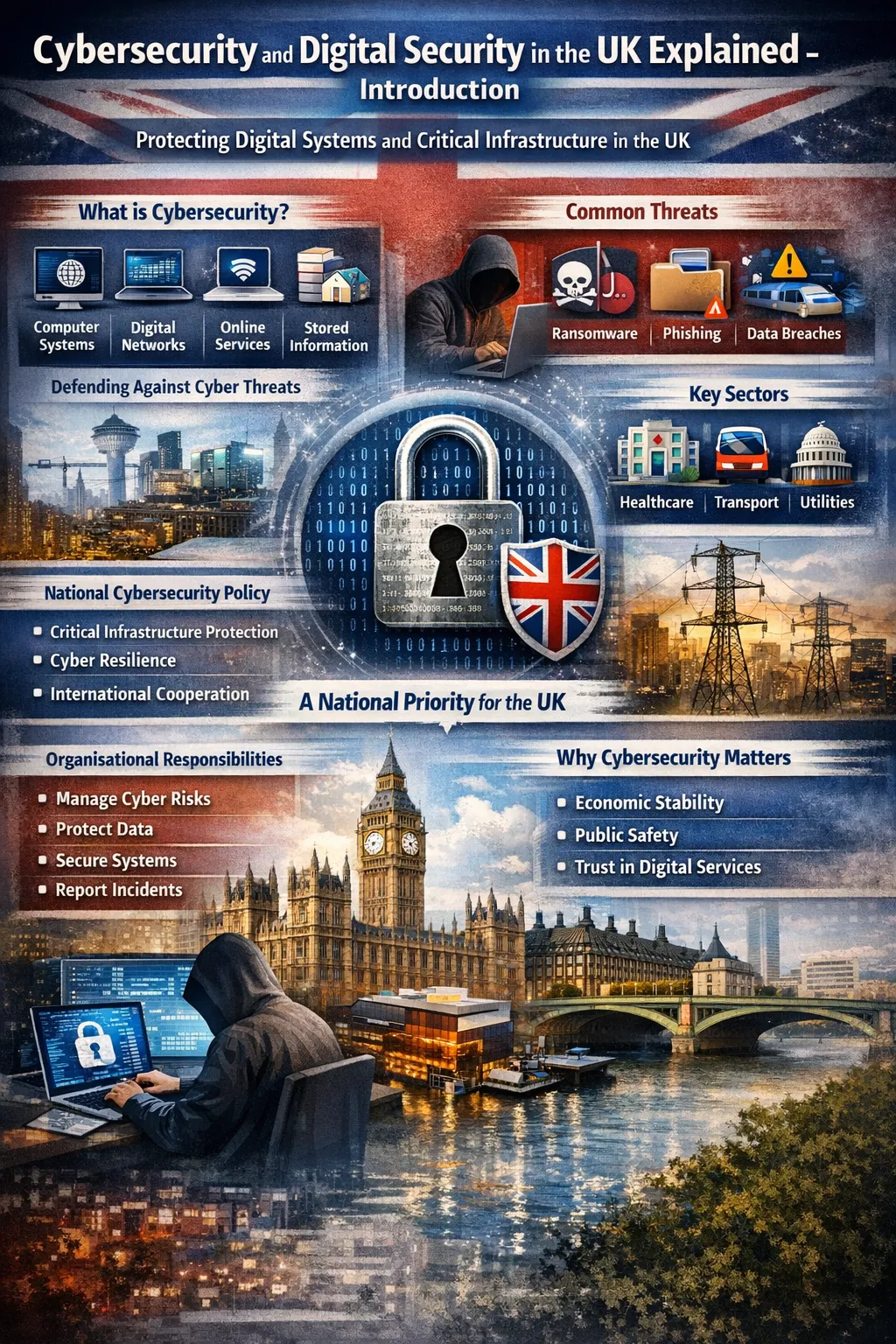
Cybersecurity is a critical national priority for the United Kingdom, protecting the digital infrastructure on which the economy, public services, national security and daily life depend. As the UK becomes ever more reliant on digital systems — from banking and healthcare to energy networks and government services — the threat landscape has grown in scale, sophistication and impact. The UK’s approach to cybersecurity involves coordination across government, law enforcement, intelligence agencies, regulators and the private sector.
This guide explains how the UK approaches cybersecurity, what the main threats are, which institutions are responsible, how businesses and critical infrastructure are protected, and what individuals can do to stay safe online.
What is the UK’s national cybersecurity strategy?
The UK’s approach to cybersecurity is set out in the National Cyber Strategy, most recently updated in 2022, which establishes five pillars: strengthening the UK’s cyber ecosystem, building resilience across the economy and public sector, taking the lead in the technologies vital to cyber power, advancing UK global leadership in cybersecurity, and detecting, disrupting and deterring adversaries. The strategy is overseen by the Cabinet Office and coordinated across multiple departments and agencies.
The National Cyber Security Centre (NCSC), a part of GCHQ, is the UK’s technical authority on cybersecurity. The NCSC provides guidance and support to government, businesses and the public, responds to major cyber incidents, analyses threat intelligence, develops defensive tools and manages the Active Cyber Defence programme — a set of automated measures that protect UK internet users from common cyber threats at scale, including blocking malicious websites, detecting phishing campaigns and removing fake government domain names.
The NCSC works closely with law enforcement agencies, principally the National Crime Agency (NCA), which leads the operational response to cybercrime. The intelligence agencies — GCHQ, MI5 and MI6 — provide strategic intelligence on cyber threats from hostile states and other advanced actors. The Ministry of Defence manages military cyber capabilities, including offensive cyber operations conducted by the National Cyber Force, a joint unit staffed by personnel from GCHQ and the armed forces.
What are the main cyber threats to the UK?
The UK faces a diverse and evolving set of cyber threats. State-sponsored cyber operations from countries including Russia, China, Iran and North Korea pose the most strategically significant threat, targeting government systems, critical national infrastructure, defence contractors, academic institutions and commercial enterprises for purposes of espionage, intellectual property theft and pre-positioning for potential disruptive attacks.
Organised cybercriminal groups, many operating from jurisdictions with limited law enforcement cooperation, conduct ransomware attacks, data theft, financial fraud and extortion campaigns against UK organisations. Ransomware remains one of the most destructive cyber threats, with attacks on hospitals, schools, local councils and businesses causing major disruption to services and significant financial losses. The NCSC’s Annual Review consistently identifies ransomware as the most acute cyber threat to UK organisations.
Other significant threats include supply chain attacks (where adversaries compromise software suppliers or managed service providers to gain access to their customers’ systems), insider threats, hacktivism (politically motivated cyber attacks by activist groups), and the exploitation of vulnerabilities in Internet of Things (IoT) devices, cloud services and legacy IT systems. The growing sophistication of AI-powered cyber attacks — including AI-generated phishing, deepfake social engineering and automated vulnerability discovery — is expected to increase the threat level further.
How is critical national infrastructure protected?
Critical national infrastructure (CNI) — including energy, water, transport, telecommunications, health, financial services and government — is subject to specific cybersecurity requirements. The Network and Information Systems Regulations 2018 (NIS Regulations) require operators of essential services and relevant digital service providers to implement appropriate security measures, manage cyber risks and report significant incidents to the relevant regulatory authority.
The government has proposed strengthening the NIS framework through a Cyber Security and Resilience Bill, which would expand the scope of regulated entities, increase the power of regulators to enforce compliance, mandate faster incident reporting and establish new requirements for supply chain security. The bill reflects the growing recognition that cyber resilience — the ability of organisations and systems to withstand, respond to and recover from cyber attacks — is as important as preventive security.
Sector-specific regulators play important roles in cybersecurity oversight. Ofcom regulates telecommunications security under the Telecommunications (Security) Act 2021, which imposed new security duties on telecoms providers following the Huawei controversy. The FCA and the Bank of England’s Prudential Regulation Authority oversee the operational resilience and cybersecurity of financial institutions. The Care Quality Commission and NHS England promote cybersecurity in the health sector, though the NHS’s vulnerability to cyber attacks — most dramatically demonstrated by the WannaCry ransomware attack of 2017 — remains a significant concern.
How does the UK promote cybersecurity skills and awareness?
The UK faces a significant cybersecurity skills shortage, with demand for qualified professionals far exceeding supply. The government has invested in developing the cyber workforce through several programmes, including the CyberFirst initiative (which provides bursaries, courses and competitions for young people interested in cybersecurity careers), academic centres of excellence in cybersecurity research, apprenticeship standards in cybersecurity and information security, and the Cyber Security Body of Knowledge (CyBOK) project, which defines the core knowledge needed by cybersecurity professionals.
For businesses, the NCSC’s Cyber Essentials scheme provides a baseline certification standard that all organisations can achieve, covering five key technical controls: firewalls, secure configuration, user access control, malware protection and security update management. The scheme has been widely adopted and is required for certain government contracts. For more mature organisations, the Cyber Essentials Plus certification includes hands-on technical verification. The NCSC also provides sector-specific guidance, small business guides and the 10 Steps to Cyber Security framework for larger organisations.
Public awareness of cybersecurity has improved but remains uneven. The NCSC’s Cyber Aware campaign promotes simple protective behaviours such as using strong passwords, enabling two-factor authentication, keeping devices updated and being vigilant about phishing. The annual UK Cyber Security Breaches Survey, published by the Department for Science, Innovation and Technology, provides data on the prevalence and impact of cyber attacks on UK businesses and charities, and consistently shows that phishing remains the most common attack vector.
How does cyber incident response work in the UK?
When a significant cyber attack occurs, the UK has established processes for incident response at both organisational and national levels. The NCSC operates a 24/7 incident management capability and has responded to thousands of significant cyber incidents since its establishment in 2016, including major ransomware attacks, data breaches, state-sponsored intrusions and attacks on critical infrastructure.
For the most serious incidents, the NCSC works directly with affected organisations to contain the attack, analyse the threat, remediate compromised systems and support recovery. It also coordinates the government’s cross-departmental response through the National Cyber Security Centre’s incident management process, which can escalate to COBRA (the Cabinet Office Briefing Room) for incidents that pose a threat to national security or essential services.
The cyber insurance market has grown significantly in the UK, providing organisations with financial protection against the costs of cyber incidents including forensic investigation, legal fees, business interruption, data breach notification, regulatory fines and ransom payments. However, the sustainability of the cyber insurance market has been questioned as claims have risen, and there is ongoing debate about whether insurance for ransomware payments incentivises further attacks. The government has consulted on measures to discourage ransomware payments, including a potential requirement for organisations to report payments and seek authorisation before paying ransoms.
How does the UK regulate the security of connected products?
The proliferation of internet-connected devices — from smart speakers and security cameras to industrial sensors and medical devices — has created new cybersecurity risks that the UK has moved to address through regulation. The Product Security and Telecommunications Infrastructure Act 2022 (PSTI Act) introduced mandatory security requirements for consumer connectable products sold in the UK, which came into force in April 2024.
The PSTI Act requires manufacturers to meet three minimum security standards: products must not use universal default passwords, manufacturers must provide a public point of contact for reporting security vulnerabilities, and manufacturers must state the minimum period for which the product will receive security updates. These requirements apply to a wide range of consumer devices including smartphones, tablets, smart TVs, connected toys, fitness trackers, smart home devices and routers.
The UK was one of the first countries to introduce mandatory IoT security legislation, and the PSTI Act has influenced similar initiatives in other jurisdictions. However, the requirements represent minimum standards, and the NCSC continues to promote the adoption of more comprehensive security measures by manufacturers, including secure boot processes, encrypted communications, automatic security updates and secure decommissioning procedures.
What are the future challenges for UK cybersecurity?
The UK’s cybersecurity landscape faces several major emerging challenges. The development of quantum computing threatens to undermine the cryptographic algorithms that currently protect digital communications, financial transactions and government secrets. The NCSC has published guidance on preparing for the migration to quantum-resistant cryptography — a process known as “post-quantum transition” — which will require organisations across all sectors to update their encryption systems over the coming decade.
The increasing integration of AI into both offensive and defensive cyber operations is transforming the threat landscape. AI-powered tools can automate the discovery and exploitation of vulnerabilities, generate highly convincing phishing content, and enable adversaries to operate at greater speed and scale. Conversely, AI-powered defensive tools offer the potential for faster threat detection, automated incident response and more effective identification of anomalous behaviour. The race between AI-powered attack and defence capabilities will be a defining feature of cybersecurity for the foreseeable future.
The resilience of supply chains remains a persistent vulnerability. Modern organisations depend on complex webs of software suppliers, cloud service providers, managed service providers and hardware manufacturers, any of which can become a vector for attack. High-profile incidents such as the SolarWinds compromise and the exploitation of vulnerabilities in widely used software libraries have demonstrated how a single supply chain weakness can affect thousands of organisations simultaneously. Building supply chain resilience — through better procurement practices, supplier assurance frameworks and diversification of critical dependencies — is a growing priority for government, regulators and industry.
The cyber skills gap continues to widen as demand for qualified professionals grows faster than the education and training system can supply them. The UK Cyber Security Council, established as the professional body for the cybersecurity workforce, is working to define career pathways, promote professional standards and support the development of the next generation of cyber professionals. However, the scale of the challenge — compounded by competition from the private sector for talent, gender and diversity imbalances in the profession and the rapidly evolving nature of the skills required — means that the skills shortage is likely to remain a constraint on UK cyber resilience for some years to come.
How does the UK cooperate internationally on cybersecurity?
Cybersecurity is inherently international, and the UK cooperates extensively with allies and partners on threat intelligence sharing, joint operations against cybercriminal groups, the development of international norms for responsible state behaviour in cyberspace, and capacity building in countries with less developed cyber capabilities. The UK is a member of the Five Eyes intelligence alliance (alongside the United States, Canada, Australia and New Zealand), which provides a framework for deep cooperation on cyber intelligence and operations.
The UK has also been active in promoting international norms and agreements on cybersecurity through the United Nations, NATO, the G7 and bilateral engagements. The government has used diplomatic tools, including public attribution of cyber attacks to specific states, sanctions against hostile cyber actors and support for international law enforcement operations against cybercriminal infrastructure, to deter and respond to hostile cyber activity.
Why does cybersecurity matter?
Cybersecurity underpins the functioning of the modern economy, the delivery of public services, the protection of individual privacy and the security of the state. A successful cyber attack on critical infrastructure, financial systems, healthcare or government services could have devastating consequences for millions of people. As the UK becomes ever more digitally dependent, ensuring that organisations, systems and individuals are resilient to cyber threats is not just a technical challenge but a fundamental requirement of national security and economic prosperity.
Related guides
- UK Technology Policy and Regulation Explained
- Artificial Intelligence and AI Regulation in the UK Explained
- UK Digital Economy and Technology Sector Explained
- Cybercrime and Fraud in the UK Explained
- How UK Companies Are Regulated
Related coverage:
Read our latest UK technology and cybersecurity news
Prepared by:
