How the UK Education System Works
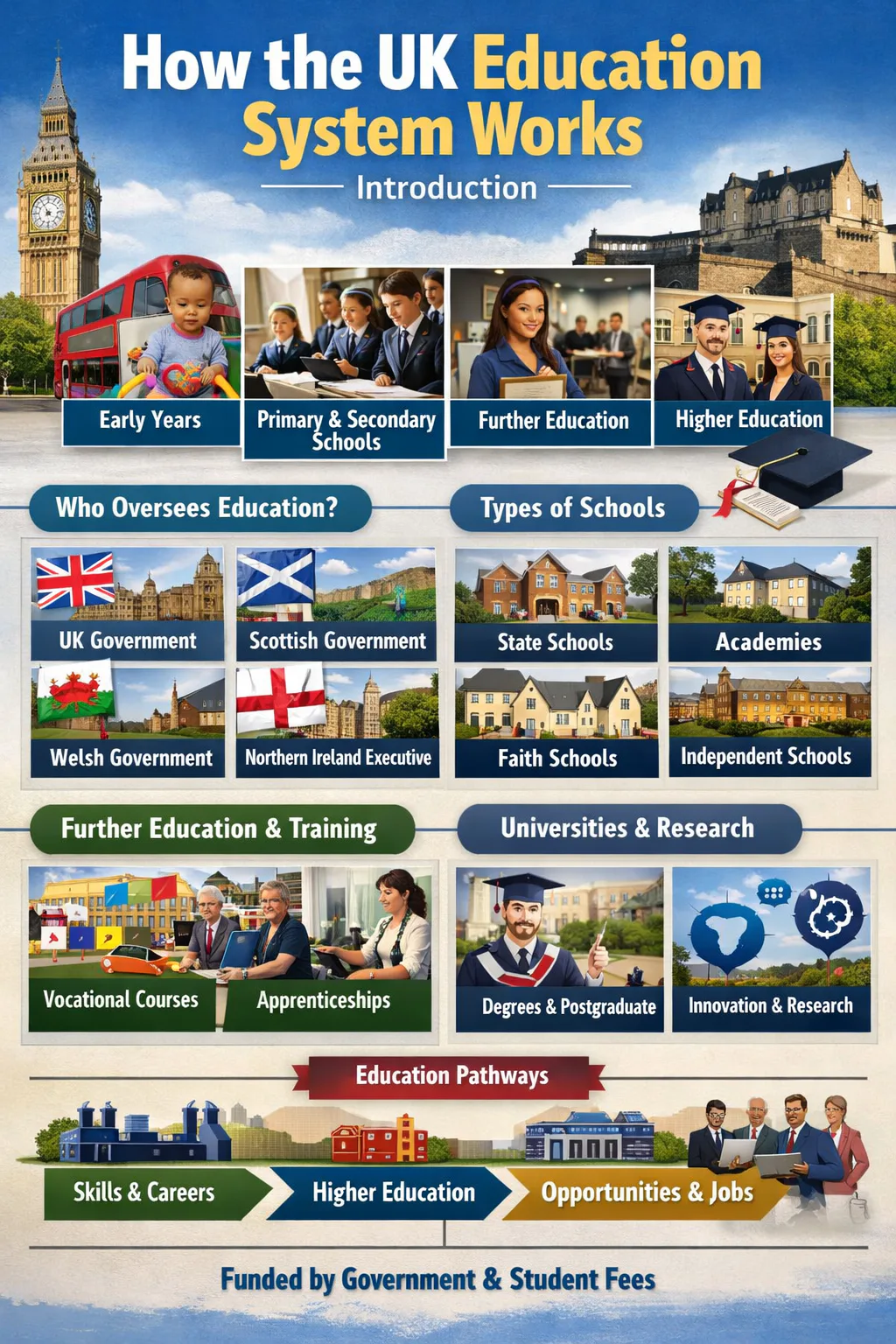
Education is one of the most important public services in the United Kingdom, shaping the life chances of millions of children and young people and playing a central role in the country’s economic competitiveness, social mobility and cultural life. The UK education system is complex, with different structures and policies operating in England, Scotland, Wales and Northern Ireland, each reflecting distinct educational traditions, governance arrangements and political priorities.
This guide provides a comprehensive overview of how the education system works across the United Kingdom, covering early years provision, primary and secondary schooling, further education, higher education and the governance and funding structures that underpin the system.
How is the UK education system structured?
Education in the United Kingdom is compulsory for all children between the ages of 5 and 16, though in England young people are required to remain in some form of education or training until the age of 18 — either in school, college or an apprenticeship. The system is broadly divided into four stages: early years (ages 0-5), primary education (ages 5-11), secondary education (ages 11-16 or 18) and tertiary or higher education (post-18).
Education is a devolved policy area, meaning that the UK government is responsible for education in England, while the Scottish Government, Welsh Government and Northern Ireland Executive each set their own education policies. This devolution has led to significant differences in curriculum content, school structures, qualifications, funding and governance across the four nations. The Department for Education (DfE) is the government department responsible for education policy in England.
How does early years education work?
Early years education covers learning and development for children from birth to the age of five. In England, the government provides funded early education entitlements — currently 15 hours per week of free childcare for all three and four-year-olds, 15 hours for disadvantaged two-year-olds, and an expanded entitlement of 30 hours for working parents of three and four-year-olds. From 2024, the government has been progressively extending funded childcare to younger age groups, with the aim of providing 30 hours of funded childcare for all children from nine months to school age by September 2025.
Early years settings include nurseries, pre-schools, childminders and school-based nursery classes. All registered providers must follow the Early Years Foundation Stage (EYFS) framework, which sets standards for learning, development and care. Ofsted inspects early years providers and rates them on a four-point scale from Outstanding to Inadequate. The quality of early years provision has been linked by research to children’s cognitive development, school readiness and long-term educational outcomes, making it a significant focus of government policy.
In Scotland, the Scottish Government provides 1,140 hours per year of funded early learning and childcare for all three and four-year-olds and eligible two-year-olds. Wales offers the Foundation Phase for three to seven-year-olds and a Childcare Offer providing 30 hours of early education and childcare for working parents of three and four-year-olds. Northern Ireland provides a funded pre-school year for children in the year before they start primary school.
How do primary and secondary schools work?
In England, children typically start primary school at age four or five (in Reception) and move to secondary school at age 11. Primary schools teach the National Curriculum, covering subjects including English, mathematics, science, history, geography, art, music, computing and physical education. Secondary schools continue with the National Curriculum through Key Stage 3 (ages 11-14) and then prepare students for GCSE examinations at Key Stage 4 (ages 14-16).
The school landscape in England includes several types of state-funded school. Community schools are maintained by the local authority. Academies are publicly funded but independently managed schools that operate outside local authority control under a funding agreement with the Secretary of State for Education — they are run by academy trusts, which can be single-academy trusts or multi-academy trusts (MATs) managing multiple schools. Free schools are a type of academy established by groups of parents, teachers, charities, businesses or other organisations in response to perceived local need. Faith schools are run in partnership with religious organisations and can be either maintained schools or academies.
The academisation programme has transformed the English school landscape since 2010. As of 2025, the majority of secondary schools and a growing proportion of primary schools in England are academies. The government has signalled its intention for all schools to eventually be part of multi-academy trusts, though this remains a subject of political debate. Grammar schools — selective state schools that admit pupils based on academic ability through the 11-plus examination — continue to operate in some parts of England, though no new grammar schools have been established for decades.
Independent schools (private or “public” schools) educate approximately 6-7 per cent of children in the UK, funded by fees paid by parents rather than by the state. The independent sector includes some of the UK’s most well-known and selective schools, including Eton, Harrow, Winchester and Westminster. The relationship between independent and state education — and the role of private schooling in perpetuating social inequality — is a recurring subject of political debate. The current Labour government has removed the VAT exemption on independent school fees, a policy that is expected to increase costs for families and may affect enrolment.
How do qualifications work in the UK?
The qualification system varies across the four UK nations. In England, students typically sit GCSEs (General Certificates of Secondary Education) at age 16 and A-levels (Advanced Levels) or equivalent qualifications at age 18. GCSEs are graded on a 9-1 scale (with 9 being the highest), introduced from 2017 to replace the previous A*-G grading system. A-levels remain the primary academic qualification for university entry, though alternatives including BTECs, T-levels and the International Baccalaureate are also accepted.
In Scotland, the qualification system is based on Scottish Qualifications Authority (SQA) awards. Students typically sit National 5 examinations at age 15-16 (broadly equivalent to GCSEs), Highers at age 16-17 (the main qualification for university entry in Scotland) and Advanced Highers at age 17-18. The Scottish system has a broader curriculum through the Curriculum for Excellence framework, with students studying more subjects to a later stage than their English counterparts.
Wales follows a similar pattern to England, with GCSEs and A-levels, though the Welsh Government has introduced significant curriculum reforms through the Curriculum for Wales framework, which replaced the National Curriculum in Wales from 2022. Northern Ireland also uses GCSEs and A-levels, with the Council for the Curriculum, Examinations and Assessment (CCEA) serving as the awarding body for locally developed qualifications.
How are schools funded?
State-funded schools in England are financed through a national funding formula, which allocates money to schools based on the number and characteristics of their pupils, with additional funding for factors such as deprivation, low prior attainment, English as an additional language and geographical sparsity. The total schools budget in England is approximately £60 billion per year, making it one of the largest areas of public spending.
Schools also receive additional funding through specific grants, including the Pupil Premium (additional funding for disadvantaged pupils, currently £1,480 per eligible primary pupil and £1,050 per eligible secondary pupil), the PE and Sport Premium for primary schools, and funding for children with special educational needs and disabilities (SEND). The adequacy of school funding has been a major political issue, with school leaders, unions and campaign groups arguing that funding has not kept pace with cost pressures including rising energy bills, staff pay increases and the growing demand for SEND support.
How is school quality assessed?
In England, school quality is assessed through inspections conducted by the Office for Standards in Education, Children’s Services and Skills (Ofsted). Until recently, Ofsted rated schools using a four-point scale — Outstanding, Good, Requires Improvement and Inadequate — based on inspections that assessed the quality of education, behaviour and attitudes, personal development and leadership and management. Following a review prompted by concerns about the impact of high-stakes inspections on school leaders’ wellbeing, Ofsted is transitioning to a new inspection framework that will replace single-word judgements with more detailed narrative assessments.
In Scotland, Education Scotland conducts inspections of schools and publishes reports, though the inspection regime operates differently from Ofsted. In Wales, Estyn is the inspectorate for education and training. In Northern Ireland, the Education and Training Inspectorate (ETI) carries out school inspections. Across all four nations, school performance data — including examination results, attendance rates and progress measures — is published to allow parents, communities and policymakers to assess how schools are performing.
How do further and higher education work?
Further education (FE) encompasses post-16 education and training outside of schools and universities. FE colleges, sixth form colleges and specialist institutions provide a wide range of academic and vocational qualifications, including A-levels, BTECs, T-levels, apprenticeships, Foundation degrees and adult education courses. The FE sector serves approximately 2.2 million students in England and is essential for skills development, social mobility and economic productivity, though it has historically received less funding and political attention than schools and universities.
Higher education in the UK is provided by over 160 universities and higher education institutions, ranging from large research-intensive universities such as Oxford, Cambridge, Imperial College London and University College London to smaller, teaching-focused institutions and specialist colleges. UK universities enjoy a high international reputation — several consistently rank among the top institutions in global league tables. Undergraduate tuition fees in England are capped at £9,535 per year (as of 2025), funded through income-contingent student loans administered by the Student Loans Company. In Scotland, tuition is free for Scottish and EU students studying at Scottish universities. Wales and Northern Ireland have their own fee and student support arrangements.
How is the teaching profession regulated and supported?
Teaching in state-funded schools in England requires Qualified Teacher Status (QTS), which can be obtained through a variety of routes including university-based teacher training (PGCE programmes), school-based training (School Direct and School Centred Initial Teacher Training), and employment-based routes such as Teach First, which places graduates in schools in disadvantaged areas. The government has introduced the Early Career Framework, providing a structured programme of support, mentoring and professional development for teachers in their first two years in the profession.
Teachers’ pay in England is set by the School Teachers’ Review Body (STRB), an independent body that makes recommendations to the government each year. Pay scales vary by region, with higher pay in inner London to reflect the higher cost of living. Starting salaries for teachers have been increased in recent years as part of efforts to improve recruitment, but pay growth for experienced teachers has been more modest, contributing to concerns about retention.
The Teaching Regulation Agency (TRA) maintains the register of qualified teachers in England and can prohibit individuals from teaching if they are found guilty of serious misconduct. Professional standards for teaching are set by the Department for Education and include expectations around subject knowledge, pedagogy, behaviour management, professional conduct and engagement with parents and the wider school community. In Scotland, the General Teaching Council for Scotland (GTCS) regulates the profession, and in Wales the Education Workforce Council (EWC) performs a similar role.
How does UK education compare internationally?
The UK’s education system is regularly assessed through international comparisons, most notably the OECD’s Programme for International Student Assessment (PISA), which tests 15-year-olds in reading, mathematics and science every three years. UK performance in PISA has been broadly average among OECD countries, with particular concerns about mathematics performance relative to leading East Asian education systems such as Singapore, Japan, South Korea and China.
The UK’s higher education sector performs strongly in international comparisons, with UK universities consistently featuring among the best in the world in global rankings. The UK attracts a large number of international students — approximately 680,000 in 2022-23 — making it one of the most popular destinations for higher education globally. International student fees and the broader economic contribution of the higher education sector are significant to the UK economy, though immigration policy and the treatment of international graduates have become increasingly politically sensitive.
Areas where the UK faces challenges relative to international peers include vocational and technical education (where countries such as Germany, Switzerland and the Netherlands have more established and prestigious systems), the attainment gap between advantaged and disadvantaged pupils (which is wider in England than in many comparable countries), and the proportion of GDP spent on education, which has declined in real terms over the past decade.
What are the major challenges facing UK education?
The UK education system faces a number of significant challenges. The attainment gap between disadvantaged pupils and their more affluent peers remains persistent and widened during the COVID-19 pandemic, when school closures and the shift to remote learning disproportionately affected children from lower-income households. Closing this gap is a central priority for education policy across all four nations.
Teacher recruitment and retention are ongoing concerns. Many subjects, particularly mathematics, science, computing and modern foreign languages, face chronic shortages of qualified teachers. Workload, pay and the pressures of accountability have been identified as factors contributing to high attrition rates, with significant numbers of teachers leaving the profession within the first five years of their careers.
The provision of support for children and young people with special educational needs and disabilities (SEND) is widely regarded as being in crisis. Demand for Education, Health and Care Plans (EHCPs) — statutory documents setting out the support a child needs — has grown rapidly, and many families experience long delays, inadequate provision and a system that requires them to fight for their children’s entitlements. The National Audit Office and parliamentary committees have repeatedly highlighted the unsustainability of the current SEND system.
Mental health and wellbeing among children and young people have emerged as major concerns, with rising rates of anxiety, depression and self-harm reported across all age groups. Schools are increasingly expected to play a role in supporting pupils’ mental health, but resources and specialist support are often insufficient to meet the scale of need.
Why does education matter?
Education shapes the knowledge, skills and opportunities available to every person in the United Kingdom. The quality of the education system determines the country’s ability to develop a skilled workforce, drive economic growth, promote social mobility, foster civic participation and support individual fulfilment. Decisions about education policy — including funding, curriculum, school structures, teacher development, qualifications and access to higher education — are among the most consequential that any government makes, affecting generations to come.
Related guides
These guides explain related topics in more detail:
- UK Schools and Curriculum Explained
- UK Universities and Student Finance Explained
- Apprenticeships and Vocational Education in the UK Explained
- How the UK Government Works
- UK Public Finances and Government Spending Explained
Related coverage:
Read our latest UK education news
Prepared by: