UK Universities and Student Finance Explained
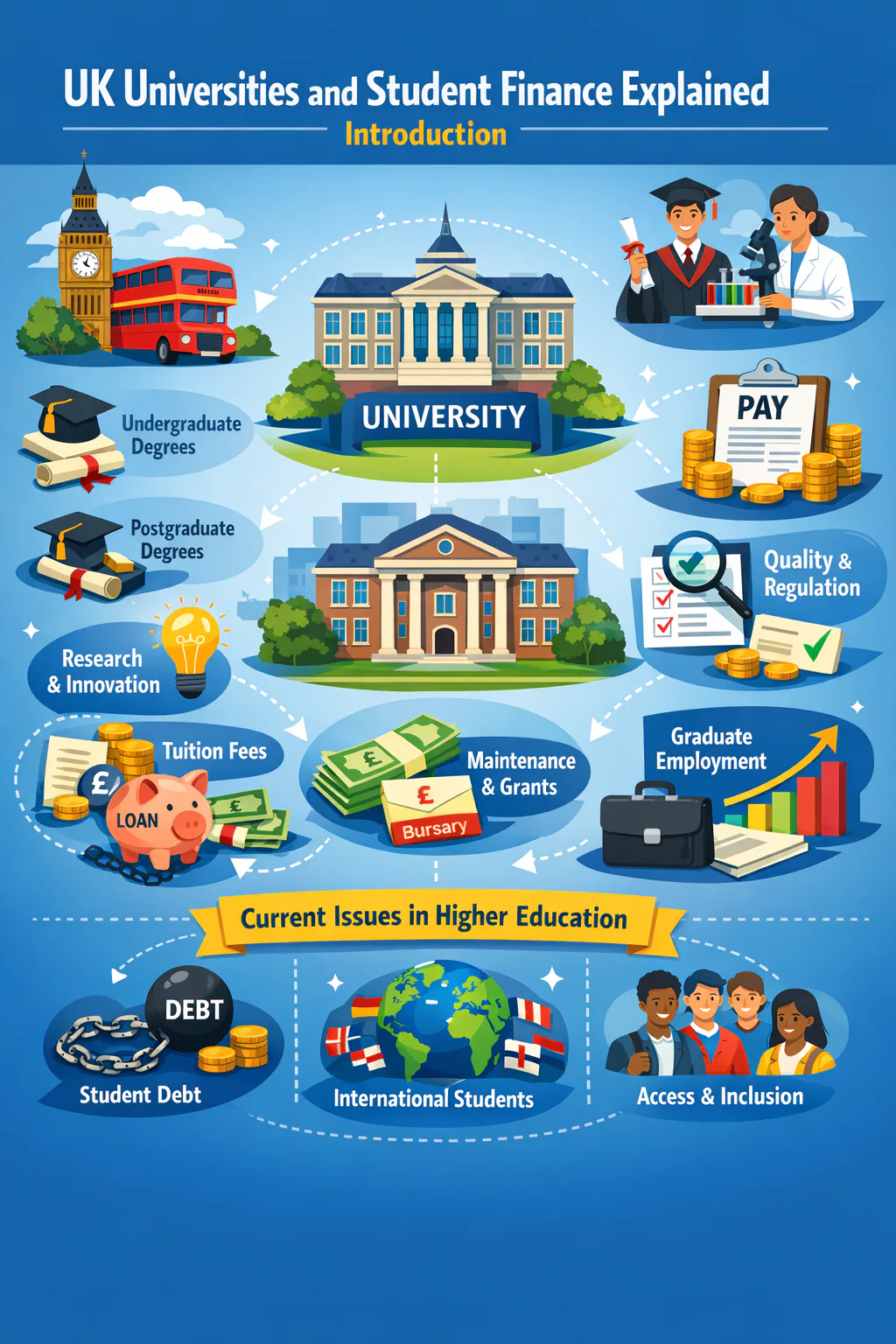
The United Kingdom is home to one of the world’s most respected higher education systems. With over 160 universities and higher education institutions, the UK attracts students from across the globe and produces world-leading research across every academic discipline. However, the system is also the subject of intense debate about funding, access, student debt, value for money and the role of universities in society.
This guide explains how UK universities work, how they are funded and regulated, how student finance operates, what challenges the sector faces and why higher education matters.
How is the UK university system structured?
UK universities are legally independent, self-governing institutions that receive public funding but operate autonomously in their academic, administrative and financial decisions. They include ancient universities founded in the medieval period (such as Oxford, Cambridge, St Andrews and Glasgow), red-brick universities established in major industrial cities in the 19th and early 20th centuries (such as Manchester, Birmingham, Leeds and Liverpool), plate-glass universities founded in the 1960s (such as Sussex, York, Warwick and East Anglia), and post-1992 universities — former polytechnics that were granted university status following the Further and Higher Education Act 1992.
The Russell Group, an association of 24 research-intensive universities, represents institutions that receive the largest share of research funding and consistently rank highest in league tables. Other groupings include the University Alliance (representing professional and technical universities), MillionPlus (representing modern universities with a focus on widening participation) and GuildHE (representing smaller and specialist institutions). The diversity of the sector — from large research universities to small specialist colleges — is considered one of its strengths, offering students a wide range of choices in terms of subject, teaching style, campus environment and location.
How are universities funded?
University funding in England comes from three main sources: tuition fees paid by students (funded through student loans for most domestic undergraduates), research funding from UK Research and Innovation (UKRI) and other research councils, and other income including international student fees, commercial activities, endowments and charitable donations. The undergraduate tuition fee cap in England is currently £9,535 per year, a figure that has remained largely unchanged in real terms since fees were raised to £9,000 in 2012, meaning that universities have experienced a significant real-terms reduction in per-student funding as costs have risen.
International student fees are not capped and vary by institution and subject, typically ranging from £15,000 to over £40,000 per year. Income from international students has become critically important to the financial sustainability of many universities, particularly as domestic fee income has stagnated. This dependence on international student revenue has created financial vulnerability, with institutions exposed to changes in global student mobility patterns, immigration policy and geopolitical developments.
In Scotland, tuition fees are not charged to Scottish-domiciled undergraduate students studying at Scottish universities — their fees are paid by the Student Awards Agency Scotland (SAAS). However, students from the rest of the UK studying in Scotland pay fees of up to £9,250 per year. Wales has its own student support arrangements, with the Welsh Government providing means-tested maintenance grants alongside loans. Northern Ireland charges lower tuition fees (currently £4,750) for Northern Irish students studying in Northern Ireland.
How does student finance work in England?
Most undergraduate students in England fund their tuition fees through student loans provided by the Student Loans Company (SLC), a government-backed body. Students do not pay fees upfront — instead, the loan covers the full cost of tuition and is repaid after graduation through the tax system once the graduate’s earnings exceed a threshold. Under the current Plan 5 system (for students starting from September 2023), repayments begin when earnings exceed £25,000 per year, at a rate of 9 per cent of income above the threshold. Outstanding balances are written off after 40 years.
Students can also take out maintenance loans to help with living costs during their studies. The amount available depends on household income, whether the student lives at home or away, and whether they study in London or elsewhere. The maximum maintenance loan for students living away from home outside London is approximately £10,200 per year (2024-25 rates), with higher amounts for London students. Additional support is available for students with disabilities through the Disabled Students’ Allowance (DSA).
The student finance system has been the subject of extensive debate. Total outstanding student loan debt in England exceeds £200 billion and is projected to continue growing. The government effectively subsidises the system because a significant proportion of loans are never fully repaid — the RAB (resource accounting and budgeting) charge represents the estimated proportion of loans that will be written off. Changes to repayment thresholds, interest rates and write-off periods have significant implications for both graduates and the public finances.
How are universities regulated?
The Office for Students (OfS), established by the Higher Education and Research Act 2017, is the independent regulator of higher education in England. The OfS is responsible for ensuring that students receive a high-quality academic experience, that universities are financially sustainable, that access and participation for students from disadvantaged backgrounds is promoted, and that the interests of students are protected. The OfS maintains the Register of English Higher Education Providers, and only registered providers can access student loan funding and award degrees.
The OfS assesses the quality of teaching and outcomes through its regulatory framework, which includes minimum thresholds for continuation rates (the proportion of students who continue their studies), completion rates and graduate outcomes (the proportion of graduates in professional employment or further study). Universities that fall below these thresholds face regulatory action, which can include enhanced monitoring, conditions on registration or, in the most serious cases, deregistration.
The Quality Assurance Agency for Higher Education (QAA) provides guidance on academic standards and quality, though its role has evolved since the creation of the OfS. Research quality is assessed through the Research Excellence Framework (REF), a periodic exercise that evaluates the quality of research produced by UK universities and determines the allocation of quality-related research funding. The most recent REF was conducted in 2021, with the next exercise expected in 2028-29.
How does university research funding work?
Research is a core function of UK universities and a major source of funding and international prestige. Research funding comes through two main channels — the “dual support” system. Quality-related (QR) funding is allocated by the relevant funding body (Research England, the Scottish Funding Council, the Higher Education Funding Council for Wales, or the Department for the Economy in Northern Ireland) based on the results of the Research Excellence Framework (REF), which assesses the quality and impact of research across all disciplines. Competitive grant funding is distributed by UK Research and Innovation (UKRI), an umbrella body overseeing nine research councils covering areas from medical sciences (MRC) and engineering (EPSRC) to arts and humanities (AHRC).
Total public investment in university research in the UK is approximately £8-9 billion per year. The UK also benefits from its association with the European Union’s Horizon Europe research programme, which the UK rejoined in 2024 after a period of exclusion following Brexit. Horizon Europe provides access to collaborative research funding, researcher mobility programmes and large-scale research infrastructure across Europe. Industry-funded research, charitable research funding (particularly from medical research charities such as the Wellcome Trust and Cancer Research UK), and international collaborations also contribute significantly to the UK’s research base.
The UK consistently ranks second in the world (after the United States) for the quality and impact of its research outputs, as measured by citation metrics and international rankings. However, concerns have been raised about the sustainability of the research funding model, with universities arguing that the full economic cost of research is not adequately covered by grant funding, leading to a cross-subsidy from teaching income and international student fees.
How does widening participation work?
Widening participation (WP) refers to the efforts made by universities, government and other organisations to ensure that access to higher education is not determined by socioeconomic background, ethnicity, disability or other factors unrelated to academic potential. Despite significant progress over recent decades — with record numbers of young people from disadvantaged backgrounds entering university — significant gaps in participation, attainment and graduate outcomes persist between different groups.
The Office for Students requires all universities that charge fees above the basic level to have an Access and Participation Plan (APP), setting out how they will improve access, support student success and promote positive outcomes for underrepresented groups. Measures include contextual admissions (taking into account the educational and socioeconomic context in which a student achieved their qualifications), outreach programmes targeting schools in disadvantaged areas, foundation year programmes, bursaries and scholarships for students from low-income households, and targeted support for students during their studies.
The attainment gap between white and Black students, between students from different socioeconomic backgrounds, and between disabled and non-disabled students remains a significant concern. Universities are expected to address these gaps through their teaching, student support and institutional culture, and the OfS monitors progress through data on continuation, completion and graduate outcomes disaggregated by student characteristics.
How does postgraduate education work?
Postgraduate study in the UK includes taught master’s degrees (typically one year full-time), research master’s degrees, doctoral programmes (PhD or DPhil, typically three to four years) and professional doctorates in fields such as education, business and clinical psychology. Postgraduate study is an important pathway for career development, academic research and specialist professional training.
Funding for postgraduate study comes from a variety of sources. The government provides postgraduate master’s loans of up to £12,471 (2024-25 rates) and doctoral loans of up to £29,390 over the duration of the programme. Research council studentships, funded by UKRI, provide fully funded PhD places including tuition fees and a maintenance stipend. Universities, charities and industry also provide scholarships, bursaries and funded positions. However, the cost of postgraduate study — particularly in London and at prestigious institutions — remains a significant barrier for students from less affluent backgrounds.
What role do international students play?
International students are a vital part of the UK higher education system, contributing to the academic diversity of campuses, enriching the learning experience for domestic students and generating significant economic value. In 2022-23, approximately 680,000 international students were studying at UK universities — around one in four of all students — making the UK the second most popular destination for international higher education after the United States.
The economic contribution of international students extends far beyond tuition fee income. The Higher Education Policy Institute (HEPI) estimates that international students contribute over £40 billion per year to the UK economy when the broader impact on local spending, employment and tax revenues is included. International graduates who remain in the UK to work contribute to the labour market, particularly in sectors facing skills shortages such as healthcare, technology, engineering and financial services.
However, the recruitment of international students has become increasingly entangled with immigration policy. The Graduate Route visa, introduced in 2021, allows international graduates to stay and work in the UK for two years after completing their degree (three years for PhD graduates). This route has been popular but has also attracted political scrutiny, with the government implementing restrictions on the ability of taught master’s students to bring dependants and signalling further policy changes. The uncertainty created by shifting immigration rules has been criticised by universities, which argue that it undermines the UK’s competitiveness as a destination for global talent.
The geographic origin of international students has also shifted significantly, with growing numbers from South Asia (particularly India and Nigeria) and continuing strong recruitment from China. The concentration of international student recruitment from a small number of countries creates both opportunities and risks — geopolitical tensions, changes in government scholarship policies or shifts in currency values can have rapid and significant effects on student numbers and institutional finances.
What are the major challenges facing UK universities?
UK universities face a combination of financial, demographic and political challenges. The freeze in domestic tuition fees, combined with rising costs for staff, energy, estates and technology, has created a growing funding gap that many institutions are struggling to manage. Several universities have announced redundancy programmes, course closures and restructuring plans in response to financial pressures.
The dependence on international student income has become a significant strategic risk, particularly as government immigration policy has tightened restrictions on post-study work visas and the ability of students to bring dependants. Changes in the global higher education market, including increased competition from universities in Australia, Canada and emerging higher education systems in Asia and the Middle East, also affect UK institutions’ ability to recruit internationally.
The debate about the value of a university degree has intensified. With graduate debt levels increasing and some graduates struggling to find professional-level employment, questions have been raised about whether all degree courses offer sufficient value for money. The government has introduced minimum outcome thresholds and has encouraged universities to provide better information about graduate employment and earnings, while also promoting apprenticeships and technical education as alternatives to traditional university study.
Academic freedom — the principle that universities should be free to pursue research and teaching without political interference — has been the subject of debate in the context of legislation on free speech, the regulation of research collaboration with certain countries and the broader political environment around campus culture. The Higher Education (Freedom of Speech) Act 2023 introduced new duties on universities to protect free speech and academic freedom, overseen by the OfS.
Why do universities matter?
Universities are essential to the UK’s intellectual, economic and cultural life. They educate the professionals, researchers, teachers, scientists, engineers, artists and leaders of the future. They produce world-leading research that drives innovation, improves public health, advances technology and contributes to the understanding of society and the natural world. They are major employers and economic anchors in their local communities, and they contribute billions of pounds to the UK economy through teaching, research, knowledge exchange and the spending power of students and staff.
Related guides
These guides explain related topics in more detail:
- How the UK Education System Works
- UK Schools and Curriculum Explained
- Apprenticeships and Vocational Education in the UK Explained
- UK Public Finances and Government Spending Explained
- How the UK Economy Works
Related coverage:
Read our latest UK education news
Prepared by: