Apprenticeships and Vocational Education in the UK Explained
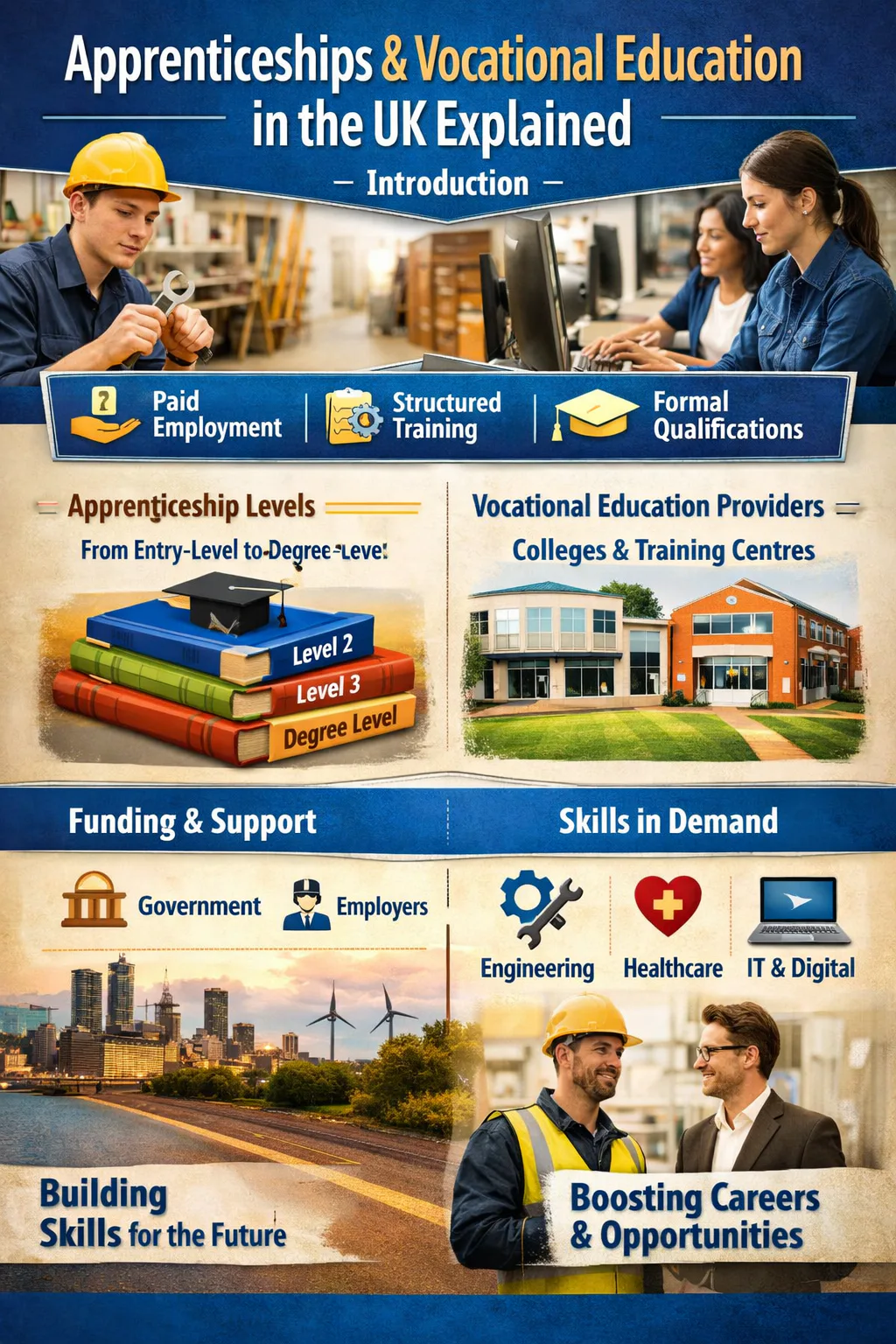
Apprenticeships and vocational education provide pathways into skilled employment that are distinct from the traditional academic route through university. In the United Kingdom, apprenticeships combine on-the-job training with an employer and classroom-based learning, leading to recognised qualifications and, in many cases, professional registration. Vocational education, delivered primarily through further education colleges and specialist training providers, encompasses a wide range of technical and professional qualifications designed to prepare people for specific careers or sectors.
This guide explains how apprenticeships work in the UK, how vocational education is structured, how these pathways are funded and regulated, what qualifications are available and why skills and technical education matter for the economy.
What are apprenticeships?
An apprenticeship is a job with structured training that leads to a nationally recognised qualification. Apprentices work for an employer, earn a wage and spend at least 20 per cent of their time on off-the-job training, which may take place at a college, training provider, university or within the workplace. Apprenticeships are available at multiple levels, from intermediate (Level 2, equivalent to GCSEs) through advanced (Level 3, equivalent to A-levels) and higher (Levels 4-5) to degree apprenticeships (Levels 6-7, equivalent to a bachelor’s or master’s degree).
Apprenticeships are available in a wide range of sectors and occupations, including construction, engineering, healthcare, digital technology, financial services, law, accounting, teaching, policing, creative industries, hospitality and agriculture. The breadth of apprenticeship opportunities has expanded significantly since the introduction of apprenticeship standards — employer-designed qualifications that specify the knowledge, skills and behaviours required for a particular occupation. There are now over 680 approved apprenticeship standards covering occupations from nursing associate to data scientist, from bricklayer to chartered manager.
Degree apprenticeships, introduced from 2015, allow apprentices to achieve a full bachelor’s or master’s degree while working. They have proven popular in sectors such as digital technology, engineering, business management, healthcare and the public sector, offering an alternative to traditional full-time university study that avoids tuition fee debt while gaining practical work experience. Major employers including the NHS, the Civil Service, large engineering firms and technology companies offer degree apprenticeship programmes.
How are apprenticeships funded?
Apprenticeship funding in England operates through the Apprenticeship Levy, introduced in April 2017. All employers with an annual pay bill of more than £3 million pay a levy of 0.5 per cent of their total pay bill, which is deposited into a digital apprenticeship service account that employers can use to pay for apprenticeship training and assessment. The levy was designed to incentivise large employers to invest in apprenticeships and to generate a sustainable funding stream for the system.
Smaller employers that do not pay the levy can access government-funded apprenticeship training, paying just 5 per cent of the training cost (with the government covering the remaining 95 per cent). Employers with fewer than 50 employees receive full government funding for apprentices aged 16-18. Additional incentive payments are available for employers who hire apprentices in certain age groups or with additional learning needs.
The Apprenticeship Levy has been the subject of significant debate. Large employers have argued that the levy is inflexible and does not allow them to spend funds on the broader range of training their workforce needs. The total amount of levy funding that expires unused each year — because employers have not been able to spend it within the 24-month window — has been substantial. The government has announced plans to reform the levy into a more flexible “Growth and Skills Levy” that allows employers to fund a wider range of accredited training, though the details of this reform are still being developed.
What are T-levels?
T-levels are a new type of technical qualification introduced from 2020, designed as a high-quality vocational alternative to A-levels for 16-19 year olds. Each T-level is a two-year programme focused on a specific technical area — such as digital, health, construction, engineering, finance or education — and includes a substantial industry placement of at least 315 hours (approximately 45 days) with an employer.
T-levels have been developed in collaboration with employers to ensure that the content reflects the skills and knowledge that industry needs. They are graded on a scale from pass to distinction* and carry UCAS tariff points equivalent to three A-levels, providing a pathway to university, higher apprenticeships or skilled employment. The rollout of T-levels has been gradual, with new subjects being introduced each year, and some early challenges around employer awareness, industry placement availability and student uptake have been reported.
How does further education support vocational training?
Further education (FE) colleges are the backbone of the UK’s vocational education and training system. There are approximately 230 FE colleges in England, serving around 2.2 million students and delivering a vast range of qualifications from basic skills and English for speakers of other languages (ESOL) to A-levels, BTECs, T-levels, apprenticeships and higher education. FE colleges also provide adult education, retraining programmes and community learning.
The FE sector has historically been underfunded relative to schools and universities, a disparity that has been the subject of sustained criticism from sector leaders, the Association of Colleges, parliamentary committees and think tanks. Funding per student in FE has fallen in real terms over the past decade, affecting the quality of facilities, the ability to recruit and retain skilled teaching staff, and the breadth of curriculum that colleges can offer. The government has acknowledged the importance of FE to the skills agenda and has announced increased investment, though many in the sector argue that funding levels remain insufficient to meet the scale of demand for vocational education and retraining.
Skills Bootcamps, funded by the Department for Education, provide short, intensive training courses in areas of skills shortage such as digital, green skills, construction and healthcare. They are designed for adults who are employed, self-employed or returning to work, and offer a flexible alternative to longer qualifications. Local Skills Improvement Plans (LSIPs), developed by employer representative bodies in collaboration with colleges and training providers, aim to ensure that local training provision is aligned with the needs of local employers and the regional economy.
How is the quality of apprenticeships assured?
The quality of apprenticeships in England is overseen by several bodies. Ofsted inspects apprenticeship training providers and rates them on the same four-point scale used for schools. The Institute for Apprenticeships and Technical Education (IfATE), an arm’s-length body of the Department for Education, is responsible for approving apprenticeship standards, managing the end-point assessment process and ensuring that standards remain current and relevant to employer needs. IfATE is being reformed into Skills England, a new body that will take a broader role in coordinating the skills system.
End-point assessment (EPA) is a distinctive feature of the English apprenticeship system. At the end of their apprenticeship, apprentices are assessed by an independent assessment organisation to confirm that they have met all the requirements of the standard. EPA methods can include practical tests, professional discussions, portfolios of evidence, written examinations and workplace observations. The independence of the assessment from the training provider is intended to ensure consistency and rigour.
Quality concerns have been raised about some aspects of the apprenticeship system, including high dropout rates (particularly at lower levels), variable quality of training provision, the extent to which some employers use apprenticeship funding for existing staff development rather than genuinely new training, and the displacement of lower-level apprenticeships by higher-level and degree apprenticeships, which tend to benefit more advantaged individuals. The government and Ofsted have taken steps to address these concerns through stricter accountability measures, provider inspections and minimum performance thresholds.
How does adult skills and retraining work?
The need for adult skills and retraining has grown in importance as the economy undergoes rapid technological change, the green transition creates new occupations and the labour market demands increasingly flexible and adaptable workers. The government provides funding for adult education through the Adult Education Budget (AEB), which supports courses in basic skills (English and maths), digital skills, English for speakers of other languages (ESOL) and other qualifications up to Level 2 for adults who do not already hold equivalent qualifications.
The Lifetime Skills Guarantee, announced in 2020, provides funding for adults aged 19 and over to achieve their first full Level 3 qualification (equivalent to A-levels or an advanced technical certificate) free of charge, in subjects aligned with national skills priorities. This represents a significant expansion of free training for adults and is intended to support those who missed out on qualifications earlier in life or who need to retrain for new careers.
In some areas of England, the Adult Education Budget has been devolved to combined authorities and the Greater London Authority, giving local leaders greater control over how adult skills funding is spent and allowing them to target provision at local economic needs. The devolution of adult education is part of the broader trend towards giving metro mayors and combined authorities greater responsibility for skills and employment in their areas.
How does the UK’s vocational system compare internationally?
The UK’s apprenticeship and vocational education system is frequently compared with those of countries where technical education has higher status and produces stronger outcomes. Germany’s dual system — in which apprenticeships are the primary route into employment for a large proportion of young people, with strong employer involvement, high completion rates and well-established career pathways — is widely regarded as a benchmark. Switzerland, Austria, the Netherlands and the Scandinavian countries also operate vocational education systems that are closely integrated with labour market needs and enjoy high public regard.
The UK has historically struggled to match the quality, coherence and prestige of these systems. Successive reforms — including the introduction of apprenticeship standards, T-levels, the Apprenticeship Levy and the creation of employer-led bodies such as IfATE — represent an attempt to move towards a more robust and employer-engaged system. However, the frequent pace of reform, the complexity of the qualification landscape and the persistent cultural preference for academic over vocational pathways remain significant challenges.
The OECD has recommended that the UK invest more in vocational education at the upper secondary level, strengthen employer engagement, improve career guidance for young people and reduce the stigma attached to non-university pathways. The World Skills competition, in which young people from around the world compete in skilled trades and technologies, provides one measure of the UK’s technical education quality — UK competitors have performed well in recent years, though the country’s overall ranking remains below the leading East Asian and European nations.
How do apprenticeships differ across the UK?
Apprenticeship policy is devolved, meaning that Scotland, Wales and Northern Ireland each operate their own systems. In Scotland, apprenticeships are managed by Skills Development Scotland and include Foundation Apprenticeships (for school pupils), Modern Apprenticeships (the main programme for those aged 16 and over) and Graduate Apprenticeships (equivalent to degree apprenticeships in England). Scotland does not use the Apprenticeship Levy system — instead, levy funds raised in Scotland are channelled through the Scottish Government’s skills budget.
In Wales, apprenticeships are managed by the Welsh Government and delivered through a network of approved training providers. The Welsh apprenticeship system includes Foundation, Apprenticeship and Higher Apprenticeship levels. Northern Ireland manages its own apprenticeship programme through the Department for the Economy, with a focus on higher-level apprenticeships and skills aligned with the Northern Ireland economic strategy.
Why do apprenticeships and vocational education matter?
Apprenticeships and vocational education are essential to the UK’s economic competitiveness, productivity and social mobility. They provide pathways into skilled employment for people who prefer practical, work-based learning or who do not wish to follow the traditional academic route through university. Sectors facing critical skills shortages — including construction, engineering, healthcare, digital technology and the green economy — depend on apprenticeships and vocational training to develop the workforce they need.
The quality and status of vocational education has been a persistent concern in the UK, where academic qualifications have historically been seen as more prestigious than technical alternatives. Raising the profile, quality and outcomes of apprenticeships and vocational pathways — and ensuring that they are genuinely valued by employers, young people and parents — is a key priority for education and skills policy in all four nations of the United Kingdom.
Related guides
These guides explain related topics in more detail:
- How the UK Education System Works
- UK Schools and Curriculum Explained
- UK Universities and Student Finance Explained
- How the UK Economy Works
- UK Public Finances and Government Spending Explained
Related coverage:
Read our latest UK education and skills news
Prepared by: