UK Schools and Curriculum Explained
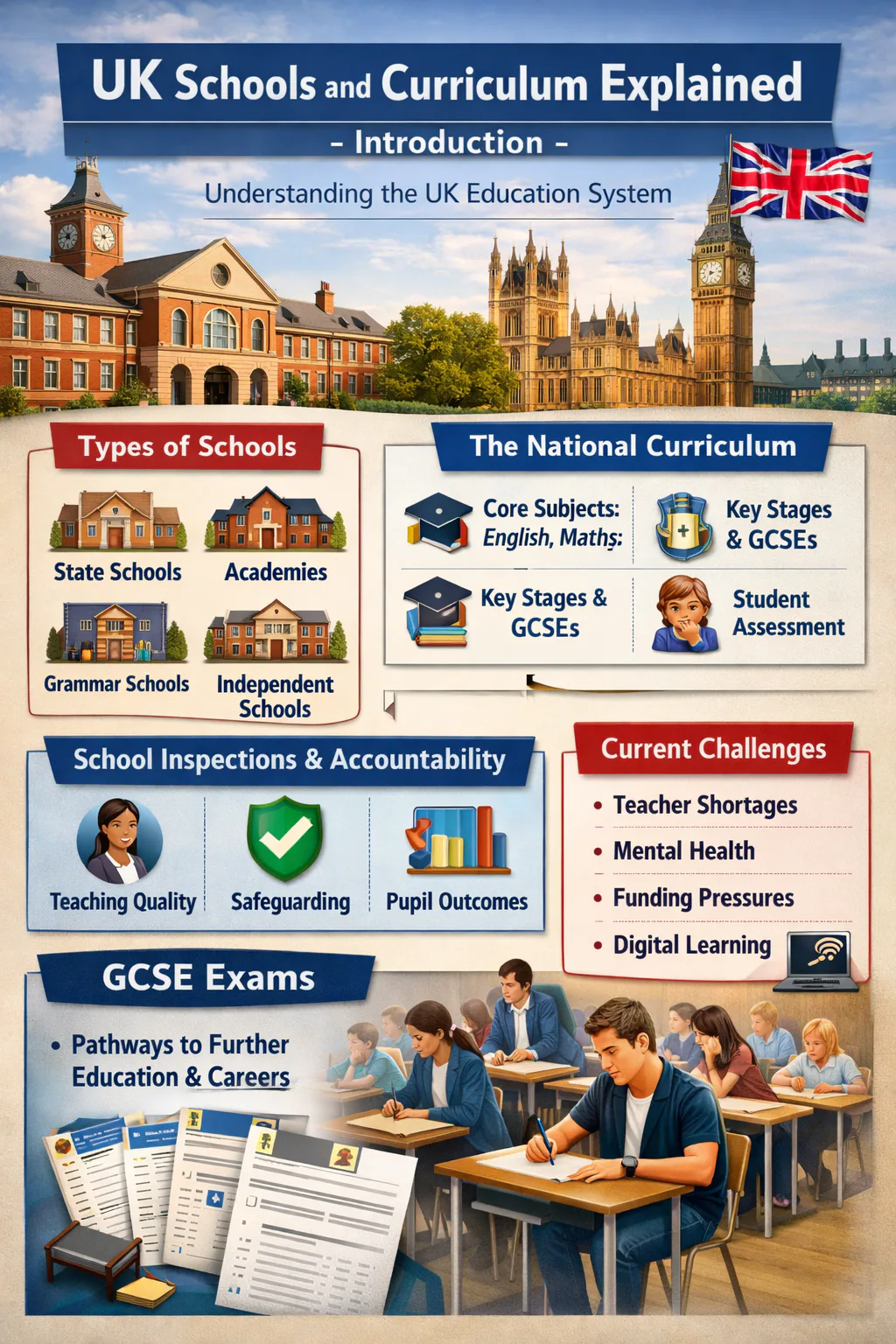
Schools are where the vast majority of children and young people in the United Kingdom receive their education. The UK education system encompasses a diverse range of school types, curriculum frameworks and assessment methods, reflecting both national policy decisions and the distinct educational traditions of England, Scotland, Wales and Northern Ireland. Understanding how schools are structured and what children learn is essential for parents, educators and anyone interested in how the UK prepares its next generation.
This guide explains the different types of schools in the UK, how the curriculum is designed and delivered, how pupils are assessed, how schools are governed and what current policy debates are shaping the future of school education.
What types of schools exist in England?
The English school system includes a wide variety of state-funded and independent schools. State-funded schools educate approximately 93 per cent of children and are free to attend. The main types are community schools (maintained by the local authority, which employs staff and owns the buildings), academies (publicly funded but independently managed by academy trusts, operating outside local authority control), free schools (a type of academy set up by groups such as parents, teachers, charities or businesses), foundation schools (where the governing body has more autonomy than in community schools), voluntary aided schools (typically faith schools where a religious body contributes to building costs and has significant influence over admissions and staffing) and voluntary controlled schools (faith schools where the local authority has greater control).
The multi-academy trust (MAT) model has become the dominant structural reform in English education. MATs are non-profit organisations that operate multiple schools under a single governance structure, with a central team providing leadership, financial management, human resources and school improvement support. The largest MATs, such as United Learning, Harris Federation and Ark Schools, operate dozens of schools across multiple regions. Supporters argue that MATs enable collaboration, resource sharing and the spread of effective practice, while critics raise concerns about accountability, local democratic control and the concentration of power in the hands of trust leaders.
Special schools provide education for children with the most complex special educational needs and disabilities (SEND), including severe learning difficulties, profound physical disabilities and complex behavioural, emotional and social needs. Alternative provision (AP), including pupil referral units (PRUs), serves children who cannot attend mainstream school due to exclusion, illness or other circumstances. Both special schools and AP have faced significant pressures from rising demand and funding constraints.
How do schools differ in Scotland, Wales and Northern Ireland?
In Scotland, the school system is managed by local authorities, and the academy model used in England does not exist. Scottish schools follow the Curriculum for Excellence (CfE), introduced from 2010, which takes a broader and more flexible approach to learning than the English National Curriculum, with an emphasis on interdisciplinary learning, skills development and learner-centred pedagogy. Schools in Scotland are inspected by Education Scotland and the Care Inspectorate.
Wales has implemented significant curriculum reforms through the Curriculum for Wales, which replaced the National Curriculum in Wales from September 2022. The new framework gives schools much greater freedom to design their own curricula around six Areas of Learning and Experience, with an emphasis on the development of four core purposes: ambitious and capable learners, enterprising and creative contributors, ethical and informed citizens, and healthy and confident individuals. Welsh-medium education — teaching through the Welsh language — is a distinctive feature of the Welsh system, supported by government targets for increasing the number of Welsh speakers.
In Northern Ireland, schools are largely organised along community lines, with controlled schools (predominantly attended by Protestant pupils), maintained schools (predominantly attended by Catholic pupils) and a growing integrated sector that educates children from both communities together. The Northern Ireland curriculum emphasises cross-curricular skills, thinking skills and personal capabilities. The transfer test (the successor to the 11-plus) continues to be used by some grammar schools in Northern Ireland for selective admissions, a practice that has been abolished in the rest of the UK.
What is the National Curriculum in England?
The National Curriculum sets out the subjects and content that must be taught in maintained schools in England. It is organised into Key Stages: Key Stage 1 (ages 5-7), Key Stage 2 (ages 7-11), Key Stage 3 (ages 11-14) and Key Stage 4 (ages 14-16). Core subjects that must be taught at all Key Stages include English, mathematics and science. Foundation subjects include history, geography, art and design, music, design and technology, physical education, computing and, from Key Stage 2, a modern foreign language.
Academies and free schools are not legally required to follow the National Curriculum, though most do in practice, particularly for core subjects and public examinations. This flexibility allows academies to innovate with curriculum design, extend the school day, specialise in particular subject areas or adopt alternative pedagogical approaches. However, all state-funded schools must provide a “broad and balanced curriculum” and are assessed by Ofsted on the quality of their curriculum provision.
Religious education (RE) is a statutory requirement in all state-funded schools in England, though parents have the right to withdraw their children. Relationships, sex and health education (RSHE) became compulsory in all schools from 2020, covering topics including healthy relationships, consent, online safety, mental health and physical wellbeing. The content of RSHE has been the subject of significant public debate, with some parents and community groups raising concerns about the age-appropriateness of certain topics.
How are pupils assessed and examined?
Assessment in English schools takes several forms. In primary schools, children are assessed through the phonics screening check in Year 1, Key Stage 1 assessments in Year 2, the multiplication tables check in Year 4 and Key Stage 2 SATs (Standard Assessment Tests) in Year 6, which test English reading, English grammar, punctuation and spelling, and mathematics. SATs results are used both to assess individual pupil progress and to hold schools accountable through published performance data.
At secondary level, GCSEs are the main qualification at age 16. Most students sit between eight and ten GCSEs across a range of subjects. The English Baccalaureate (EBacc) is a government performance measure that tracks the proportion of students achieving a grade 5 or above in English, mathematics, science, a humanity (history or geography) and a modern foreign language. Post-16, students choose between A-levels (the traditional academic route), BTECs (vocational qualifications), T-levels (new technical qualifications combining classroom learning with substantial industry placements) and other pathways including apprenticeships.
The examination system in England is regulated by Ofqual (the Office of Qualifications and Examinations Regulation), an independent body that sets standards for qualifications, monitors the conduct of examinations and ensures that assessment outcomes are consistent and comparable over time. The main awarding bodies — AQA, Pearson (Edexcel), OCR and WJEC — develop and administer examination papers, mark student work and award grades. The integrity and fairness of the examination system is essential to public confidence in qualifications and to the use of examination results for university admissions, employment and accountability purposes.
How are schools governed?
Each state-funded school in England has a governing body (or board of trustees in the case of academies) responsible for strategic oversight, setting the school’s vision and ethos, holding the headteacher to account for educational performance, ensuring financial probity and compliance with legal requirements. Governing bodies typically include representatives of parents, staff, the local authority (in maintained schools) and, in faith schools, the founding religious body. In multi-academy trusts, governance operates at both the trust level (through a board of trustees) and at individual school level (through local governing bodies with delegated responsibilities).
The role of local authorities in education has diminished significantly with the growth of academisation. Local authorities retain statutory responsibilities for school place planning, SEND provision, safeguarding, school admissions coordination and support for vulnerable children, but they no longer directly manage the majority of secondary schools in many areas. The relationship between local authorities, academy trusts, regional schools commissioners (now regional directors) and the Department for Education creates a complex and evolving governance landscape.
How does the SEND system work in schools?
Children and young people with special educational needs and disabilities (SEND) are entitled to additional support in school to help them access the curriculum and make progress. The SEND system in England is governed by the Children and Families Act 2014 and the associated SEND Code of Practice. Schools are required to identify pupils with SEND, assess their needs and provide appropriate support through a graduated approach — first through in-school interventions (SEN Support) and, for children with more complex needs, through an Education, Health and Care Plan (EHCP) that sets out the provision the child requires.
The SEND system has been under immense pressure. Demand for EHCPs has grown rapidly — the number of plans in England has approximately doubled since 2015 — driven by increased identification of needs, rising expectations among parents and shortages of specialist provision. Many families experience long delays in the assessment process, inadequate provision in mainstream schools, a shortage of places in special schools and difficulty accessing therapies such as speech and language therapy, occupational therapy and mental health support. The SEND tribunal system, where parents can challenge local authority decisions, has seen a significant increase in appeals, with the overwhelming majority decided in favour of families.
The government has acknowledged that the SEND system is not working effectively and has published an improvement plan, though many stakeholders — including parents’ groups, schools, local authorities and the National Audit Office — have expressed concern that the proposed reforms do not go far enough to address the fundamental challenges of funding, capacity and consistency.
How do schools manage behaviour and safeguarding?
Schools are responsible for maintaining an orderly and safe environment in which all pupils can learn. The Department for Education publishes guidance on behaviour in schools, and individual schools set their own behaviour policies, which may include systems of rewards and sanctions, restorative approaches, and procedures for managing persistent or serious misbehaviour. Schools have the power to issue detentions, confiscate items, use reasonable force to prevent harm, and in the most serious cases, suspend or permanently exclude pupils.
The rate of permanent exclusions and suspensions has been a subject of significant policy attention. Certain groups of pupils — including those with SEND, pupils eligible for free school meals and pupils from some ethnic backgrounds — are disproportionately affected by exclusion. The government has established an independent review process for permanent exclusions and has encouraged schools to use exclusion as a last resort, with greater emphasis on early intervention, alternative provision and support for pupils at risk of exclusion.
Safeguarding is a paramount responsibility for all schools. The statutory guidance Keeping Children Safe in Education (KCSIE), updated annually, sets out the legal duties of schools to protect children from harm, including physical, emotional and sexual abuse, neglect, exploitation, radicalisation and online risks. Every school must have a designated safeguarding lead (DSL) who coordinates the school’s response to child protection concerns, liaises with external agencies including children’s social care and the police, and ensures that all staff receive regular safeguarding training.
How is technology used in schools?
Digital technology plays an increasingly important role in schools, both as a subject of study and as a tool for teaching and learning. Computing became a compulsory National Curriculum subject in England in 2014, covering computer science, information technology and digital literacy from primary school onwards. The curriculum includes programming, algorithms, data representation and the responsible use of technology.
The use of educational technology (EdTech) in classrooms has grown significantly, accelerated by the experience of the COVID-19 pandemic when schools relied heavily on digital platforms for remote learning. Tools such as online learning platforms, interactive whiteboards, educational software, virtual learning environments and AI-powered tutoring systems are now widely used across the school system. The government has supported the adoption of EdTech through initiatives such as the Oak National Academy, which provides free, openly licensed curriculum resources for schools.
The emerging impact of artificial intelligence on education — including generative AI tools such as large language models — is a rapidly developing area of policy and practice. Schools and examination bodies are grappling with questions about the appropriate use of AI in learning, the implications for assessment and academic integrity, and the skills that students will need for an AI-shaped economy. The Department for Education has published guidance on the use of generative AI in education, and Ofqual is considering the implications for examination security and fairness.
Why do schools and the curriculum matter?
Schools are the institutions through which society transmits knowledge, develops skills, socialises children and prepares them for adult life. The curriculum — what children learn, how they learn it and how their progress is assessed — shapes their understanding of the world, their qualifications and their future opportunities. Decisions about school structures, curriculum content, assessment methods and funding have profound consequences for social mobility, economic productivity and the cohesion of communities across the United Kingdom.
Related guides
These guides explain related topics in more detail:
- How the UK Education System Works
- UK Universities and Student Finance Explained
- Apprenticeships and Vocational Education in the UK Explained
- How the UK Government Works
- UK Public Finances and Government Spending Explained
Related coverage:
Read our latest UK education news
Prepared by: