UK Healthcare Regulation and Quality Standards Explained
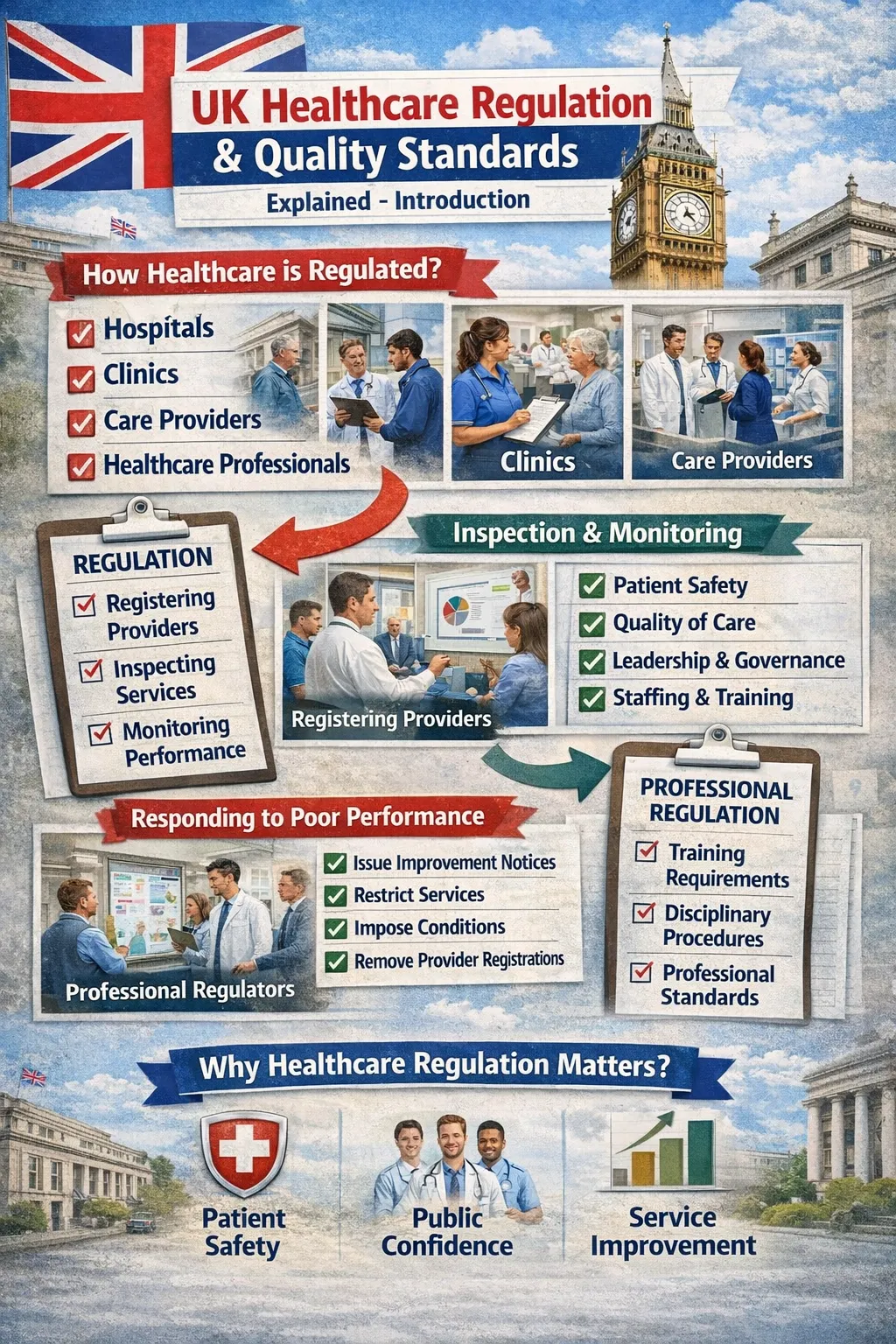
Healthcare regulation ensures that the services provided by the NHS and independent healthcare providers meet the standards of safety, quality and effectiveness that patients have a right to expect. The United Kingdom has a comprehensive system of regulatory bodies, professional standards organisations and inspection regimes that together form the framework for healthcare quality assurance.
This guide explains how healthcare is regulated in the UK, which bodies are responsible, how quality is measured and enforced, and what happens when care falls below acceptable standards.
Who regulates healthcare in England?
The Care Quality Commission (CQC) is the independent regulator of health and social care services in England. The CQC registers, monitors and inspects hospitals, GP practices, dental surgeries, care homes, home care agencies, mental health services and other healthcare providers. Until recently, the CQC rated providers on a four-point scale — Outstanding, Good, Requires Improvement and Inadequate — based on inspections that assessed whether services were safe, effective, caring, responsive and well-led. The CQC is transitioning to a new regulatory framework with a more targeted and data-driven approach to assessment.
The CQC has powers to issue warning notices, impose conditions on registration, restrict the services a provider can offer and, in the most serious cases, cancel a provider’s registration, effectively closing the service. High-profile CQC interventions have included placing failing hospitals into special measures, requiring management changes at care homes and taking enforcement action against GP practices that pose risks to patient safety.
In Scotland, healthcare is regulated by Healthcare Improvement Scotland (HIS). In Wales, Healthcare Inspectorate Wales (HIW) performs a similar role. In Northern Ireland, the Regulation and Quality Improvement Authority (RQIA) inspects and regulates health and social care services. Each body operates independently and has developed its own inspection methodologies and reporting frameworks.
How are healthcare professionals regulated?
Healthcare professionals in the UK are regulated by independent statutory bodies that set standards for education, training, conduct and competence, maintain registers of qualified practitioners and take action against professionals who fall below required standards. The General Medical Council (GMC) regulates doctors, the Nursing and Midwifery Council (NMC) regulates nurses and midwives, the General Dental Council (GDC) regulates dentists and dental care professionals, the General Pharmaceutical Council (GPhC) regulates pharmacists and pharmacy technicians, and the Health and Care Professions Council (HCPC) regulates a range of allied health professionals including physiotherapists, paramedics, radiographers, occupational therapists, dietitians and psychologists.
These regulators can investigate complaints about professionals, hold fitness to practise hearings, issue warnings, impose conditions on practice, suspend professionals from the register or, in the most serious cases, remove them from the register entirely (known as “striking off”), which prevents them from practising in the UK. The regulators also set the standards for professional education and training, approving the courses and programmes that lead to registration.
The government has proposed reforms to professional regulation through the Regulatory Reform Programme, which aims to modernise the legislative framework, give regulators greater flexibility to set their own standards and procedures, and improve the speed and efficiency of fitness to practise processes. Reform has been slow, partly because of the complexity of the legislation involved and the number of different regulatory bodies.
How are medicines and medical devices regulated?
The Medicines and Healthcare products Regulatory Agency (MHRA) is responsible for ensuring that medicines, medical devices and blood products used in the UK meet appropriate standards of safety, quality and efficacy. The MHRA assesses applications for marketing authorisation (licensing) of new medicines, monitors the safety of medicines after they reach the market through pharmacovigilance, regulates clinical trials and oversees the safety and performance of medical devices.
Since Brexit, the UK has operated its own medicines regulatory framework independently of the European Medicines Agency (EMA), though there is significant ongoing alignment in many areas. The MHRA has introduced new streamlined approval pathways, including the Innovative Licensing and Access Pathway (ILAP), designed to accelerate patient access to promising new treatments. The National Institute for Health and Care Excellence (NICE) assesses the clinical and cost-effectiveness of new medicines and treatments, publishing technology appraisals that determine whether the NHS should fund them.
The regulation of medical devices has come under increased scrutiny following safety scandals including the use of faulty breast implants, the Primodos hormone pregnancy test and the use of pelvic mesh implants that caused serious harm to patients. The Cumberlege Review (2020) highlighted systemic failures in the regulation of medical devices and recommended significant reforms, including the creation of a patient safety commissioner for England, a role that has since been established.
How does patient safety governance work?
Patient safety is a fundamental priority across the healthcare system. The Patient Safety Strategy for England, published by NHS England, promotes a culture of learning from mistakes, reporting incidents transparently and implementing systematic improvements. The Learn from Patient Safety Events (LFPSE) service collects reports of patient safety incidents from healthcare providers across England, enabling analysis of trends and the identification of systemic risks.
When serious incidents occur — including unexpected deaths, severe harm or systemic failures — providers are required to conduct thorough investigations and report their findings. The Healthcare Safety Investigation Branch (HSIB), now reconstituted as the Health Services Safety Investigations Body (HSSIB), conducts independent investigations into the most significant patient safety concerns, operating on a “no blame” basis to identify learning rather than to apportion responsibility.
High-profile failures in healthcare quality — including the Mid Staffordshire NHS Foundation Trust scandal (where hundreds of patients suffered from poor care between 2005 and 2009), the Morecambe Bay maternity failures and the Shrewsbury and Telford maternity review — have driven significant reforms in patient safety governance, inspection regimes and the culture of accountability within the NHS. The duty of candour, introduced following the Francis Report into Mid Staffordshire, requires healthcare providers to be open and honest with patients when things go wrong.
How does NHS quality monitoring work?
The Care Quality Commission (CQC) is the independent regulator of health and social care services in England. It inspects hospitals, GP practices, care homes, dental surgeries, mental health services and ambulance services, rating them on a four-point scale from Outstanding to Inadequate. CQC inspections assess whether services are safe, effective, caring, responsive to people’s needs and well-led. Inspection reports are published publicly, allowing patients, families and commissioners to make informed choices about the services they use.
When the CQC identifies serious concerns, it has the power to issue warning notices, impose conditions on registration, suspend registration or cancel a provider’s registration entirely, effectively closing the service. In the most serious cases, the CQC can prosecute providers for offences under the Health and Social Care Act 2008. The CQC also has a special role in monitoring the use of the Mental Health Act, ensuring that patients detained under the Act are treated with dignity and that their rights are respected.
The CQC has undergone significant reform following criticism of its own performance, including a major internal review that identified weaknesses in its inspection methodology, its use of data, and its ability to detect and respond to failing services in a timely manner. A new single assessment framework, introduced from 2023, aims to make regulation more responsive, data-driven and proportionate, moving away from large-scale periodic inspections towards a model of continuous monitoring supplemented by targeted inspections where risk indicators suggest concerns.
How are healthcare complaints handled?
Patients who are unhappy with the care they have received can complain through the NHS complaints procedure, which requires providers to investigate complaints and provide a response within a specified timeframe. If the patient is not satisfied with the response, they can refer their complaint to the Parliamentary and Health Service Ombudsman (PHSO), an independent body that investigates complaints about the NHS and UK government departments.
For complaints about individual healthcare professionals, patients can raise concerns with the relevant professional regulator — the General Medical Council (GMC) for doctors, the Nursing and Midwifery Council (NMC) for nurses and midwives, the General Dental Council (GDC) for dentists, and other regulators for allied health professionals. These regulators have the power to investigate, impose sanctions and, in the most serious cases, remove practitioners from the professional register, preventing them from practising.
Serious incidents and never events (defined types of wholly preventable serious incidents) are subject to mandatory investigation and reporting. The Healthcare Safety Investigation Branch (HSIB), now operating as the Health Services Safety Investigations Body (HSSIB), conducts independent investigations into patient safety incidents of national significance, with a focus on learning and systemic improvement rather than individual blame. The Patient Safety Commissioner, a role created by the Medicines and Medical Devices Act 2021 following the Cumberlege Review, provides an independent voice for patients affected by medicines and medical devices.
How does healthcare regulation differ across the UK?
Healthcare regulation is partly devolved across the United Kingdom. While professional regulation of doctors, nurses and other health professionals is UK-wide (the GMC, NMC and other professional regulators cover the whole of the UK), the regulation of health services is devolved. In Scotland, Healthcare Improvement Scotland (HIS) inspects and regulates NHS services, and the Care Inspectorate oversees care services. In Wales, Healthcare Inspectorate Wales (HIW) fulfils a similar function. In Northern Ireland, the Regulation and Quality Improvement Authority (RQIA) inspects health and social care services.
These different regulatory bodies reflect the distinct structures of the health systems in each nation. Scotland operates an integrated health and social care system through Integration Joint Boards, Wales has integrated health boards that commission and provide hospital and community services, and Northern Ireland operates a fully integrated Health and Social Care system. The regulatory approaches in each nation have evolved to reflect these structural differences, though the core objectives of ensuring safety, quality and accountability are shared.
How is health technology regulated?
The regulation of health technology — including medical devices, digital health applications, AI-powered diagnostic tools and telemedicine platforms — is an increasingly important area of healthcare regulation. The Medicines and Healthcare products Regulatory Agency (MHRA) regulates medical devices and medicines in the UK, ensuring that products are safe, effective and of acceptable quality before they can be marketed.
The rapid growth of digital health technologies has created new regulatory challenges. Software that provides clinical decision support, AI algorithms that analyse medical images, and apps that monitor health conditions may all be classified as medical devices and subject to MHRA regulation. The MHRA has published guidance on the regulation of AI and machine learning-based medical devices, and is developing a proportionate regulatory framework that encourages innovation while ensuring patient safety.
The National Institute for Health and Care Excellence (NICE) plays a crucial role in health technology assessment, evaluating the clinical and cost-effectiveness of new medicines, treatments, medical devices and diagnostic technologies. NICE guidance determines which treatments are routinely available on the NHS, and its technology appraisal process is closely watched by pharmaceutical companies, clinicians and patient groups. NICE’s recommendations are based on rigorous assessment of the available evidence and are intended to ensure that NHS resources are used to achieve the greatest possible health benefit.
How does social care regulation work?
Social care — support for adults with care needs arising from age, disability, illness or mental health conditions — is regulated alongside healthcare but operates under a separate policy and funding framework. The CQC inspects and rates care homes, home care services, supported living and other social care providers, assessing whether they meet fundamental standards of quality and safety. The social care sector employs approximately 1.6 million people in England and faces significant challenges including workforce shortages, low pay, high vacancy rates and the financial sustainability of care providers.
The regulation of social care has been the subject of intense policy debate, particularly around the funding of adult social care. The current system requires individuals to pay for their own care if they have assets above a means-testing threshold, creating a situation described by many as a “lottery” in which people with conditions such as dementia bear the full cost of their care while those with conditions treated by the NHS receive it free. Successive governments have proposed reforms to the social care funding system, including a cap on lifetime care costs, but implementation has been repeatedly delayed.
How are clinical trials and research regulated?
Clinical research — the testing of new medicines, treatments and medical devices in human participants — is regulated by the MHRA and overseen by research ethics committees. The UK Medicines for Human Use (Clinical Trials) Regulations set out the requirements for conducting clinical trials, including the need for regulatory approval, ethics committee review, informed consent from participants and the monitoring of safety throughout the trial.
The Health Research Authority (HRA) protects the interests of research participants and promotes ethical research. It operates the research ethics service, provides regulatory advice and works to streamline the approvals process to make the UK an attractive location for clinical research. The National Institute for Health and Care Research (NIHR) funds and supports clinical research across the NHS, including through a network of Biomedical Research Centres, Clinical Research Facilities and Applied Research Collaborations that bring together researchers, clinicians and patients.
The UK is one of the world’s leading destinations for clinical research, with a strong track record in recruiting participants, conducting high-quality trials and translating research findings into clinical practice. The COVID-19 pandemic demonstrated the UK’s research capabilities, with the RECOVERY trial (the world’s largest clinical trial of treatments for COVID-19) and the rapid development and deployment of vaccines highlighting the strengths of the NHS as a research platform.
Why does healthcare regulation matter?
Healthcare regulation exists to protect patients from harm and to ensure that the care they receive meets acceptable standards of safety and quality. The consequences of regulatory failure can be devastating — as tragedies such as Mid Staffordshire, Morecambe Bay and the infected blood scandal have demonstrated. Effective regulation requires independent, well-resourced regulatory bodies, a culture of transparency and learning within healthcare organisations, meaningful patient involvement in safety and quality processes, and the political will to act on the findings of inspections and investigations.
Related guides
- How the NHS Works in the UK
- Public Health System in the UK Explained
- Mental Health Services and Policy in the UK Explained
- How the UK Government Works
- UK Government Departments and Public Bodies Explained
Related coverage:
Read our latest UK health news
Prepared by: