UK Transport Policy and Funding Explained
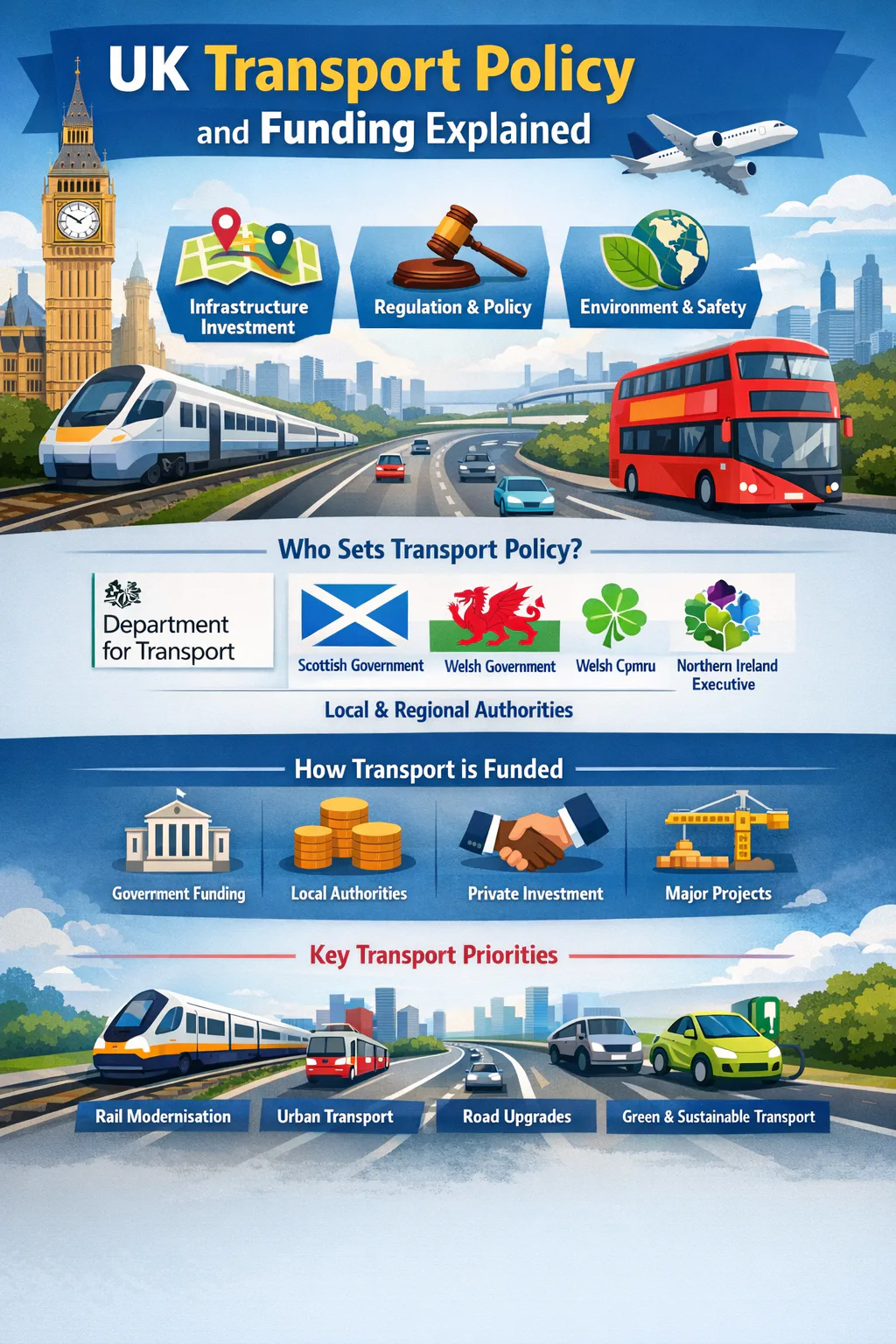
Transport policy determines how the United Kingdom invests in, manages and develops its transport networks — roads, railways, buses, cycling infrastructure, aviation and maritime connections. Decisions about transport funding have a direct impact on economic growth, regional inequality, environmental sustainability and the daily experience of millions of commuters, travellers and businesses. Transport is one of the largest areas of public capital spending and one of the most politically contested areas of government policy.
This guide explains how transport policy is made in the UK, who is responsible for setting priorities, how projects are funded, what the major national programmes are and why transport investment decisions matter.
What is UK transport policy?
Transport policy encompasses the strategic decisions that governments make about the planning, investment, regulation and management of transport systems. In the UK, transport policy covers a wide range of issues including road building and maintenance, rail investment and reform, public transport provision, active travel (cycling and walking), aviation and airports, shipping and ports, vehicle emissions standards, the transition to electric vehicles, road safety and accessibility for disabled people.
Transport policy is shaped by multiple objectives that can sometimes conflict — promoting economic growth through better connectivity, reducing carbon emissions to meet climate targets, improving air quality in urban areas, addressing regional inequality in transport provision, ensuring affordability for passengers and taxpayers, and maintaining safety across all modes. Balancing these objectives is at the heart of transport policy-making.
Who sets transport policy in the UK?
The Department for Transport (DfT) is the main UK government department responsible for transport policy in England and for UK-wide responsibilities including aviation, maritime and some aspects of rail regulation. The DfT is headed by the Secretary of State for Transport and employs around 17,000 staff across the department and its agencies, including National Highways, the DVLA, the DVSA, the Maritime and Coastguard Agency and the Civil Aviation Authority.
Transport is a devolved policy area, meaning that the Scottish Government, Welsh Government and Northern Ireland Executive each have responsibility for transport within their respective nations. Transport Scotland manages rail, trunk roads and ferry services in Scotland. Transport for Wales oversees rail and strategic transport planning in Wales. The Northern Ireland Department for Infrastructure manages roads and public transport through Translink.
At the regional and local level, combined authorities with elected mayors have increasing powers over local transport. The Mayor of London, through Transport for London, has the most extensive transport powers of any regional leader, but other metro mayors — in Greater Manchester, the West Midlands, West Yorkshire, South Yorkshire, Liverpool, the North East and elsewhere — are acquiring growing influence over local buses, cycling, roads and in some cases rail services through devolution deals with the UK government.
How are transport projects funded?
Transport investment is funded through a combination of central government capital spending, hypothecated revenues (such as Vehicle Excise Duty, which is ring-fenced for the National Roads Fund in England), local authority funding, private sector investment and, for some projects, developer contributions through planning obligations.
Major national transport projects — such as HS2, the Transpennine Route Upgrade, the A303 Stonehenge tunnel and the Lower Thames Crossing — are funded directly by the DfT through capital budgets allocated in Spending Reviews. These projects go through an appraisal process set out in the DfT’s Transport Analysis Guidance (TAG) and HM Treasury’s Green Book, which require a business case demonstrating that the project offers value for money by comparing the expected benefits (including journey time savings, economic growth, reduced congestion and environmental improvements) against the costs.
Local transport schemes are typically funded through competitive bidding processes. The City Region Sustainable Transport Settlements (CRSTS) provide multi-year funding to combined authorities for local transport improvements. The Levelling Up Fund and Towns Fund have also included transport as an eligible category. Local councils use their own capital budgets, supplemented by government grants, to maintain local roads, improve junctions, provide bus shelters and invest in cycling and walking infrastructure.
The rail network is funded through a combination of government grants, fare revenue, track access charges and network grants. The total public subsidy for the railways has increased significantly since the pandemic, as passenger numbers and fare revenue have not returned to pre-2020 levels while the costs of running the network remain broadly the same.
What are the major national transport programmes?
The UK has a significant portfolio of transport investment programmes at various stages of planning and delivery. High Speed 2 (HS2) is the largest, with the London to Birmingham phase currently under construction at an estimated cost of over £50 billion. The project is designed to increase rail capacity on the West Coast corridor, reduce journey times between London and the Midlands, and free up space on the existing network for more commuter and freight services.
The Road Investment Strategy (RIS) sets out the government’s plan for investing in the strategic road network in England over a five-year period. RIS includes schemes to add capacity at congested junctions, build new bypasses, improve safety and maintain the existing network. The current RIS period runs alongside National Highways’ strategic plan for the network.
Other major programmes include East West Rail (Oxford to Cambridge), the Transpennine Route Upgrade (Manchester to York), Northern Powerhouse Rail (proposals for improved east-west connectivity across the North, though significantly scaled back from original plans), electrification programmes for key rail routes, and investment in zero-emission bus fleets through the ZEBRA programme. Airport expansion remains a long-running policy issue, with the approved third runway at Heathrow not yet commenced and subject to ongoing legal and political uncertainty.
How does transport policy address climate change?
Transport is the UK’s largest emitting sector, responsible for approximately 26 per cent of domestic greenhouse gas emissions. Decarbonising transport is therefore central to meeting the UK’s legally binding net zero target. The government’s Transport Decarbonisation Plan, published in 2021, set out a comprehensive strategy covering all transport modes.
Key elements of the strategy include ending the sale of new petrol and diesel cars by 2035, investing in public charging infrastructure for electric vehicles, transitioning bus and rail fleets to zero-emission technology, promoting modal shift from cars to public transport, cycling and walking, investing in rail electrification, developing sustainable aviation fuels and supporting the decarbonisation of maritime shipping. The government has also introduced a zero-emission vehicle mandate, requiring manufacturers to sell an increasing proportion of zero-emission vehicles each year.
Many cities have introduced or are planning Clean Air Zones (CAZs) or Ultra Low Emission Zones (ULEZs) that charge the most polluting vehicles for entering designated areas. London’s ULEZ, which was expanded to cover the whole of Greater London in 2023, has been the most prominent example, though Bath, Birmingham, Bristol and other cities have also introduced or planned similar schemes. These zones have been effective at reducing air pollution but have been controversial, particularly among drivers of older vehicles who face charges or the cost of upgrading.
How does transport policy address regional inequality?
Transport investment has been a central theme of the debate about regional inequality in the UK. Analysis by the Institute for Public Policy Research (IPPR) and others has consistently shown that per capita transport spending in London and the South East significantly exceeds that in other regions of England, particularly the North and the Midlands. This disparity is partly explained by the scale and complexity of London’s transport network, but it has fuelled criticism that successive governments have underinvested in transport infrastructure outside the capital.
The levelling up agenda has placed transport investment at the heart of efforts to reduce regional disparities. The government has committed to improving east-west connectivity in the North, investing in local transport in underserved areas and ensuring that transport decisions better reflect the needs of communities outside London. However, the cancellation of the northern sections of HS2 and the scaling back of Northern Powerhouse Rail have raised questions about the government’s commitment to delivering on these promises.
How are aviation and maritime transport regulated?
Aviation policy is a reserved matter, meaning it is managed by the UK government rather than the devolved administrations. The Civil Aviation Authority (CAA) is the independent regulator responsible for aviation safety, airspace regulation, consumer protection and the economic regulation of airports with significant market power (principally Heathrow). The DfT sets the overall policy framework for aviation, including decisions on airport capacity, noise mitigation, slot allocation and international aviation agreements.
The UK has some of the busiest airports in Europe, with Heathrow being the largest, followed by Gatwick, Manchester, Stansted and Luton. Aviation policy has been dominated for decades by the question of whether to expand runway capacity in the South East. The government approved a third runway at Heathrow in 2018, but the project has faced legal challenges, pandemic-related delays and ongoing uncertainty about its environmental compatibility with the UK’s net zero targets.
Maritime policy is overseen by the Maritime and Coastguard Agency (MCA), which regulates ship safety, seafarer certification and maritime pollution prevention. The UK’s ports handle over 95 per cent of the country’s international trade by volume, making them critical to the economy. Major ports include Felixstowe (the UK’s largest container port), Southampton, London Gateway, Liverpool and Immingham. Port operations in the UK are largely privately owned and commercially operated, with the government’s role focused on regulation, safety and strategic planning.
How is transport appraisal and evaluation conducted?
Before the government commits public money to a transport project, it must go through a rigorous appraisal process. The DfT’s Transport Analysis Guidance (TAG) sets out the methodology for assessing the costs and benefits of proposed transport schemes. This includes estimating journey time savings, economic impacts, safety benefits, environmental effects and distributional impacts (how the scheme affects different groups in society).
Projects must also demonstrate a strategic case (why the project is needed), a commercial case (how it will be delivered), a financial case (how it will be funded), a management case (governance and delivery arrangements) and an economic case (whether the benefits justify the costs), following the HM Treasury Five Case Model used across government for public investment decisions.
The use of benefit-cost ratios (BCRs) in transport appraisal has been criticised for systematically favouring projects in areas that already have high economic productivity and high land values — typically London and the South East — over projects in less prosperous regions where the economic benefits per pound invested may appear lower. The government has acknowledged this concern and has made changes to the appraisal framework to give greater weight to strategic and distributional factors, but the debate about whether the system adequately captures the transformative potential of transport investment in underserved areas remains active.
What are the future priorities for UK transport policy?
UK transport policy faces a number of major challenges and decisions in the coming years. The creation of Great British Railways will represent the most significant reform of the rail industry since privatisation, and its success or failure will have far-reaching implications for passengers, freight users and taxpayers. The transition to electric vehicles will require massive investment in charging infrastructure, grid capacity and supply chains, while also creating a significant revenue gap from declining fuel duty receipts.
The decarbonisation of transport as a whole will require sustained investment in zero-emission technology, modal shift to public transport and active travel, and potentially controversial measures such as road pricing and restrictions on car use in urban areas. Emerging technologies including autonomous vehicles, electric aviation, hydrogen fuel and mobility-as-a-service platforms have the potential to transform how people and goods move, though the timeline and scale of their impact remains uncertain.
Perhaps most fundamentally, the persistent gap in transport investment between London and the rest of the country remains one of the defining challenges of UK transport policy. Addressing this gap — and ensuring that transport investment genuinely supports economic opportunity in all parts of the country — will be essential to achieving the government’s broader ambitions for growth, sustainability and social equity.
Why does transport policy matter?
Transport investment decisions shape the economic geography of the country for decades. A new rail line, motorway junction or bus network can transform the prospects of a community, while the absence of investment can entrench isolation and disadvantage. Transport policy affects how easily people can reach work, education and healthcare, how efficiently goods are moved across the country, how much carbon the UK emits and how liveable its cities and towns are. Understanding how these decisions are made — and who benefits from them — is essential for informed engagement with one of the most important areas of public spending.
Related guides
These guides explain related topics in more detail:
- How the UK Public Transport System Works
- UK Rail System Explained
- UK Road Transport and Driving Laws Explained
- UK Climate Change Policy Explained
- UK Public Finances and Government Spending Explained
Related coverage:
Read our latest UK transport news
Prepared by: