Biodiversity and Nature Protection in the UK Explained
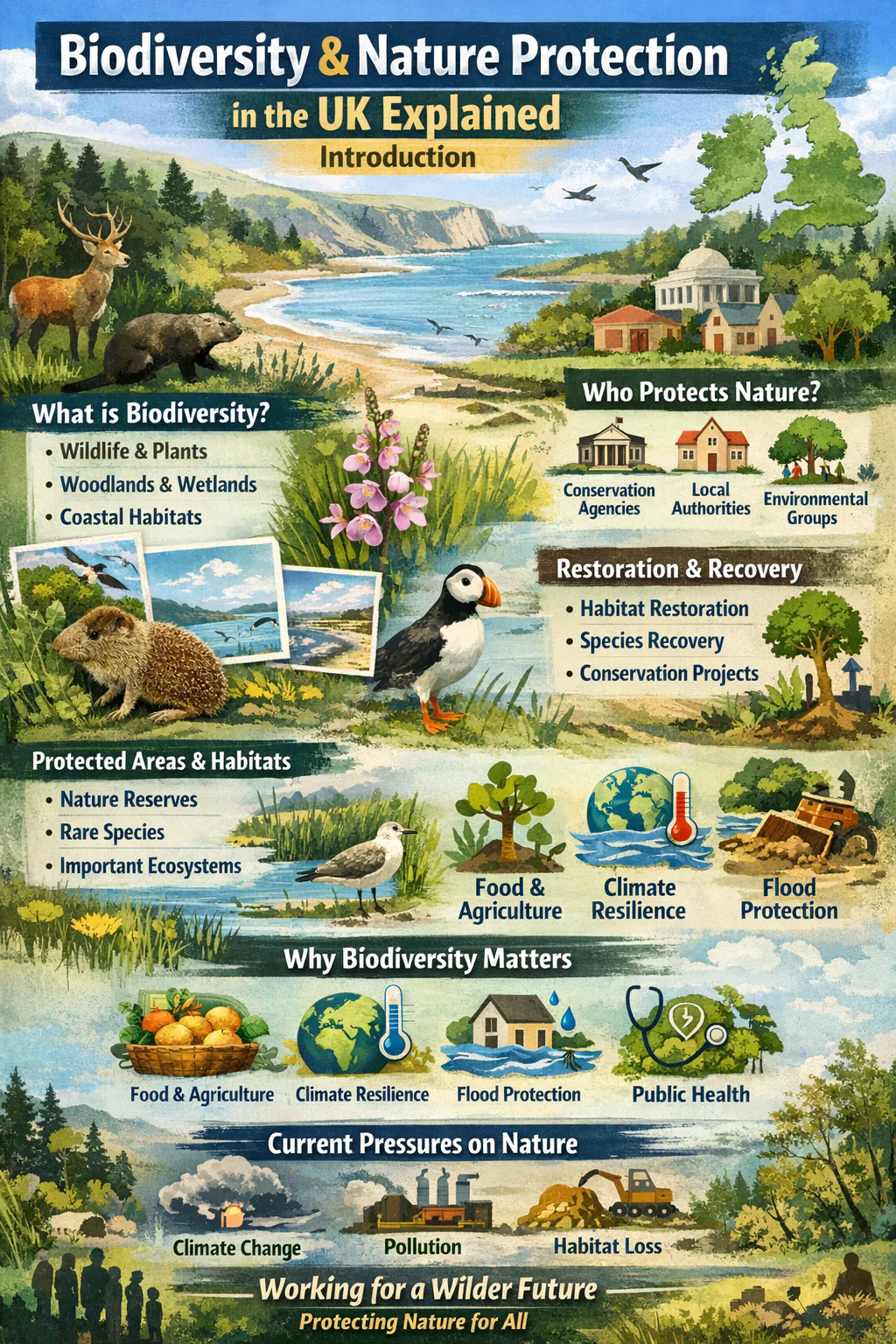
The United Kingdom is home to a rich diversity of wildlife, habitats and ecosystems, from ancient woodlands and chalk grasslands to coastal wetlands, peatlands, heathlands and marine environments. However, decades of habitat loss, agricultural intensification, pollution, urbanisation and climate change have taken a severe toll on UK biodiversity. The UK is one of the most nature-depleted countries in the world, with significant declines in the abundance and diversity of many species groups. Reversing this decline has become one of the most urgent environmental priorities for government, conservation organisations and communities across the country.
This guide explains the state of biodiversity in the UK, how nature is legally protected, what policies are in place to drive recovery, how the planning system interacts with nature conservation and why protecting biodiversity matters.
What is the state of biodiversity in the UK?
The State of Nature report, produced periodically by a coalition of conservation organisations, provides the most comprehensive assessment of UK wildlife. The most recent report found that the abundance of UK species has declined by an average of approximately 19 per cent since monitoring began in the 1970s, with one in six species at risk of extinction from Great Britain. Particularly severe declines have been recorded among insects (including pollinators such as bees and butterflies), farmland birds, freshwater species and certain plant groups.
The causes of biodiversity loss are well understood. Agricultural intensification — including the loss of hedgerows, wildflower meadows and mixed farming landscapes, the heavy use of pesticides and fertilisers, and land drainage — is the single largest driver. Urbanisation and development have destroyed and fragmented habitats. Pollution — including nitrogen deposition from agriculture and transport, water pollution from sewage and agricultural runoff, and plastic waste — affects terrestrial, freshwater and marine ecosystems. Climate change is altering the distribution and timing of species, disrupting ecological relationships and increasing the risk of extreme weather events.
The UK’s marine environment has also suffered significant impacts. Overfishing, bottom trawling, pollution, coastal development and climate-driven changes in sea temperature and chemistry have affected marine habitats and species. However, some marine recovery has been observed in areas where effective management measures have been implemented, including in Marine Protected Areas and around offshore wind farm sites where fishing restrictions have allowed seabed habitats to recover.
How is wildlife legally protected in the UK?
The UK has a comprehensive framework of wildlife and habitat protection law. The Wildlife and Countryside Act 1981 is the principal legislation, providing legal protection for scheduled species (including all wild birds, certain mammals, reptiles, amphibians, fish, invertebrates and plants) and establishing the framework for designating Sites of Special Scientific Interest (SSSIs) — areas of particular importance for their wildlife, geological features or both. There are over 4,100 SSSIs in England alone, covering approximately 8 per cent of the country’s land area.
The Conservation of Habitats and Species Regulations 2017 (the Habitats Regulations) provide additional protection for European protected species — including bats, great crested newts, otters, dormice and certain plants — and for Special Areas of Conservation (SACs) and Special Protection Areas (SPAs), which together form the UK’s National Site Network. These sites were originally designated under the EU Habitats and Birds Directives and continue to be protected under UK law following Brexit.
The Environment Act 2021 introduced several important new provisions for nature recovery, including legally binding targets for halting the decline in species abundance by 2030, a requirement for Local Nature Recovery Strategies (LNRS) to map priorities for habitat creation and restoration at the local level, the mandatory requirement for Biodiversity Net Gain (BNG) in the planning system, and the establishment of new reporting duties on the government’s progress towards meeting its environmental targets.
What is the government’s approach to nature recovery?
The government’s Environmental Improvement Plan (EIP), published in 2023, sets out the policies and actions intended to deliver the legally binding environmental targets established under the Environment Act 2021. For biodiversity, the key targets include halting the decline in species abundance by 2030, increasing species abundance by at least 10 per cent by 2042, restoring or creating 500,000 hectares of wildlife-rich habitat outside protected sites by 2042, and ensuring that 70 per cent of designated sites are in favourable condition by the same date.
The government’s principal tool for delivering nature recovery on farmland is the Environmental Land Management (ELM) scheme, which is replacing the EU Common Agricultural Policy’s Basic Payment Scheme. ELM pays farmers and land managers for delivering environmental goods including biodiversity enhancement, habitat creation, tree planting, hedgerow management, water quality improvement and carbon sequestration. The scheme operates at three levels: the Sustainable Farming Incentive (SFI) for broad, accessible environmental actions, Countryside Stewardship for more targeted habitat management, and Landscape Recovery for large-scale, long-term projects such as rewilding, peatland restoration and species reintroduction.
Protected areas remain the cornerstone of the UK’s nature conservation strategy. The national network of SSSIs, National Nature Reserves, Areas of Outstanding Natural Beauty (AONBs, now being renamed National Landscapes), National Parks and Marine Protected Areas provides a framework for protecting the most important sites. However, the condition of many protected sites is poor — Natural England’s assessments show that a significant proportion of SSSIs are in unfavourable condition, affected by factors including agricultural diffuse pollution, inappropriate management, invasive species and under-grazing or over-grazing.
How does Biodiversity Net Gain work?
Biodiversity Net Gain (BNG) is a requirement introduced by the Environment Act 2021 that requires most new developments in England to deliver a minimum 10 per cent increase in biodiversity value compared to the pre-development condition of the site. BNG is measured using the statutory biodiversity metric, a tool that calculates the biodiversity value of a site based on the type, condition and extent of habitats present.
Developers can deliver BNG through on-site habitat creation (incorporating green spaces, wildflower areas, ponds, hedgerows and native planting into the development), off-site habitat enhancement (funding habitat improvements on land elsewhere), or by purchasing statutory biodiversity credits from the government as a last resort. BNG habitats must be maintained for at least 30 years. The policy is intended to ensure that the planning system contributes positively to nature recovery rather than simply minimising the ecological damage caused by development.
What is rewilding and how is it being implemented?
Rewilding is an approach to nature recovery that involves restoring natural processes and allowing ecosystems to function with minimal human intervention. It can involve removing artificial drainage, reintroducing native species, reducing or eliminating livestock grazing, allowing natural regeneration of woodland and restoring rivers to their natural channels. Rewilding has gained significant public and media attention in the UK, inspired by high-profile projects and publications.
The Knepp Estate in West Sussex is one of the most well-known rewilding projects, where former arable farmland has been allowed to revert to a mosaic of habitats supporting species including turtle doves, nightingales, purple emperor butterflies and rare plants. In Scotland, projects such as Trees for Life in the Caledonian Forest and the Cairngorms Connect partnership are working to restore native woodland and montane habitats at landscape scale. The government’s Landscape Recovery scheme within ELM provides funding for ambitious, long-term nature recovery projects, and several rewilding projects have received support through this mechanism.
Species reintroduction is a controversial but growing aspect of rewilding. Beavers have been officially reintroduced in England and Scotland, where they create wetland habitats, improve water quality and reduce downstream flood risk. Proposals to reintroduce other species — including the white-tailed eagle (now breeding again in England for the first time in over 200 years), the pine marten and, most controversially, the Eurasian lynx — generate debate about the balance between ecological ambition, farming interests and public acceptance.
How is marine biodiversity protected?
The UK’s marine environment covers an area of ocean several times larger than its land mass, supporting a rich diversity of habitats including coral reefs, seagrass meadows, kelp forests, deep-sea sediments, sandbanks and rocky reefs. The Marine and Coastal Access Act 2009 established the framework for Marine Protected Areas (MPAs) in English and Welsh waters, and the UK now has a network of over 370 MPAs covering approximately 38 per cent of UK waters.
However, the effectiveness of MPAs has been questioned by conservation organisations, which point out that many sites lack adequate management measures and that damaging activities such as bottom trawling continue within their boundaries. The government has committed to implementing Highly Protected Marine Areas (HPMAs) — zones where all extractive and destructive activities are prohibited — in a small number of pilot sites, representing the highest level of marine protection.
The management of fisheries is an important aspect of marine biodiversity policy. Following Brexit, the UK gained full control over its Exclusive Economic Zone and now sets its own fishing quotas, informed by scientific advice from the International Council for the Exploration of the Sea (ICES) and the Centre for Environment, Fisheries and Aquaculture Science (Cefas). The Fisheries Act 2020 establishes sustainability as a core objective of UK fisheries management, though balancing ecological sustainability with the economic viability of fishing communities remains a persistent challenge.
What threat do invasive species pose?
Invasive non-native species are one of the most significant threats to UK biodiversity. Species such as grey squirrels (which have displaced the native red squirrel across most of England and Wales), Japanese knotweed (which damages buildings and infrastructure and suppresses native vegetation), Himalayan balsam, signal crayfish (which have devastated native white-clawed crayfish populations), rhododendron and muntjac deer cause billions of pounds of economic damage and ecological harm each year.
The Non-Native Species Secretariat coordinates the UK’s response to invasive species threats. The Wildlife and Countryside Act 1981 makes it an offence to release or allow the escape of certain non-native species into the wild, and the Infrastructure Act 2015 introduced species control orders that allow government agencies to require landowners to take action against invasive species on their property. Biosecurity measures at ports, airports and borders aim to prevent the introduction of new invasive species, though the volume of international trade and travel makes complete prevention impossible.
What role do conservation organisations play?
The UK has a strong tradition of nature conservation led by voluntary and charitable organisations. The Royal Society for the Protection of Birds (RSPB) manages over 200 nature reserves and campaigns on policy issues affecting birds and wildlife. The Wildlife Trusts, a federation of 46 local trusts across the UK, manage thousands of nature reserves and lead community engagement in nature conservation. The National Trust, the Woodland Trust, Buglife, Plantlife, the Marine Conservation Society and many other organisations play vital roles in habitat management, species recovery, education and policy advocacy.
Conservation organisations work alongside government bodies including Natural England, NatureScot, Natural Resources Wales and the Northern Ireland Environment Agency to deliver nature recovery at scale. Partnerships between government, NGOs, landowners, farmers and local communities are essential to addressing the interconnected challenges of biodiversity loss, climate change, water management and sustainable land use.
Why does biodiversity protection matter?
Biodiversity underpins the natural systems on which human life depends. Healthy ecosystems provide essential services including clean air, clean water, pollination of crops, natural flood management, carbon storage in soils and vegetation, nutrient cycling and the regulation of pests and diseases. The economic value of these ecosystem services is enormous — the UK National Ecosystem Assessment estimated their contribution at billions of pounds per year. Beyond economics, biodiversity has intrinsic value and contributes to human wellbeing, cultural identity, recreation and mental health.
The decline of UK biodiversity is not just an environmental issue — it is an economic and social issue with consequences for food security, public health, climate resilience and the quality of life of current and future generations. Reversing this decline requires sustained investment, ambitious policy, effective regulation and widespread public engagement with the natural world.
Related guides
These guides explain related topics in more detail:
- UK Climate Change Policy Explained
- Environmental Regulation and Law in the UK Explained
- UK Energy Transition and Renewable Energy Explained
- How UK Government Policy Is Made
- How the UK Economy Works
Related coverage:
Read our latest UK environment and nature news
Prepared by: