
UK Energy Transition and Renewable Energy Explained
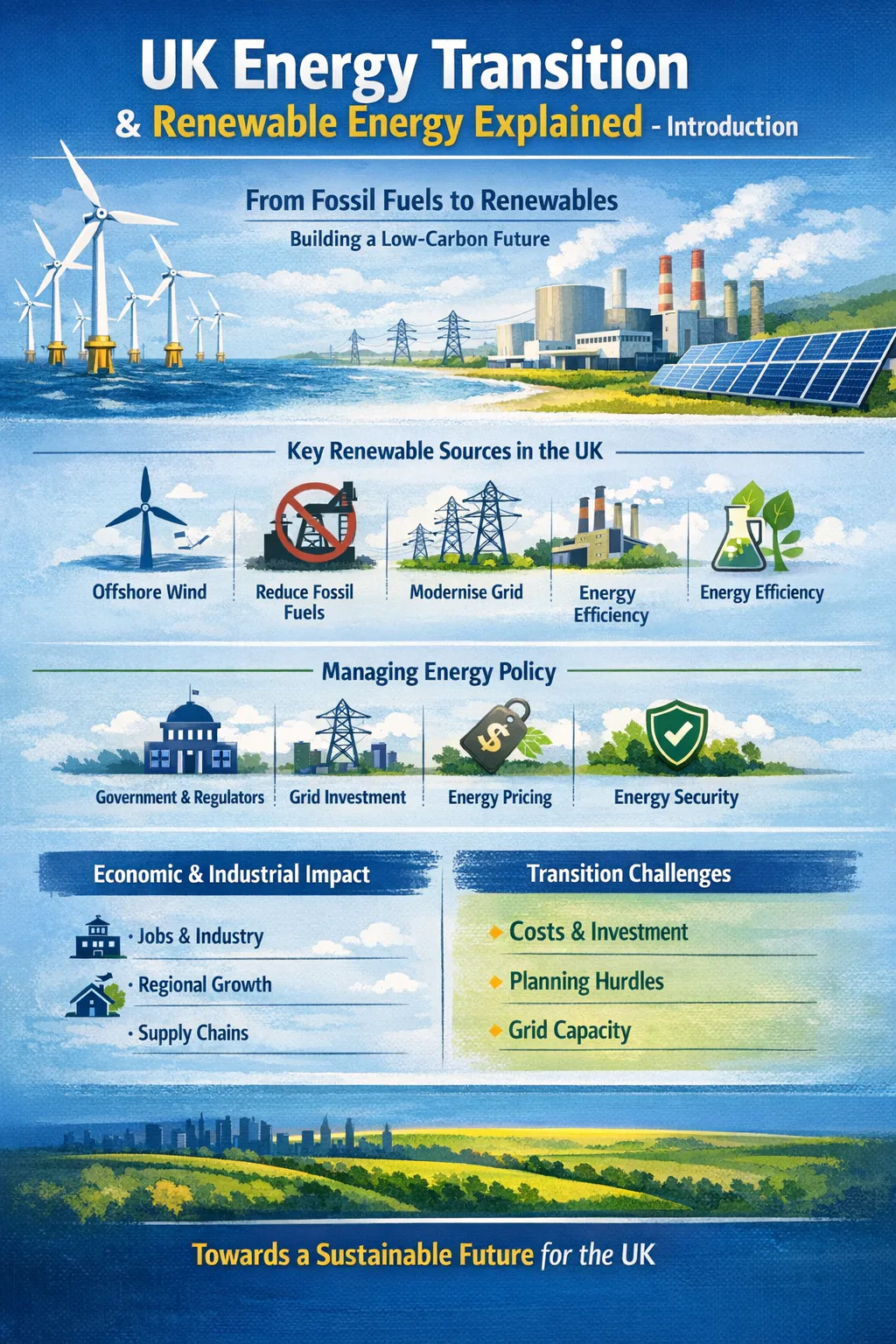
The United Kingdom is undergoing a fundamental transformation of its energy system. The shift from fossil fuels to renewable and low-carbon energy sources — driven by climate change commitments, energy security concerns and falling technology costs — is reshaping how electricity is generated, how homes and businesses are heated and how the UK positions itself in the global energy market. The government has committed to fully decarbonising the electricity grid by 2030, one of the most ambitious clean power targets in the world.
This guide explains how the UK energy system works, how renewable energy has grown, what the main low-carbon technologies are, how energy policy is set and funded and what challenges remain in the transition to a net zero energy system.
How is the UK energy system structured?
The UK energy system encompasses the generation, transmission, distribution and supply of electricity and gas to homes, businesses and industry. Electricity is generated by a diverse mix of sources including wind, solar, nuclear, gas and biomass, transmitted across the country through the National Grid’s high-voltage transmission network and distributed to consumers through regional distribution networks operated by Distribution Network Operators (DNOs).
The gas system operates in parallel, with natural gas imported through pipelines from the North Sea, Norway and continental Europe, and as liquefied natural gas (LNG) from global suppliers. Gas is distributed through a national transmission system and local distribution networks to homes and businesses, where it is used primarily for heating and cooking. Approximately 85 per cent of UK homes are connected to the gas grid and use gas boilers for central heating.
The energy market is liberalised, meaning that multiple competing companies generate, supply and trade electricity and gas. The market is regulated by Ofgem (the Office of Gas and Electricity Markets), which sets the price cap for domestic energy tariffs, regulates network companies, oversees market conduct and administers schemes that support renewable energy and energy efficiency. Energy policy is set by the Department for Energy Security and Net Zero, a government department created in 2023 to bring together energy, climate and net zero responsibilities.
How has renewable energy grown in the UK?
The growth of renewable energy in the UK over the past two decades has been remarkable. In 2000, renewables accounted for less than 3 per cent of UK electricity generation. By 2023, they provided over 40 per cent, with wind power alone generating more electricity than gas on some days. The UK is the world leader in offshore wind, with installed capacity exceeding 14 GW and a pipeline of projects that will take this significantly higher.
Offshore wind has been the flagship technology of the UK’s renewable energy strategy. Major wind farms including Hornsea (off the Yorkshire coast), Dogger Bank (the world’s largest when complete), East Anglia and Moray East represent billions of pounds of investment and thousands of jobs. The Contracts for Difference (CfD) scheme has been instrumental in driving down costs — the price of offshore wind electricity fell by around 70 per cent between the first CfD allocation in 2015 and the mid-2020s, making it one of the cheapest forms of new electricity generation.
Onshore wind and solar power have also grown substantially, though onshore wind deployment in England was effectively paused between 2015 and 2024 by restrictive planning policies that have since been partially relaxed. Solar capacity has increased to over 15 GW, with growth driven by both large-scale solar farms and rooftop installations on homes and commercial buildings. Biomass power — principally the Drax power station in Yorkshire, which has converted from coal to wood pellet fuel — also makes a significant contribution, though the sustainability credentials of large-scale biomass have been questioned by environmental groups.
What role does nuclear power play?
Nuclear power currently provides approximately 13-15 per cent of UK electricity, generated by a fleet of ageing reactors that are progressively being decommissioned. The government regards nuclear as an essential component of a reliable, low-carbon electricity system, providing baseload power that complements the variable output of wind and solar. Hinkley Point C in Somerset, currently under construction by EDF Energy, will be the UK’s first new nuclear power station in a generation and is expected to begin generating in the late 2020s, providing enough electricity for approximately six million homes.
The government has also committed to supporting the development of Small Modular Reactors (SMRs), which are smaller, factory-built nuclear units that can be deployed more quickly and cheaply than conventional large reactors. Great British Nuclear, a new public body, is managing the process of selecting SMR technology for deployment in the UK. The long-term ambition is for up to 24 GW of nuclear capacity by 2050, representing around a quarter of projected electricity demand.
How is the UK decarbonising heat?
Heating buildings accounts for approximately 17 per cent of UK greenhouse gas emissions, making it one of the most challenging sectors to decarbonise. The dominant technology for low-carbon heat is the air source heat pump, which extracts heat from the outside air and uses it to warm buildings, operating at two to three times the efficiency of a gas boiler. Ground source heat pumps, which extract heat from the ground, are also used but are more expensive to install.
The government’s target of installing 600,000 heat pumps per year by 2028 represents a massive scaling up from current levels of approximately 55,000-60,000 per year. The Boiler Upgrade Scheme provides grants of £7,500 towards the cost of heat pump installation, and the Future Homes Standard (effective from 2025) requires new-build homes to be fitted with low-carbon heating from the outset. However, the cost of retrofitting existing homes — including the need for improved insulation, larger radiators and upgraded electrical connections — remains a significant barrier, particularly for older properties and lower-income households.
Hydrogen is being explored as a potential alternative for heating, particularly for homes on the existing gas grid. The government funded hydrogen heating trials, including the H21 project in the North East, to test the feasibility of blending hydrogen into the gas network or converting it entirely. However, in late 2023 the government paused plans for a hydrogen village trial and has increasingly signalled that electrification through heat pumps will be the primary pathway for decarbonising domestic heating, with hydrogen potentially playing a more limited role in industrial applications and heavy transport.
How is energy storage and grid infrastructure being developed?
The rapid growth of variable renewable generation — wind and solar that depend on weather conditions — requires complementary investment in energy storage, grid flexibility and network infrastructure. Battery storage has grown rapidly, with over 4 GW of grid-scale battery capacity installed by 2024, providing services such as frequency response, peak shaving and energy arbitrage. Pumped hydro storage — the oldest form of large-scale energy storage — continues to operate at sites such as Dinorwig in Wales, and new projects are under development in Scotland.
The electricity grid itself needs massive investment to accommodate the energy transition. New transmission infrastructure is needed to connect offshore wind farms to the onshore grid, to reinforce connections between regions and to enable the electrification of heating and transport. The National Grid’s Electricity System Operator (now transitioning to the National Energy System Operator, NESO) manages the real-time balancing of supply and demand across the system. The Strategic Spatial Energy Plan, currently in development, will set out the long-term vision for the location and design of energy infrastructure across Great Britain.
What is happening to North Sea oil and gas?
The UK has been a significant producer of oil and gas from the North Sea since the 1970s, and the sector continues to employ tens of thousands of people, predominantly in Scotland and North East England. However, production has been declining for over two decades as mature fields are depleted, and the sector faces an increasingly uncertain future as climate policy drives the transition away from fossil fuels.
The government’s approach to North Sea oil and gas involves a managed transition rather than an abrupt shutdown. Existing fields continue to produce under licences granted by the North Sea Transition Authority (NSTA, formerly the Oil and Gas Authority), which regulates the sector and is responsible for maximising the economic recovery of UK petroleum resources while supporting the energy transition. The government has introduced the Energy Profits Levy (a windfall tax on oil and gas company profits) to capture excess profits during periods of high energy prices, with the revenue used to fund cost-of-living support and investment in clean energy.
The question of whether to issue new oil and gas exploration licences has been one of the most politically contentious aspects of UK energy policy. The current government has announced that no new exploration licences will be granted, arguing that existing licences provide sufficient production to manage the transition. Critics of this approach, including the industry and some unions, argue that continued domestic production is preferable to increased imports, which carry their own carbon footprint and supply security risks. The transition of the North Sea workforce — with its significant engineering, technical and offshore skills — to careers in renewable energy, carbon capture and hydrogen is a major economic and social priority.
How does energy policy support consumers?
Energy affordability is a critical concern for UK households and businesses. Ofgem sets the energy price cap, which limits the per-unit cost of gas and electricity for consumers on default tariffs, and is updated quarterly to reflect wholesale energy costs. The price cap does not cap total bills — it sets the maximum rate that suppliers can charge per unit of energy, meaning that total costs depend on how much energy a household uses.
The government provides targeted support for vulnerable and low-income households through schemes including the Warm Home Discount (a £150 annual rebate on electricity bills for eligible households), the Winter Fuel Payment (a payment to help older people with heating costs) and the Cold Weather Payment (triggered when temperatures fall below zero for seven consecutive days). The Energy Company Obligation (ECO) requires energy suppliers to fund energy efficiency improvements in the homes of low-income and vulnerable customers, including insulation, heating system upgrades and draught-proofing.
Energy efficiency is widely recognised as one of the most cost-effective ways to reduce both emissions and energy bills. The Energy Performance Certificate (EPC) system rates the energy efficiency of buildings on a scale from A (most efficient) to G (least efficient). The government has set targets for improving the energy efficiency of homes and has proposed that all rented properties must achieve a minimum EPC rating of C by 2030, though the implementation timeline and funding support for landlords remain subjects of policy debate.
What are the challenges facing the UK energy transition?
The energy transition faces significant challenges including the cost and pace of infrastructure investment (the CCC estimates that tens of billions of pounds of additional annual investment are needed), the political sensitivity of energy bills and the impact of energy costs on households and businesses, the need to maintain energy security during the transition (ensuring that the lights stay on as fossil fuel capacity is retired), planning and permitting delays for new energy projects, supply chain constraints for technologies such as heat pumps and batteries, and the need to manage the social and economic impact of the transition on communities that currently depend on fossil fuel industries.
Energy affordability is a particularly acute concern. The energy price crisis of 2022-23, triggered by Russia’s invasion of Ukraine and the resulting spike in global gas prices, demonstrated the UK’s vulnerability to fossil fuel price volatility and led to unprecedented government intervention through the Energy Price Guarantee and Energy Bills Support Scheme, costing tens of billions of pounds. The transition to domestically generated renewable energy is expected to reduce this vulnerability over time, but the upfront investment costs and the impact on energy bills during the transition period remain a major policy challenge.
Why does the energy transition matter?
The energy transition is central to the UK’s ability to meet its climate targets, strengthen energy security, create jobs and economic growth in clean energy industries and reduce the country’s dependence on volatile international fossil fuel markets. The decisions made in the next decade about energy investment, infrastructure and policy will shape the UK’s energy system — and its carbon emissions — for generations to come. Understanding how the energy transition works is essential for citizens, businesses and policymakers navigating one of the most significant economic and industrial transformations in the country’s history.
Related guides
These guides explain related topics in more detail:
- UK Climate Change Policy Explained
- Environmental Regulation and Law in the UK Explained
- Biodiversity and Nature Protection in the UK Explained
- How the UK Economy Works
- UK Public Finances and Government Spending Explained
Related coverage:
Read our latest UK energy and environment news
Prepared by:
