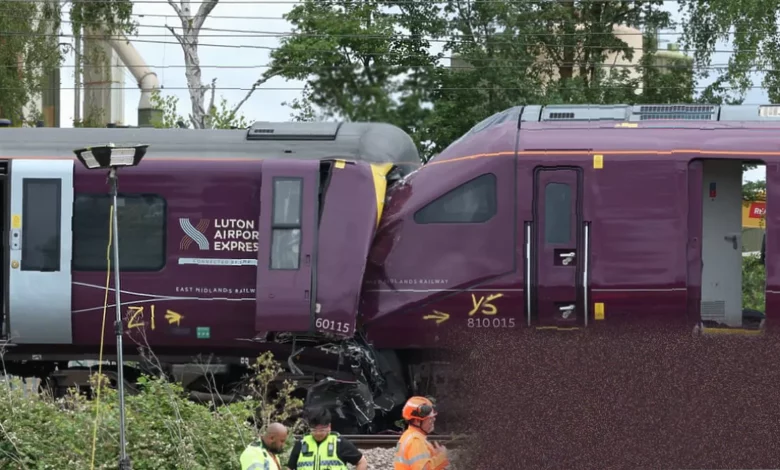
A train whose driver was killed in last week’s collision near Bedford passed a red danger signal without stopping, according to preliminary findings from the Rail Accident Investigation Branch (RAIB). The southbound Luton Airport Express from Corby – a four-car Class 360 electric multiple unit operating as service 1H46 – had left Bedford station and crossed onto the Up Fast line before it approached and went past the red signal, designated WH154, roughly two and a half miles south of the station.
CCTV footage shows that the driver, 60-year-old Shaun Burton, first passed two yellow caution lights after leaving the platform – signals that require a driver to be prepared to stop at a red ahead. The train then proceeded through the red aspect. Data recovered from the on-train data recorder (OTDR) indicates that the brakes were applied nine seconds before the collision, slowing the train from 76 mph to 49 mph at the moment of impact.
The stationary train that was hit was the 15:50 service from Nottingham to London St Pancras – a five-car Class 810 “Aurora” bi-mode multiple unit built by Hitachi Rail, operated by East Midlands Railway (EMR), and brought into service within the past six months. Investigators believe that train, service 1B67, had halted unexpectedly because a fault developed in its Automatic Warning System (AWS) equipment, which caused the brakes to apply automatically.
The collision, which occurred at 5.15pm on Friday 19 June, left a total of 162 people injured. Of those, 102 required hospital treatment; at the time of the latest update from the RAIB, 53 remained in hospital, with eight in critical condition. The driver of the Corby service, Shaun Burton, was killed. EMR described him as a “dedicated railway professional” who had “touched the lives of colleagues and passengers alike”.
Railway system data has confirmed that the track circuit occupied by the stationary train was correctly registered, meaning the signal behind it should automatically have displayed a red aspect. The RAIB is still analysing the data recorder from the front vehicle of the Corby train to determine whether the AWS alerted Burton to the red signal. Unless a driver acknowledges an AWS alert, the system is designed to trigger the train’s emergency brake.
Absence of a key safety system
A central focus of the investigation is the fact that another protection layer – the Train Protection and Warning System (TPWS) – was not installed on this stretch of the Midland Main Line. The TPWS is widely used across the UK rail network and is designed to automatically stop a train if it passes a red signal, even if the driver does not respond. It works in conjunction with the AWS but provides a second, independent mechanism that can override the train’s controls. According to the RAIB’s initial report, the section of line between Bedford and Elstow lacks this system.
Dave Calfe, the general secretary of the train drivers’ union Aslef, said: “What will concern passengers, and what concerns us, is that there are safety systems that can be put in place to prevent such accidents happening and the network should have been able to cope.” He added: “If TPWS had been installed, this accident would not have happened, the driver would not have died, and no passengers would have been injured.”
The transport secretary, Heidi Alexander, told Parliament that the government would “leave no stone unturned to understand what happened”. She said the RAIB would publish its full report in due course and that she would consider the findings “with the utmost care and take any action necessary”. Alexander also thanked NHS staff and emergency responders for their “brave and professional” response.
Will Rogers, the managing director of EMR, said: “Our thoughts and heartfelt condolences remain with those affected. Given the complexity of the issues being examined, it is important that the independent investigation is allowed to reach its conclusions.” Ellie Burrows, the managing director of Network Rail’s eastern region, described incidents of this kind as “extremely rare on Britain’s railways which remain among the safest in the world”, but pledged to “carefully consider any findings” and “act quickly on any lessons and share learning across the industry”.
Disruption on the line is expected to continue through the week as engineers work to access the crash site, remove the damaged trains and complete repairs to the track. The Class 810 Aurora fleet, which entered commercial service in December 2025 after earlier delays, is a bi-mode design capable of running on both electric overhead lines – the Midland Main Line electrification currently stops south of Leicester – and diesel power. The crash is the fourth involving passenger trains on the UK railway since 2020, after more than a decade without a similar serious incident.
The RAIB said it would continue to analyse the sequence of events, the performance of the signalling system, the actions of those involved, and the status and performance of the braking, AWS and other safety systems on the Corby train, as well as the reason why the first train had stopped.