Classical music audiences today are taught to suppress every physical impulse — to sit still, to stay silent, to leave their breathing, pulsing bodies at the concert hall door. Yet in Johann Sebastian Bach’s own time, listeners described music as something that could contract their innards, make their hearts leap, taste like vinegar in the throat, melt earwax, or even draw the soul out of the body. That stark contrast, between modern restraint and historical abandon, is at the heart of a research project by Professor Bettina Varwig of the University of Cambridge, who argues that the way we listen now may be robbing music of its power.
Varwig’s work draws on a wealth of testimonies from the 17th and 18th centuries, when music was understood as a force that could affect listeners physically and spiritually. Philosophers, music theorists, theologians, devotional writers, poets, anatomists, medics and listeners all described music as “moving, ravishing, painful, dangerous, curative and miraculous.” The effects were strikingly bodily: music could “soften your heart, pierce your brain, make your teeth grate and rattle, constrict your chest like it was bound with ropes, or flood you with honeyed sweetness.” It could enter the body through the pores of the skin and spread contagiously between people. It could induce melancholic disorders or drive out the plague. These accounts, Varwig explains, were not merely metaphorical. Early modern subjects perceived their bodies as “ensouled, porous, fluid, volatile and open to influxes from the environment.” Music penetrating these bodies could cause profound change, affecting the flow of “vital spirits” — the substance linking body and soul. That worldview, grounded in a mechanistic model of nervous stimulation and older ideas of harmony, meant that listening was an intensely physical event.
The shift towards passive, silent listening came later. Stendhal, the writer who served as Rossini’s biographer, observed at the Paris opera in 1824: “What will result from this scrupulous silence and continuous attention? That fewer people will enjoy themselves.” Even in the 19th century, however, some listeners retained a visceral response. Hector Berlioz, who trained as a doctor, described listening to Beethoven’s Op. 131 quartet in 1829 with precise biological language: “Bit by bit, a heavy weight seemed to press on my breast as in a horrible nightmare, I felt my hair tingling, my teeth chattering, all my muscles contracting.” The Promenade concerts, which began in 1895 in London’s Queen’s Hall, took their name from the tradition that allowed audiences to move about — a practice rooted in the 18th-century pleasure gardens of Vauxhall and Ranelagh, where promenading while music played was common. Yet over time, even the Proms’ once-relaxed informality has been eroded by the expectation of stillness. The BBC Proms still let “prommers” stand in the arena, but general movement during a performance is now far less accepted.
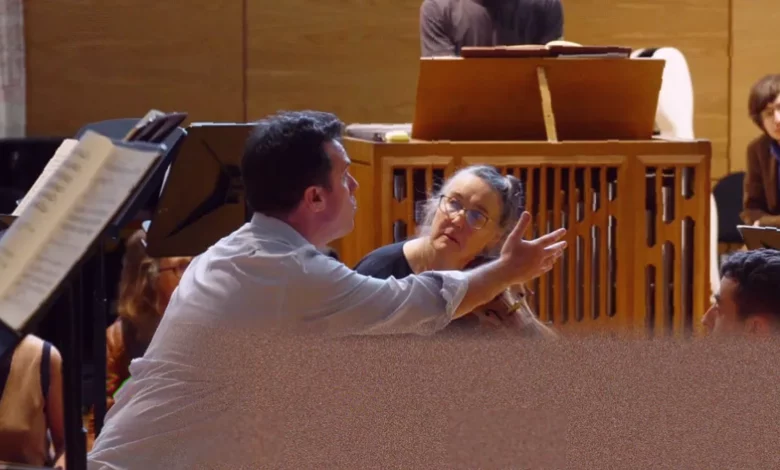
Varwig’s research, detailed in her monograph “Music in the Flesh: An Early Modern Musical Physiology” (University of Chicago Press, 2023), which won the 2024 Otto Kinkeldey Award, is not just historical. She has sought to revive embodied listening through practical experiment. Together with the violinist Margaret Faultless and the tenor Nicholas Mulroy from the Royal Academy of Music, she ran a two-day workshop centred on Bach’s St John Passion. The intention was not to prepare a performance or a recording, but to allow musicians to respond physically and emotionally to the music — to let it take them wherever it wanted. They were not instructed to dance, play kneeling on the floor, gesticulate or conga to Bach’s contrapuntal intricacies — but that is what happened. The pain of the tenor aria “Ach, mein Sinn” was amplified through what Faultless called the “cosmically messy” intensity of the performance, where the emotional togetherness of singer and players mattered far more than any conventional polish. Another tenor aria, “Erwäge, wie sein blutgefärbter Rücken” (“Ponder how his bloodstained back”), became an “unbearable” confrontation, in Faultless’s words. The singer and the musicians knelt, entreating heaven with outstretched hands, listening to each other more intensely and intimately than a conventional concert performance usually allows.
For the participants, the experience was transformative. “We found ourselves engaged in music we know so well in such different ways. We experienced the physicality of our own bodies and emotions,” Faultless said. “We were incredibly attuned to our fellow performers and listeners in the room. We were free to inhabit the intensity of Bach’s music, free to move, to breathe together and to respond to the power of the story through our shared humanity … [It felt] intensely immediate, connected and transformative.”
First time @UKLabour leader’s speech to conf has mentioned Brahms Beethoven Shostakovich and the flute 👏👏👏👏 https://t.co/FM19eXl4vX
— Harriet Harman (@HarrietHarman) September 27, 2024
Varwig herself has spoken of “utopian visions where this level of physical and emotional engagement among performers and audiences becomes the norm in the classical music world.” Whether such a shift can happen depends partly on wider cultural and political support for music. The former prime minister Sir Keir Starmer, a former flute-player who also played piano, violin and recorder and attended the Guildhall School of Music and Drama, has spoken about the importance of music education, noting the skills learned through ensemble playing — watching cues, communicating. He is the only party leader or prime minister to mention Shostakovich in a conference speech, and the only one since Edward Heath to profess a genuine love for Beethoven’s symphonies. Labour has pledged to “put creativity at the heart of the curriculum,” reform the Progress 8 measure to include creative subjects, and establish a Growth and Skills Levy. Yet during Starmer’s two years in office, there was no transformative pitch to put music at the centre of the curriculum, nor a massive boost to the music portfolio of Arts Council England — in fact the reverse. The crisis in music education continues, with funding cuts, fewer teachers and declining participation in GCSE and A-level music. Industry figures such as Ed Sheeran and UK Music have called for more government investment. Andy Burnham, the Mayor of Greater Manchester and a former culture secretary, has integrated music into his political persona — flying a rapper to SXSW, having Liam Gallagher record tram announcements, and initiating a review of Greater Manchester’s music scene. His passions, from the Smiths to the Pogues, are well known, but whether that will translate into broader support for classical music education remains to be seen.
Meanwhile, the vitality of contemporary classical performance continues elsewhere. The flautist Adam Walker founded the Orsino Ensemble in 2018, a flexible chamber group focused on wind music. Their debut album, “Belle Époque: French Music for Wind,” released in April 2021 on Chandos Records and featuring the pianist Pavel Kolesnikov, showcases late-19th and early-20th-century French repertoire by Roussel, Debussy, Chaminade, Saint-Saëns and Caplet. Reviewers praised the “beguiling and dazzling” performances and Kolesnikov’s “genius for lightening up and clarifying the textures of the music.” The opening track, Albert Roussel’s Divertissement, is a jewel — the characters that Kolesnikov and the wind players conjure in just a few minutes are staggering. It is a reminder that the kind of listening Varwig advocates — engaged, embodied, communal — is not a lost art, but one that can be rediscovered, whether in a Cambridge workshop or in the sonorities of a wind quintet.