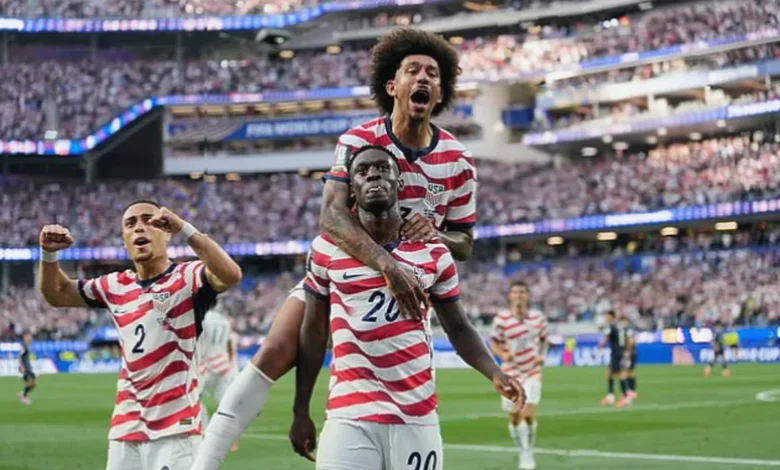
Mauricio Pochettino had watched the 2004 film Miracle during the build-up, and what unfolded at SoFi Stadium on Friday night felt like something close to it. The United States opened their World Cup campaign with a 4-1 evisceration of Paraguay that left those who witnessed it reaching for words like “magical” and “miraculous” — a performance that went beyond the scoreline and spoke to eight years of pent-up national expectation finally being released.
The first half was freestyle football. Weston McKennie, Folarin Balogun, Christian Pulisic and Malik Tillman threaded moves together with an instinctive, almost telepathic understanding. Paraguay were not so much beaten as overwhelmed by the brio and self-belief coursing through the home side. Giovanni Reyna’s goal, bent with the outside of his foot from distance, could sit on any best-of-tournament reel. This was not merely a victory; it was a statement of intent delivered with Hollywood production values in the very city that invented the blockbuster.
A star born in Brooklyn, forged in London and Monaco
Every player in that attacking quartet has his story, but Folarin Balogun’s is the most compelling. Born in Brooklyn, New York, he spent his childhood in London and rose through Arsenal’s Hale End academy. He was eligible to represent England through residency, yet chose the United States — a decision influenced in part by the clamour on social media for him to commit to the USMNT. The choice looks increasingly prescient with every performance.
Balogun scored twice against Paraguay, and his first-half display was a masterclass in composure. His third goal for the night showcased spatial awareness and ice-cold thought: he guided the ball across the box beyond two defenders without even lifting his eyes, then despatched it left-footed into the top-left corner. It was the kind of finish that makes you understand why Monaco paid an initial £25.7m (€30m) — potentially rising to £34.3m (€40m) with add-ons — to prise him from Arsenal in 2023. Arsenal also inserted a 17.5 per cent sell-on clause, a detail that adds a certain piquancy to the post-match chatter among American fans.
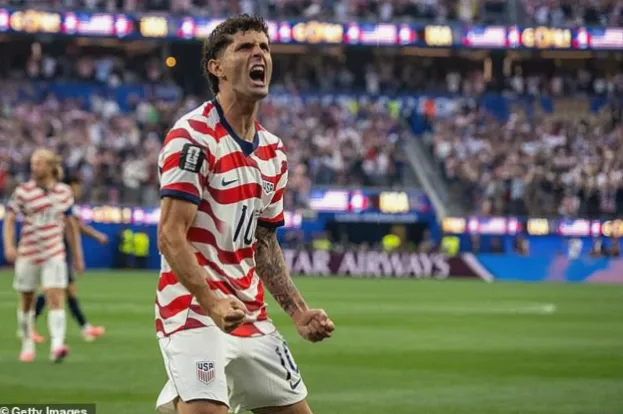
There was visible satisfaction among the US supporters last night, some of whom noted the irony of Arsenal selling Balogun only for him to display finishing that has often been absent in Viktor Gyokeres. Several pointed to Balogun’s two first-half goals against Paris Saint-Germain in the Champions League knockout round playoff in February — a performance that suggested he was an asset the Gunners could have used in the final against the same opposition. Arsenal, at the time, had three established strikers, and Balogun wanted more minutes. His second half here was less emphatic, and further evidence is required before concluding that the London club sold a future superstar. But Balogun is clearly a dangerous focal point for America’s World Cup attacks. His loan spell at Reims, where he scored 21 goals in 37 Ligue 1 appearances, first demonstrated his potential, and he was named Monaco’s Player of the Season for 2025-26. At the time of his move to Monaco, he commanded the second-highest transfer fee ever paid for an American player, behind only Christian Pulisic.
Captain America and the emerging generation
Pulisic, the man known as Captain America, was operating on a higher plane of anticipation in the first half. He bisected two defenders to provoke panic in the Paraguayan box, leading to an own-goal. His removal at half-time, however, caused concern. Pulisic and Pochettino described a kick to the calf that tightened during the first half. The US camp insisted it was only a precaution, but the 27-year-old has sustained a number of soft tissue injuries during his three influential years with AC Milan, and the memory of previous setbacks will not have been easy to shake. His transfer from Borussia Dortmund to Chelsea in 2019 cost $65m — a record for an American player at the time.
Malik Tillman, the 23-year-old German-born midfielder, displayed the uncluttered audacity of youth, surging forward from deep positions with a samba touch that lit up the early exchanges. But it was McKennie who had fans at the Memorial Coliseum Watch Party in a state of delirium with his attacking combinations. Sophie Salvador, a supporter watching the game, said: “We knew he was coming here in form and that he’s world class.” Her father David added: “He’s got better and better. He had a loan spell at Leeds which didn’t help him but he’s proof that players can blossom with time. He doesn’t divide opinion as he once did.”
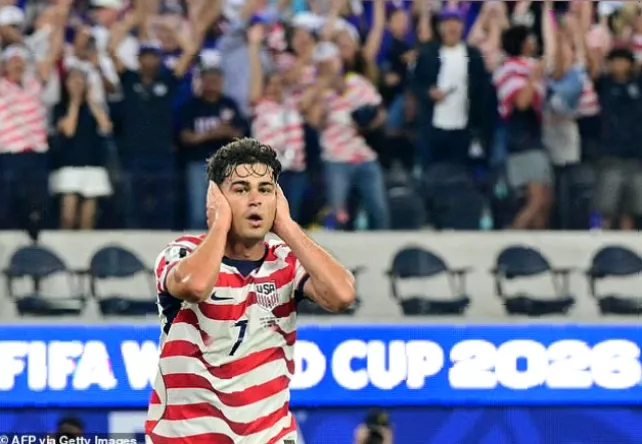
Giovanni Reyna, who scored that stunning outstep goal, has his own redemption narrative. The 23-year-old, born in Sunderland, England, moved from Borussia Dortmund to Borussia Mönchengladbach in August 2025 for a reported fee of €4m, with some reports suggesting up to €7.5m including bonuses. He recently ended a 16-month goal drought for his club. Pochettino has publicly backed Reyna to thrive at this World Cup despite limited playing time at club level, and that faith was repaid here.
The road ahead: Turkey, Belgium and the talk of semi-finals
The US team sit ten ranking places above Australia, whom they meet next in Seattle on June 19. But the greater group challenge will come on June 25, when they face Turkey back at SoFi Stadium. Turkey are five places behind the US in the FIFA rankings, but they are a well-organised side under Italian manager Vincenzo Montella, who guided them to Euro 2024 and the 2026 World Cup and recently extended his contract with the Turkish FA until 2028. Montella represented Italy at the 2002 World Cup and has a strong connection with Turkish culture. His side will present a sterner test than Paraguay, who are ranked 40th in the world and whose best World Cup achievement remains the quarter-finals in 2010.
If the US win Group D, their path into the knockout stages opens up. A third-place finisher from another group would be their Round-of-32 opponent, with the winner of Group G — expected to be Belgium — potentially awaiting in the later rounds. Beyond that lie teams such as Canada, Ivory Coast, Sweden, Norway or Austria, none of whom look impregnable. Sophie Salvador captured the mood of cautious optimism: “Factor in the home support, too, and the fact Pochettino has clearly removed the fear. The semi-finals have never looked impossible. Now we can say that.”
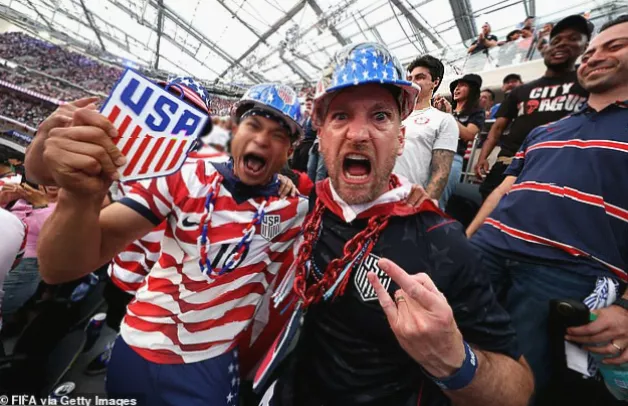
Pochettino himself will not relish that kind of talk, but the benefits of a deep run would be seismic for a country where soccer still fights for space. The New York Times captured the national exuberance in Saturday’s edition, extolling the virtues of a “thundering, near-flawless start.” It was, the paper said, “a long-awaited coming-out party that will send hype into overdrive heading into next Friday’s match against Australia.”
Yet the tournament remains oddly invisible in parts of Los Angeles. On the LA Metro and road network, there is an astonishing absence of World Cup branding. One of the few prominent ads on the subway system features Harry Kane promoting training shoes. David Beckham was at SoFi Stadium on Friday, collecting a star on the Hollywood Walk of Fame earlier that day in the “Sports Entertainment” category, with Tom Cruise and Victoria Beckham in attendance. He also appears in a nationwide advertisement for a popular brand of crisps that riffs on American scepticism about soccer. The Brits, it seems, are still needed for the hard sell.
The Academy Museum of Motion Pictures is currently hosting a “Marilyn Monroe: Hollywood Icon” exhibition marking the centenary of her birth — a reminder of how baseball’s Joe DiMaggio, the man she married and remained close to until her death, once commanded the kind of national obsession that soccer is still chasing. The footage of DiMaggio emerging with Monroe from their registry office wedding and driving off in his sports car captures two superstars in their pomp, and underscores how much ground the beautiful game must make up in a country crowded with sporting distractions. But if Friday night was any guide, that ground may be shrinking faster than anyone expected.