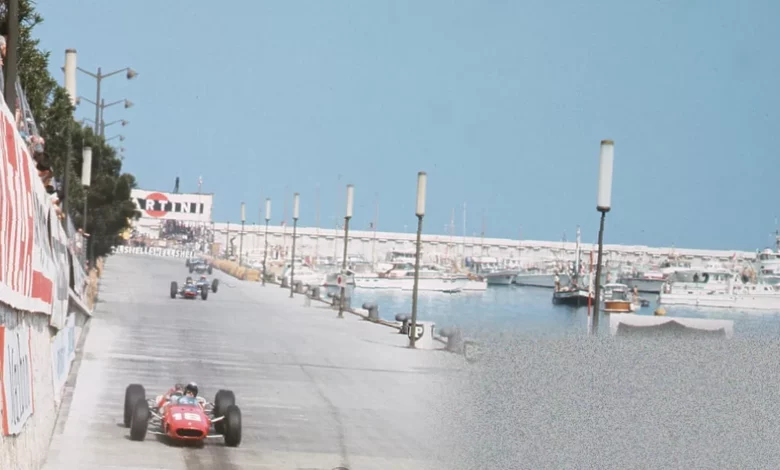
McLaren marks its 1000th Grand Prix this weekend in Monaco, a milestone that places the team second only to Ferrari in longevity and success among Formula 1’s constructors. The occasion was celebrated on Thursday when double world champion Mika Häkkinen drove the team’s first ever Formula 1 car, the M2B, around the streets of Monte Carlo – the same circuit where Bruce McLaren brought his fledgling operation to its debut race in 1966.
Since that tentative start, McLaren has accumulated 203 Grand Prix victories, 13 drivers’ championships and 10 constructors’ titles, with a roll call of champions that includes Emerson Fittipaldi, James Hunt, Niki Lauda, Alain Prost, Ayrton Senna, Häkkinen, Lewis Hamilton and, most recently, Lando Norris, who claimed the drivers’ crown last year. Yet the opening chapter of that story was anything but glorious.
Humble beginnings
Bruce McLaren founded the team in 1963, driven by a passion for motorsport that had first taken root in his native New Zealand, where his parents ran a service station. The operation began in the most rudimentary of conditions. “We started in a little workshop in New Malden,” recalled Howden Ganley, who joined as a 23-year-old mechanic from New Zealand. “We had a portion of a contractor’s shed so we were working among the bulldozers. The floor may have been concrete at one time but it was broken up so it was almost just dirt. There was a wooden work bench with a vice on it, a drill press and some welding bottles, the bare minimum of what we needed.”
The founding team comprised just six people: Bruce McLaren himself; his wife, Patty, who served as his assistant and official timekeeper; Eoin Young as general manager; Wally Willmott and Tyler Alexander running the workshop; and Ganley as the third mechanic. When McLaren brought his first Formula 1 car, the M2B – designed with Robin Herd and powered by a Ford ‘Indy’ V8 engine – to Monaco in 1966, it was towed behind a Ford Fairlane estate on a trailer, a vivid symbol of the team’s resourcefulness.
That first race ended in disappointment. McLaren qualified 10th and retired after just 10 laps with an oil leak. Yet he was undeterred. The team’s first Grand Prix victory came two years later at Spa in 1968, a monumental result for the still embryonic outfit. More would surely have followed had tragedy not intervened.
On 2 June 1970, aged 32, Bruce McLaren was killed while testing the team’s M8D sports car at Goodwood. The rear bodywork detached from the chassis at high speed, causing a sudden loss of downforce. The car spun off the track and struck a concrete marshal post. It was a devastating blow, but the team he had built refused to fold. Teddy Mayer, who took over leadership, rallied the group with a characteristic determination. “But we do have a motor race – at Mosport in two weeks’ time – and we all owe it to Bruce to race. So we might as well get to it,” he said. The team won that race.
Ganley, reflecting on the man who had inspired them all, said: “He was the greatest leader of men I have ever met in all my life.” That ethos – of loyalty, mutual respect and a shared purpose – became the thread that ran through the team’s subsequent decades.
Enduring spirit
Under Mayer, McLaren claimed its first constructors’ championship in 1974, and Fittipaldi delivered the first drivers’ title the same year. Hunt’s famously hard-fought title followed in 1976. But it was the arrival of Ron Dennis in 1981 – when his Project Four Racing merged with McLaren – that ushered in the team’s most dominant era. Between 1984 and 1998, McLaren won seven constructors’ championships, with the partnership with Honda from 1988 to 1991 proving particularly formidable: in 1988 the team won 15 of 16 races. Dennis’s leadership brought a level of success that was both admired and envied.
Yet the team’s story has also known steep declines. Between 2015 and 2017, McLaren fell to the back of the grid, a nadir that made its once-mighty reputation seem a distant memory. The revival under CEO Zak Brown – whose background in motorsport marketing helped reshape the team’s fortunes – and team principal Andrea Stella, an aerospace engineer who joined McLaren in 2015 and rose through the ranks, has been remarkable. The team took the constructors’ title in 2024 and followed it with a drivers’ and constructors’ double last year, a testament to the resilience that Bruce McLaren himself embodied.
Mark Temple joined McLaren straight out of university at 23 in 2003, starting in gearbox design before becoming Lewis Hamilton’s performance engineer and later his race engineer. He is now the team’s performance technical engineer, and after more than two decades he remains certain of what makes the team endure. “It’s much, much more than just a job for everyone here,” he said. “That sense of being part of the team and the team is bigger than any one individual. That really helps with that sense of a common purpose. The best test of that is were people still proud to work for McLaren, even when we were finishing ninth in the championship? The answer is yes.”
The team’s spirit, he added, is like a family. “If your team looks after you, you want to look after the team. I think that’s a big part of it. There is a kind of a mutual respect and wanting to feel that you’re part of something special and that the team values you and your contribution makes you want to stay part of that team.”
That same sense of belonging resonates with Norris, who has now driven more races for McLaren – 156 – than any other driver in the team’s history. “It’s a team I think a lot of people want to be a part of,” he said. “To be alongside Lewis and Senna and Prost in terms of drivers who have driven for the team, helped to win constructors’, now achieved a world championship, that’s something that makes me smile more than just saying ‘I’ve won a race’. That’s something in the future I’ll look back on and be happy about.”
McLaren is one of only three constructors, and the only team, to have achieved motorsport’s Triple Crown – wins at the Indianapolis 500, the 24 Hours of Le Mans and the Monaco Grand Prix. This weekend, as the team contests its 1000th Grand Prix on home soil for that particular crown, it does so with a record that few can match and a story that began in a small shed in New Malden. Win or lose in Monaco, the team has earned its moment.