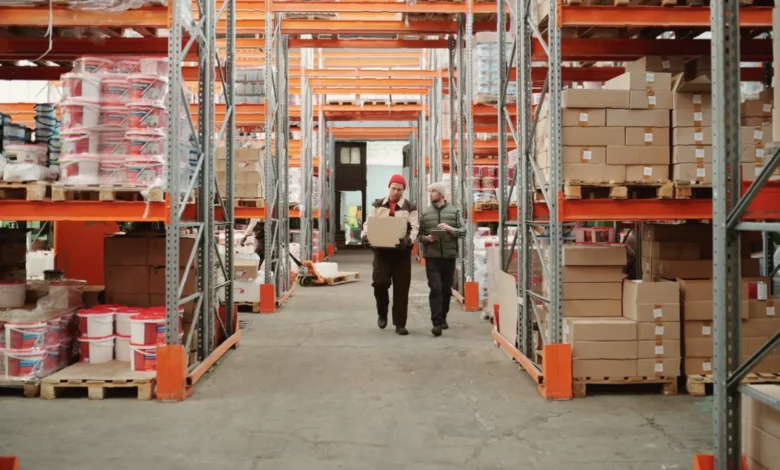
For Midlands retailers, stock accuracy now depends on integrated systems, not just warehouse operations. The same inventory figure must serve online availability, store replenishment, enterprise resource planning records, finance reports and customer service teams handling delivery queries. When those systems operate at different speeds, the business loses its grip on what it actually holds.
The weakness typically appears as a data timing problem. ERP stock moves at one speed; e-commerce availability moves at another. The warehouse team may know where a pallet went, but the customer-facing system may not have caught up. No single dramatic error occurs. Instead, several small delays accumulate into one operational issue, according to the original analysis. This is especially acute in fast-moving categories such as food and drink, where batch data, expiry dates and location updates cannot drift far from the real floor. A site can look controlled at the start of the day, then unravel once picking, replenishment, returns and dispatch begin pulling from the same stock pool.
Where integration issues create operational problems
The problem is not confined to the warehouse floor. Manual tracking rarely fails in one clean moment. It leaks between tasks. A pallet moves before the record moves. A picker finds stock in a nearby location and carries on. A spreadsheet gets cleaned up after dispatch. The work still gets done, but the data trail becomes harder to trust, the original article notes. That loss spreads quickly. Customer service sees orders that need explaining. Finance queries stock value. Operations asks why the team is still firefighting. IT gets pulled into exports, fixes and one-off reports. The warehouse floor may look busy, but the bigger issue is that the business no longer trusts the inventory state.
Many warehouse processes still carry the rhythm of older retail. Goods arrive, staff book them in, stock moves to a bay, orders are picked, and someone corrects the gaps later. The research briefing highlights that this pattern becomes fragile when the same inventory supports wholesale orders, store transfers, direct-to-consumer fulfilment and marketplace demand simultaneously. The traditional model is proving inadequate for the real-time demands of modern commerce.
For food and beverage operations, the pressure is sharper. The research briefing explains that perishable inventory, seasonal demand fluctuations, complex unit management, contamination risk, and strict health and safety regulations demand robust lot and batch tracking. First-Expired, First-Out logic is crucial for managing shelf-life and reducing waste. The system must capture the right data at the point where the action happens. Goods-in needs enough detail for downstream control. Put-away needs to respect storage rules. Picking needs to follow rotation logic. Dispatch needs to preserve the link between order, batch and movement history. FEFO only works when the system holds the right data and the team follows the task sequence. If staff bypass the process too easily, the WMS becomes a record of what people remembered to enter, not an execution layer, according to the original article.
Integration is where the project proves itself. A warehouse system can look convincing in a demo and still create trouble after go-live. The interface matters, but the integration model matters more. Item masters, units of measure, order status, stock adjustments, batch events and exception messages all need ownership before the warehouse starts depending on the system. The research briefing notes that this is often more technical than anticipated. Operations focuses on pick paths and locations. IT has to handle API behaviour, error queues, retry logic, data mapping and monitoring. If failed transactions are not visible, the business returns to manual checking, only with a newer system in the middle.
A cleaner design gives each platform a defined job. ERP holds the commercial and financial record. The WMS controls physical execution. Commerce channels consume stock from a governed source. Reporting teams work with reconciled events instead of patched exports, the original article advises. Cloud deployment can reduce infrastructure overhead, but it does not remove the need for governance. Access roles, data retention, update cycles, monitoring and release control still need attention. The research briefing adds that cloud-based WMS solutions are gaining traction in the UK due to flexibility and scalability, but senior technology teams must ask how the WMS fits the operating model, not whether the hosting option sounds modern.
The Midlands context amplifies these challenges. The research briefing points to the “Golden Triangle” of UK logistics, encompassing areas like Birmingham, which is strategically important for efficient distribution. E-commerce occupiers have increased their warehouse footprint by 813% between 2015 and 2024. This expansion places immense pressure on logistics operations, especially for third-party logistics providers managing multiple clients. The Midlands retail sector is grappling with the need for seamless integration across multiple sales channels and evolving consumer expectations.
Automation and robotics are rapidly being adopted, with projections indicating over 85% of UK warehouses will deploy some form of automation by 2030. WMS acts as the control layer for automated guided vehicles, autonomous mobile robots, and robotic picking and sorting systems. Artificial intelligence and machine learning are being integrated for predictive analytics, demand forecasting, and resource allocation. Modern WMS platforms are also compatible with e-commerce platforms like Shopify, Amazon and eBay, streamlining order processing and inventory management. However, the research briefing warns that cybersecurity is a major challenge. With increased reliance on integrated systems and IoT devices, cyberattacks can disrupt operational systems and supply chains, and the manufacturing industry has been a significant target in the UK.
Testing the awkward scenarios before rollout
A WMS project should not start from a feature checklist alone, according to the original article. Senior teams need scenarios that expose where data, permissions and process could break. Split pallets, short picks, damaged goods, returns, stock holds, urgent replenishment and expiry-led picking all show how the system behaves when the floor is not tidy. User roles need the same pressure. Too much freedom weakens control, but least privilege applied without the real workflow in mind can push staff towards informal fixes.
Peak trading should also be tested. Scanning latency, task release timing, integration queues and reporting delays all become more visible when volume rises. These details decide whether the site feels controlled or reactive during the moments that matter, the original article notes. A phased rollout can give the business a cleaner route. One zone, workflow or product category can reveal configuration issues before the whole operation depends on the system. It also gives IT and operations a shared language for incidents, which matters once the project leaves the workshop and meets live volume.
For Midlands retailers, a specific solution mentioned in the original article is Infios WMS from Balloon One. The system belongs in the evaluation because the decision has to cover FEFO logic, lot control, scanning discipline, ERP integration, user permissions and exception workflows under live trading pressure. The research briefing identifies Infios WMS as a “clear category leader for 2025” for mid-market companies, offering high accuracy and productivity gains. The useful test, the original article states, is not whether a function exists somewhere in the platform. It is whether the configured process can handle receiving, storage, replenishment, picking and exceptions without forcing people back into side notes and workarounds.
The return on investment case is best built from operational leakage. WMS investment is often sold internally around labour efficiency, stock accuracy and better fulfilment. Those benefits become easier to defend when the business can name the current leakage. Manual recounts, failed picks, refunds, spoilage, emergency replenishment, overtime and slow goods-in processing rarely sit in one tidy cost line, the original article points out. The stronger business case starts with those weak points. Better location accuracy reduces search time. Batch control improves traceability. Directed replenishment lowers disruption during picking. ERP integration cuts duplicate entry and reconciliation work. Payback depends on volume, process maturity and data readiness. A retailer with weak master data or inconsistent scanning will not see the same return as one that treats WMS implementation as operational change.
Midlands retailers do not need another platform that only moves reconciliation from one team to another, the original article concludes. A WMS has to make stock movement more reliable across ERP, commerce, reporting and warehouse execution, without creating a new layer of manual checking. The decision starts on the warehouse floor, but it does not stay there. Data ownership, integration design, user control, exception handling and support capability all shape whether the system holds up once trading volume rises.