The rush of high-profile artificial intelligence companies towards public listings has ignited fears that parts of the equity market are entering bubble territory, as investors grapple with valuations that appear increasingly detached from underlying financial fundamentals. Anthropic, the creator of the Claude chatbot, has filed confidentially for an initial public offering that could value the AI group at nearly one trillion dollars (£743 billion), coming “hot on the heels” of SpaceX’s S-1 registration statement, according to Susannah Streeter, chief investment strategist at Wealth Club. She warned that “there are expectations that OpenAI will also go public pretty soon”, and that “high-profile IPOs can still become turning points for market sentiment if valuations appear too detached from fundamentals. Any disappointment could trigger a wider reassessment across tech stocks, which have soared in value.”
AI IPOs and the spectre of a market bubble
Anthropic’s confidential filing places it ahead of rival OpenAI in the race to go public, after the company recently raised $65 billion in private markets at a valuation of $965 billion. OpenAI, the maker of ChatGPT, is itself reportedly preparing for a historic IPO with potential valuations reaching up to $1 trillion, although the company does not expect to be profitable until the 2030s and has engaged financial institutions including Citigroup and JPMorgan for discussions. SpaceX, the aerospace firm founded by Elon Musk, has filed its S-1 registration statement aiming to raise up to $75 billion, potentially valuing the company at over $2 trillion. The filing revealed that SpaceX posted a $4.9 billion loss in 2025 on revenue of $18.7 billion, and notably shows that it is monetising AI infrastructure, with Anthropic as a major early customer.
The flurry of listings is being accompanied by enormous capital deployment by the largest technology companies. Google parent Alphabet announced plans to raise up to $80 billion (£59 billion) in stock — described by analysts as the largest equity fundraising ever — to fund a major expansion of its AI infrastructure. Warren Buffett’s Berkshire Hathaway has committed $10 billion (£7.4 billion) to the effort. Alphabet stated the funds will be used for “general corporate purposes, including capital expenditures to scale AI infrastructure and global compute”, noting that demand for its AI solutions exceeds current supply. The company’s capital expenditures for 2026 are projected to be between $180 billion and $190 billion, with further increases expected in 2027.
Nvidia, the dominant supplier of chips for AI, also fanned the excitement after unveiling a new AI-focused processor, the RTX Spark, for Windows PCs. The chip is designed to run AI agents on personal devices and marks Nvidia’s deeper entry into the PC processor market, challenging established players such as Intel and AMD as well as Qualcomm’s expansion into AI-powered PCs. Nvidia shares opened higher on Tuesday after jumping more than 6% on Monday, as CEO Jensen Huang described the shift as a significant change in computing architecture driven by agentic AI.
Market performance and geopolitical influences
Despite the froth around AI, London’s blue-chip index posted only modest gains on Tuesday. The FTSE 100 closed up 34.56 points, or 0.3%, at 10,373.51, while the FTSE 250 ended 132.58 points higher, or 0.6%, at 23,378.36. The AIM All-Share index dipped 0.92 of a point, or 0.1%, to 818.32. The gains were driven primarily by mining stocks as metals prices rose: Antofagasta surged 6.5%, Anglo American advanced 4.1%, and Glencore climbed 4.6%.
The market mood continues to be dictated by events in the Middle East. US President Donald Trump insisted that peace talks with Iran were moving rapidly and that Israel and Hezbollah had agreed to stop fighting, although Israeli strikes resumed on Tuesday. “There is no concrete progress in Middle East negotiations to hang a hat on, but investors appear broadly optimistic that a longer-term resolution will be reached,” said Susannah Streeter of Wealth Club. Meanwhile, David Morrison at Trade Nation noted that despite the oil market turmoil, “prices remained near the bottom of their recent range”, well below the $100 a barrel seen a few weeks ago. Brent crude for August delivery traded lower at $94.68 a barrel on Tuesday, down from $97.22 at the time of the equities close in London on Monday.
In Europe, equity markets also gained, with the CAC 40 in Paris ending up 0.8% and the DAX 40 in Frankfurt closing 0.5% higher. In New York, the Dow Jones Industrial Average was up 0.3%, the S&P 500 rose 0.2%, and the Nasdaq Composite firmed 0.3%. US markets had posted record highs on Monday as AI enthusiasm again sent tech stocks soaring.
Other corporate news provided a mixed picture. British American Tobacco fell 2.5% despite reiterating full-year guidance for group revenue to rise by between 3% and 5% for 2026. The company now expects global cigarette industry volumes to decline by 2.5% in 2026, worse than the previously forecast 2%, although it lifted guidance for new categories such as vapes and nicotine pouches, forecasting mid-teens revenue growth. Citigroup analyst Simon Hales said the combination of lower global cigarette volume estimates, a slower than expected first-half recovery in Asia-Pacific, the Middle East and Africa, an 80 basis points share loss in US combustibles, and Philip Morris’s announcement that it is launching ZYN Ultra nicotine pouches in the US this month is likely to be seen as a negative for the firm.
On the FTSE 250, Elementis rose 2.9% after pledging a €30 million (£25.9 million) share buyback, using the proceeds from the sale of its pharmaceutical manufacturing business to Associated British Foods for an enterprise value of €34.3 million. The move sharpens Elementis’s focus on its core specialty additives for personal care and coatings markets. GB Group fell 16% after announcing £6 million in investment that will impact near-term margins, with benefits expected in later years. Analysts at Jefferies said: “This will impact short-term numbers, which may annoy some. However, in the context of the valuation, we think management should be backed for making positive strategic moves. We continue to believe the valuation overlooks today’s growth, let alone future growth potential.”
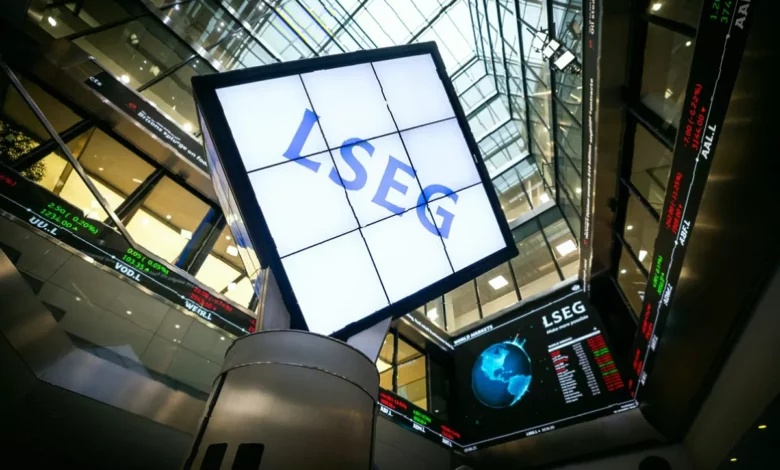
The biggest risers on the FTSE 100 were Antofagasta, up 268.00p at 4,408.00p; Glencore, up 26.90p at 615.00p; Anglo American, up 168.00p at 4,225.00p; Barclays, up 15.40p at 470.20p; and Intercontinental Hotels Group, up 5.05p at 158.20p. The biggest fallers were Airtel Africa, down 18.40p at 334.60p; Sage Group, down 36.80p at 870.80p; Endeavour Mining, down 167.00p at 4,250.00p; Experian, down 88.00p at 2,588.00p; and London Stock Exchange Group, down 262.00p at 8,924.00p.
Economic data and currency movements
In currency markets, sterling traded at $1.3475 on Tuesday afternoon, up from $1.3447 on Monday, and firmed to €1.1578 from €1.1570. The yield on the US 10-year Treasury trimmed to 4.45% from 4.51%, while the yield on the US 30-year Treasury narrowed to 4.96% from 5.01%.
In the eurozone, inflation accelerated according to a flash reading from Eurostat. The harmonised index of consumer prices rose 3.2% annually in May, up from a 3.0% rise in April and in line with consensus cited by FXStreet. Core HICP, which excludes food, energy, alcohol and tobacco, accelerated to 2.5% in May from 2.2% in April, ahead of the 2.4% consensus and hitting its highest level since April last year. “A week ahead of the next ECB meeting, this is the expected uptick in inflation that will motivate the central bank to decide on an ‘insurance’ hike,” suggested ING Global Head of Macro Carsten Brzeski. Iain Simmons at Oxford Economics said that while small, the acceleration “will remain uncomfortable for the ECB and in our view confirms that the central bank will hike rates in June”.
The euro traded higher against the dollar at $1.1638 on Tuesday from $1.1624 on Monday, while the dollar was trading at 159.89 yen, higher than 159.64. Gold prices rose to $4,503.10 (£3,346) an ounce, up from $4,472.82 (£3,323) on Monday, supported by the pullback in oil prices that has eased concerns about energy-induced inflation and potential further interest rate hikes.
Wednesday’s global economic calendar includes Australian GDP data overnight, a slew of composite PMI readings, ADP payroll data and the Federal Reserve’s Beige Book. The local corporate calendar has full-year results from DiscoverIE Group and third-quarter results from Seraphim Space Investment Trust.