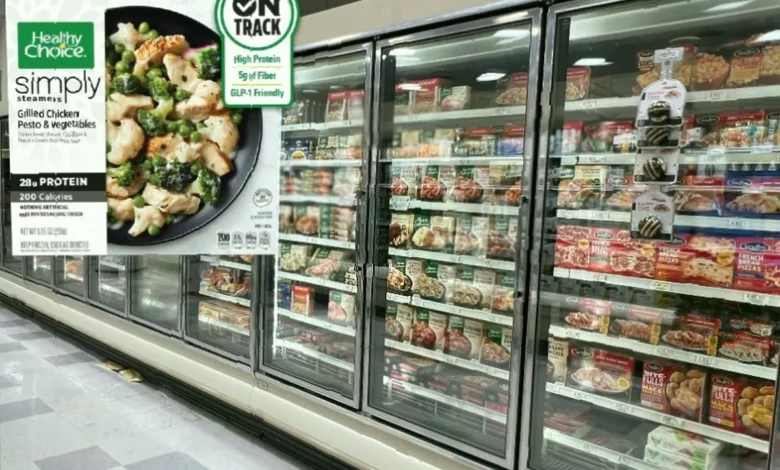
Marketing Trend: Cashing In on the Weight-Loss Drug Boom
Food manufacturers are rushing to label products as “GLP-1 friendly” in an attempt to profit from the soaring popularity of weight-loss medications such as Ozempic and Mounjaro. The labels, appearing on frozen meals, tortillas and ready-to-eat snacks, highlight attributes such as high protein, extra fibre or smaller portion sizes — but experts warn the claims are largely a marketing exercise with little scientific foundation.
The rise of GLP-1 drugs has reshaped eating habits. Almost one in five American adults has used a GLP-1 medication at some point, and within six months of starting treatment households typically spend 5 per cent less on groceries. In Great Britain, usage has nearly doubled in a year; 4.1 per cent of households now use the drugs, primarily for weight loss, and an estimated 1.6 million adults had taken them for weight management by early 2025. Some reports suggest nearly 7 per cent of the UK population have used GLP-1 drugs, with another 8 per cent considering them — equating to around 8.25 million people. The surge has outpaced NHS capacity, with roughly 90 per cent of UK patients obtaining the medication privately or off-label.
The shift in consumption is dramatic. Surveys show that 64 per cent of UK users are snacking less, 74 per cent have reduced takeaways, and 63 per cent have cut down on pizza. Alcohol consumption has dropped by 77 per cent among users. Spending on ultra-processed, calorie-dense categories such as savoury snacks, sweets and bakery items has declined, while fast-food chains and coffee shops have seen an 8.6 per cent drop in spending from GLP-1 users. As appetites shrink, the few meals people do eat need to be nutrient-dense — a gap that food companies are now trying to fill with specially labelled products.
Expert Scepticism: ‘No Real Science Behind It’
Medical professionals have greeted the “GLP-1 friendly” trend with considerable scepticism. Dr Zaid Fadul, a physician and former U.S. Air Force flight surgeon, told The Independent: “A GLP-1 friendly label is good in theory, but it’s bulls***. There’s no real science behind it.” Dr Ethan Balk, a clinical associate professor at NYU specialising in medical nutrition for bariatric surgery and metabolic weight loss, said companies were “cherry picking some pieces of the product to highlight that they are in the realm of what we recommend for somebody on a GLP-1.” He compared the phenomenon to the low-calorie snack packs of the early 2000s, calling it “a total marketing, money-grab by companies.”
Despite the marketing hype, some clinicians acknowledge a potential upside. “All of us could benefit from a lot more fibre intake, and so now you have patients who are being a little more mindful of their food choices, that’s a net win for society,” Fadul said. Yet the consensus remains cautious. Pre-packaged meals will never match whole foods in nutritional quality, though they may be better than nothing for users in a hurry — or those craving something less wholesome. Balk pointed out that a “GLP-1 friendly” pepperoni pizza might have more protein than a standard frozen pizza but likely has “zero nutrient value.”
Company Examples: From Nestlé to UK Supermarkets
Food giants have moved quickly. Nestlé launched its “GLP-1 friendly” Vital Pursuit range of frozen meals, including a white cheddar mac and broccoli bowl with 21g of protein and a meat lover’s pizza with 32g of protein. Conagra Brands added the label to 26 of its Healthy Choice frozen meals, such as a beef merlot containing 13g of protein. Popular tortilla maker Mission has also introduced “GLP-1 friendly” packaging on some of its tortillas, alongside claims of high fibre and zero net carbs — its Zero Net Carbs Spinach Tortillas boast 15g of fibre and 6g of protein per serving.
In the UK, supermarkets have responded in similar fashion. Morrisons launched own-brand “GLP-1 friendly” ready meals in partnership with Applied Nutrition, offering high-protein products. Marks & Spencer introduced a “Nutrient Dense” range, while Co-op brought out “Good Fuel – Power Up Your Plate” mini meals. Asda has introduced high-protein “power pots”, and Iceland Foods expanded its weight-loss range. Notably, some retailers — including M&S, Co-op and Iceland — have avoided explicit mentions of GLP-1 drugs on packaging, reportedly to prevent potential stigma among shoppers.
The underlying driver is clear: “Companies are freaking out because people are eating less on these drugs,” Balk said. “This is just the newest iteration of marketing that is out there to try and maintain profit.”
Regulatory Gaps and the Risk of Misleading Consumers
The most significant concern about “GLP-1 friendly” labelling is the lack of regulation — a gap that experts say leaves consumers vulnerable to misleading claims. In both the UK and the US, the label is not subject to the same strict guidelines that apply to markers such as “heart healthy” or “organic”. In the US, Nestlé and Conagra received approval to use the term from the Department of Agriculture’s Food Safety and Inspection Service, but only on condition that the products must not mislead customers and must include statements about protein and fibre content. There is no independent verification that a “GLP-1 friendly” product actually meets any nutritional standard beyond what the manufacturer chooses to emphasise.
In the UK, food labelling is governed by the Food Information Regulations 2014, which incorporate retained EU rules. Nutrition and health claims are regulated by retained EU Regulation (EC) No 1924/2006. UK law restricts the attribution of properties relating to the prevention, treatment or cure of human disease to food, unless the claim has been specifically approved. Whether the term “GLP-1 friendly” contravenes this restriction is untested in UK courts. The Advertising Standards Authority (ASA) has banned advertising of weight-loss drugs themselves and does not allow claims containing “GLP-1” in such advertising, but it has not explicitly prohibited “GLP-1 friendly” food advertising to date. In the EU, the label would be treated as a health or disease-related claim requiring formal approval — which experts say is unlikely to be granted.
Experts warn that without a regulatory framework, the term can be applied arbitrarily. “If you don’t have regulation coming in, they’ll stick a GLP-1 friendly label on celery,” Fadul said. Balk noted that companies are free to cherry-pick nutritional attributes — a pizza with extra protein but otherwise poor nutritional quality can still carry the label. Dieticians emphasise that GLP-1 users genuinely need higher protein to prevent muscle loss during weight reduction, adequate water because the drugs reduce thirst, and fibre to counter constipation caused by slowed digestion. But none of these requirements is enforced by the “GLP-1 friendly” designation.
The potential for consumer confusion is considerable. A household using GLP-1 drugs may see the label as a shortcut to healthy choices, yet the product could be no better than a standard processed meal. The comparison to the low- or 1,000-calorie snack packs of the early 2000s — a trend widely criticised for promoting diet culture without meaningful nutritional benefit — underscores the risk. As Fadul put it: “Consumers should be on alert because it’s a matter of time before it gets abused.”