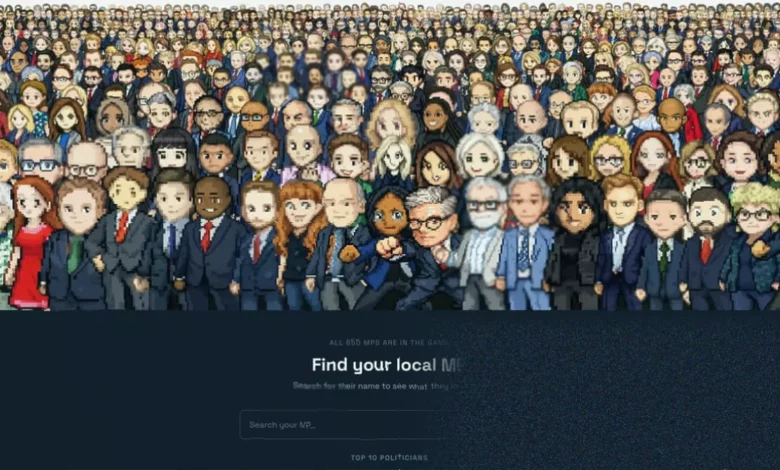
A new mobile game allows players to “catch” and train their local politicians, building their own political parties in a playful twist on the Pokémon formula. Ten years after Pokémon Go sent people wandering miles for fictional creatures, Politidex swaps Pikachu for backbenchers and Charizard for cabinet ministers — and some MPs have already started catching themselves.
Officially launched on 6 May, Politidex is a free-to-play iOS and Android game that features more than 18,000 characters, including all 650 MPs and thousands of local councillors. Players begin in their own area and travel through constituencies teeming with virtual politicians. The goal is to “catch ’em all” and become the dominant party across the UK. Within a week of release, users had already fought more than 45,000 battles and caught over 17,000 politicians.
How the battles and politician moves work
Unlike traditional Pokémon-style combat, encounters in Politidex take the form of debates. Each politician has an “approval rating” that serves as a health bar, and players must reduce it to zero by using a range of parliamentary manoeuvres. These include a barrage of questions at PMQs, calling for a recount, or weakening an opponent with an embarrassing soundbite. Once a politician’s approval rating is depleted, the player can add them to their party.
The characters come with signature moves drawn from real‑world politics. Senior figures such as Diane Abbott wield advanced attacks like “select committee” and “policy statement”. Other moves reference well‑known gaffes or controversies: Ed Miliband’s “bacon sandwich”, Angela Rayner’s “second home” — updated after Thursday’s HMRC investigation revelation to “exoneration” — and Nigel Farage’s “border control”, balanced by a second move, “milkshake”. Rare politicians, including Keir Starmer and Farage himself, are harder to find. Rachel Blake, MP for Cities of London and Westminster, can deliver a particularly powerful blow with her signature attack “international sanctions”.
The creator, 28‑year‑old game developer Fred Parry, was careful to avoid any depiction of violence against politicians. “I was very wary of making sure MPs weren’t scared of being in it,” he said. “I wanted [battles] to be more from a political angle.”
Creator’s intent and player reception
Parry, a former contestant on the BBC show Dragons’ Den, already runs a real‑life hide‑and‑seek game called Chicken Rush that he launched in 2022. He appeared on the programme seeking £50,000 for a 10% stake in that venture but did not secure investment; the appearance nonetheless drove a significant spike in website visits and bookings. The idea for Politidex came to him on April Fool’s Day. “I was thinking: What’s the most ridiculous idea that I have, which I can feasibly build quickly?” he explained. “The idea was always that you could ‘catch’ your local MP. Pokémon is the game that basically made that famous, it’s the game I grew up on. And it’s not like you’re hunting them. It’s quite positive, you’re catching and training them up.”
Parry built the entire game in roughly one month, using AI tools to generate software and artwork at low cost. He was open about his use of AI, which prompted some backlash from players who object to AI‑generated art. “I do really hear them on that,” he said. “But the game would’ve never existed without those tools, so it’s a bit of a catch‑22.” His decision to be transparent places Politidex within a broader debate about AI art in game development, where some developers have faced criticism for undisclosed use of the technology.
The timing of the local elections made the project feel increasingly relevant. Parry said he realised many people, including himself, could not name their local MP or a single councillor. “Most people are just a bit suspicious of politicians as a whole, which is really sad,” he added. “Hopefully, this serves as a way of flipping the narrative. Instead of trying to defeat politicians and bring them down, you’re actually catching them and training them up, which sounds fun.”
Players have responded positively. Will, a 19‑year‑old fine arts student in south‑east London, described the game as “a cool tool to get to know your local MPs or councillors, or just to generally familiarise yourself with politicians nationally.” One Reddit user called it “goated”. The reaction from Westminster has been “really wholesome”, according to Parry: “We’ve had MPs catching themselves, which is amazing. They’ve messaged in and said this is hilarious.”
The game taps directly into the “gotta catch ’em all” culture that Pokémon popularised, applying it to the political sphere as a light‑hearted alternative to often‑divisive discourse. Other politically themed games exist — such as the grand strategy title Realpolitiks and the viral quiz Guess the Party — but Politidex distinguishes itself by aiming to humanise politics and encourage voters to learn the names and roles of their local representatives. Parry kept the gameplay “neutral with some tongue‑in‑cheek chaos”, particularly when depicting divisive figures. “I just thought,” he said, “if we’re gonna be very angry in politics, very let down by politicians, quick to judge on what their motivations are – you probably do need to know their names beforehand, as a basic thing. And just have more awareness of who they are, what part they’re from, which area they’re working in.”