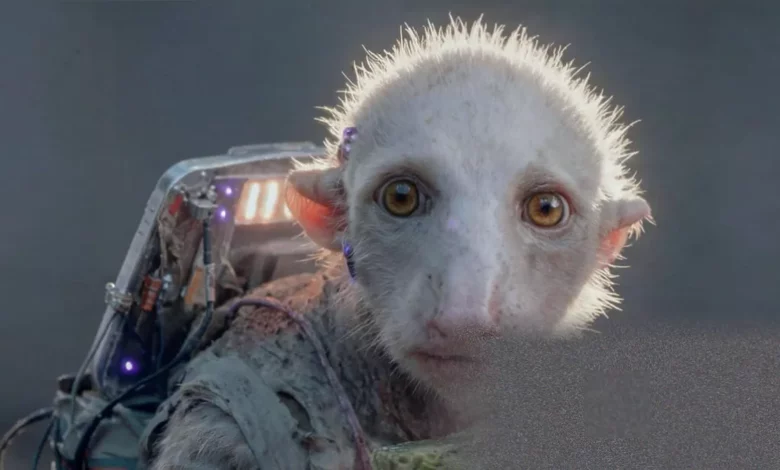
In a former hemstitching workshop where artisans once sewed pleats for Stockholm’s 19th-century bourgeoisie, a distinctly 21st-century craft is taking root: AI film-making. One day last week, an actor, director and composer squeezed into a tiny studio booth to record a voiceover for their next release, fussing over a monologue by a poetic Scottish gorilla inhabiting a transhumanist cyberpunk universe. “It was a bit like recording The Archers,” one of them joked. Despite critics who disparage AI movies as “automated slop” or cheating, the operation had a distinctly homespun feel.
A new film studio in a former sewing workshop
The production is the work of Gossip Goblin, the nom de plume of Zack London, a 35-year-old transplant from California to Sweden who leads a tiny kitchen-table AI film-making outfit. London calculates his audience at more than 500 million views, and his speciality is grotesque and satirical sci-fi shorts that riff on the absurdities and anxieties of the technological zeitgeist. The films are knocked together at low cost using off-the-shelf AI tools — including Midjourney, the Chinese model Seedance and Google’s Nano Banana — and a team of eight collaborators dotted across Europe. London buys credits for these tools and uses his laptop to create a dystopian world of cybernetic slums where characters are part “wet-ware” (flesh) and part hardware, allowing them to be zapped into parallel universes — if they can afford it. Speed is a key advantage: he can release Instagram shorts every few days, and with each short he creates what Hollywood craves: fresh intellectual property.
This is no longer a hobby. Heavyweight Los Angeles talent agents, movie producers, screenwriters, studios, streamers and A-list actors are clamouring to get involved, with some leading Hollywood figures boarding flights to Stockholm in the coming weeks, intrigued not least by Gossip Goblin’s surging Instagram and YouTube audience numbers. London has been making AI films for just over three years, but the spotlight is intensifying. Mathieu Kassovitz, the award-winning director of La Haine, said he shivered when he saw the emotion in the eyes of one of London’s AI-generated actors. Last month podcaster Joe Rogan declared, “It’s amazing – I might follow that guy,” showing his hundreds of millions of viewers a clip of a character plugged into a “dream-spool” and experiencing a hallucinogenic parallel life as a goldfish. Other AI filmmakers such as Neural Viz and Kavanthekid are also gathering millions of views, defying the negative reactions to initiatives including a feature starring AI versions of the late actor Val Kilmer and the attempt to launch the career of the AI-generated actor “Tilly Norwood”.
London’s first 20-minute film, The Patchwright, got 11 million views, and he has attracted a respected songwriter and producer, Sebastian Furrer, to score his next longer film. Furrer, who worked with the Swedish EDM superstar Avicii, said he was attracted by the “sometimes uncomfortable” quality of the heightened sequences. “I like that because it makes you feel something,” Furrer said. “The AI here is more like a tool. The only thing I object to about AI is to use it to make things for you. There needs to be a human behind it. That’s what Zack is doing.” London insists he and his collaborators — not the AI — are in control, repeatedly prompting the systems to get the right performances. He writes the scripts and views AI as a “visualization tool” and a “new form of storytelling,” emphasising that the art lies in world-building, selection, rewriting and judgement calls. He acknowledges the limits: “We’re not going for quiet, subtle, Olivia Colman, Anthony Hopkins films. We adapt to the limits of AI acting.” Yet his work also digs for emotional heart — in one story, a jaded aristocrat comes alive only when he experiences the pure, short lifespan of a fruitfly.
The copyright storm: training data, authorship and the law
The rising movement triggers despair for critics who fume about “ugly slop” and “AI sludge”, robots replacing human creativity and copyright piracy in AI model training. Artists from Elton John to Scarlett Johansson and Breaking Bad creator Vince Gilligan have called the training of AI models on their work without permission theft. London’s view is blunt: “That ship has kind of sailed.” He argues it is impossible to determine how the models’ intelligence is formed because they have absorbed such vast bodies of information. “It’s all been mushed into a grey goo,” he says. Instead, he argues, film-makers must ensure what they produce is not theft: “If I’m making Darth Vader kill Mickey Mouse then I’m stealing … Where it lands for me is [the question of] can you demonstrate sufficient authorship?”
The legal landscape remains unsettled. In the United States, the Copyright Office requires “human authorship” for copyright protection, meaning purely AI-generated works may not qualify, although human creative input in prompts, curation, and transformation can establish copyrightable aspects. The UK’s Copyright, Designs and Patents Act 1988 designates the person who undertakes the necessary arrangements for a computer-generated work as its author. However, the UK government is currently consulting on AI copyright rules, aiming to balance innovation with creators’ rights, with a focus on consent and fair compensation. It recently altered its position, deciding against introducing an “opt-out” copyright exception for AI training and opting instead to gather more evidence and focus on licensing agreements. The EU AI Act, coming into full effect in August 2026, will mandate the labelling of AI-generated or manipulated content.
Lawsuits have been filed against AI image generation platforms such as Midjourney over alleged copyright infringement in their training data. Meanwhile, the use of digital replicas — such as the AI-generated actress Tilly Norwood produced by Particle 6 Productions — has stirred particular outrage. The actors’ union SAG-AFTRA has stated that Tilly Norwood is not an actor but a computer program trained on performers’ work without consent, while Particle 6 claims she could cut production costs by 90%. The ethical debate also encompasses job displacement (unions like SAG-AFTRA actively protect human performers), bias and misrepresentation from algorithms trained on skewed data, and broader concerns about transparency. The British Film Institute has called for standards around content provenance. Mathieu Kassovitz, who is working on an almost entirely AI-enabled film, has dismissed copyright concerns with the exclamation, “Fuck copyright,” and co-founded Venturi Production to integrate technology into filmmaking.
London’s own production costs are a fraction of conventional budgets: he estimates about $500,000 per hour of finished film when factoring in AI models and payments for human editing, design, acting and music. Industry-wide, AI video production can range from $0.50 to $30 per minute, compared with $1,000 to $50,000 per minute for traditional methods. The cost advantage is driving major industry shifts: Pinewood, where Star Wars and Bridgerton were shot, recently secured permission to build an AI datacentre in Buckinghamshire where new studios had been planned. Plans to build more traditional TV and film sound stages are being frozen.
AI film-makers stand on the brink of a breakthrough that backers believe will unleash a new wave of creativity, freeing artists from “red lights” imposed by studio gatekeepers. “Way back in films in the 1920s it was anarchy, but people with good ideas could get them through without having to go through the gatekeepers saying ‘that’s not going to work’,” London says. “I have found myself at the inception of a new thing where there are no rules.” He creates quickly made vertical videos that tackle trends like looksmaxxing and ICE raids, some getting up to seven million views — though his audience skews heavily toward young men and includes very few women. A resonant recurring theme in his work is the quandary of what it means to be human in a world of ever more powerful technology, a question no longer just sci-fi speculation as AI seeps into offices and classrooms.
Yet as AI tears down barriers to entry, London admits he is worried that “there’s a tsunami of shit on the horizon.” Whether Gossip Goblin is part of that wave will be a question of taste. But for now, Hollywood calls. As he deliberates whether to work with a studio — partly to establish AI film in the wider culture and show “we are not the same as the person making Fruit Love Island TikTok” — the future of distribution is likely to be direct to consumers, London says. The debate over whether AI will replace human creativity or serve as a powerful new tool continues, but in a former hemstitching workshop in Stockholm, the next act is already being scripted.