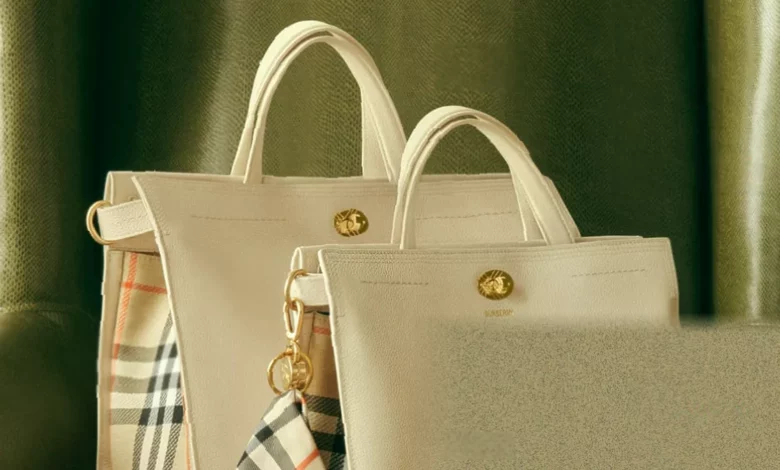
Burberry’s new £2,000 handbag named after the Cotswolds has bolstered sales, with the luxury fashion house reporting its strongest performance in bag sales since 2023 as wealthy American shoppers flock to the brand’s heritage-inspired designs.
The Cotswolds handbag success
Joshua Schulman, Burberry’s chief executive who joined the company in 2024, said the Cotswolds tote bags – which blend leather with the signature Burberry check – had proved a hit during the Mother’s Day period in North America. “The customer has been responding to our vintage check introductions and Cotswolds lines,” Schulman said. “We’ve hit a sweet spot on price and value for money in a luxury context.”
The Cotswolds bags are priced at “around and under £2,000” – approximately $2,650 USD – placing them at a more accessible luxury price point than the Knight bag they replaced. The Knight bag, which Schulman said had been phased out, retailed at more than £2,400 for certain versions.
The Cotswolds region itself, which runs through counties including Gloucestershire and Oxfordshire, has become increasingly popular with wealthy Americans and is often referred to as the “Hamptons of England”. Known for its picturesque villages, rolling hills, luxury homes and upscale rural hotels, the area has seen a surge in American interest, with real estate professionals reporting that property prices in some “golden triangle” villages have risen by about 30% in the past year. Industry reports have noted that American tech founders, media moguls and billionaires are actively seeking historic properties there, while figures such as Ellen DeGeneres have lived in the region and rumours have circulated that Beyoncé and Jay-Z have looked for property. Even US Vice President J.D. Vance was reported to be vacationing in the Cotswolds.
A strategic pivot
The success of the Cotswolds handbag marks a deliberate departure from the strategy pursued under Burberry’s previous management. Schulman said that past leadership had focused “all attention on bags and having those at pinnacle price points without recognisable brand signatures” – an approach he bluntly described as one that “didn’t work”.
By contrast, the Cotswolds line explicitly draws on Burberry’s heritage: the iconic check pattern, first created in 1920 as a lining for trench coats and later adopted as a staple on scarves, umbrellas and leather goods, is front and centre. Schulman’s “Burberry Forward” strategic reset aims to rebalance the pricing pyramid, increase access to heritage-led staples and reduce reliance on ultra-high-priced items. The revival has been led by core categories such as scarves and outerwear, but Schulman said ready-to-wear sales had now “taken off”, bag sales were beginning to improve and the brand had “strong attraction” among younger shoppers.
Under previous leadership, Burberry had focused heavily on high-priced leather goods without prominent brand signatures – including the TB bag introduced by Riccardo Tisci – a direction that failed to resonate. The Cotswolds bags, by contrast, offer a blend of leather and the unmistakable check, marrying practicality and simple beauty with the brand’s identifiable heritage.
Financial turnaround
Burberry on Thursday reported a return to full-year profitability, posting pre-tax profits of £49 million for the year to 28 March, compared with a loss of £66 million in the previous 12 months. The company achieved this by cutting £80 million in annual costs, trimming store numbers and winning back shoppers in both China and North America.
Sales were flat year on year once the impact of exchange rates was taken into account, at £2.4 billion. However, the company reported a return to comparable sales growth from the second quarter onwards, with retail comparable store sales up 2% for the full 52 weeks – a sharp improvement from the 12% decline in the prior year. Both Greater China and the Americas delivered double-digit comparable sales growth in the fourth quarter.
Schulman expressed optimism about the medium-term outlook: “I am more optimistic than ever that Burberry can meet the £3bn [sales] milestone and go beyond that.”
Geopolitical headwinds and cautious confidence
Global sales were knocked back by poor performance in Europe and the Middle East, where travel was affected by the ongoing conflict in the Middle East, described as the “Iran war”. Burberry reported a 2% decline in comparable sales across the EMEA and India region, with the Middle East accounting for just 2% of the group’s global sales. The broader luxury sector has been hit hard: Dubai’s luxury malls have seen footfall and sales drop sharply, with some retailers reporting revenue declines of 30-50% in March 2026 compared with the previous year, affecting major groups including LVMH, Kering (Gucci) and Hermès.
Shares in Burberry fell 5% on Thursday amid fears about the conflict’s impact, though the stock has shown signs of recovery from earlier lows. Kate Ferry, Burberry’s finance director, said the company was confident it could meet the consensus of analysts’ profit expectations for the year ahead. “We have great momentum starting the year and we are confident we are going to make progress on sales growth and margin,” she said.
Burberry has acknowledged being “mindful of the uncertain geopolitical and macro-economic environment and its potential impact on consumer confidence”. The company is also navigating shifting luxury handbag trends for 2026, which include ultra-soft silhouettes, textured materials, larger practical bags and a move towards understated elegance and “quiet luxury” with less emphasis on overt logos.
On the sustainability front, Burberry has pledged to become climate positive by 2040 and aims to reduce supply-chain emissions by 46% by 2030. The brand is committed to using 100% responsibly sourced raw materials by FY 2029/30 (its Heritage Trench Coats already use organically grown cotton), is eliminating plastic from consumer packaging by FY 2025/26, and has issued a £300 million sustainability bond to fund green initiatives. The company is also expanding aftercare services including repair, reproofing and resale.
Analysts generally rate Burberry as a ‘buy’ with a mean long-term price target suggesting upside from current levels, and investors are closely monitoring the “Burberry Forward” strategy for signs that the turnaround is sustainable. Meanwhile, the company has announced that chairman Gerry Murphy is set to retire in November 2026, to be succeeded by William Jackson after a comprehensive selection process.