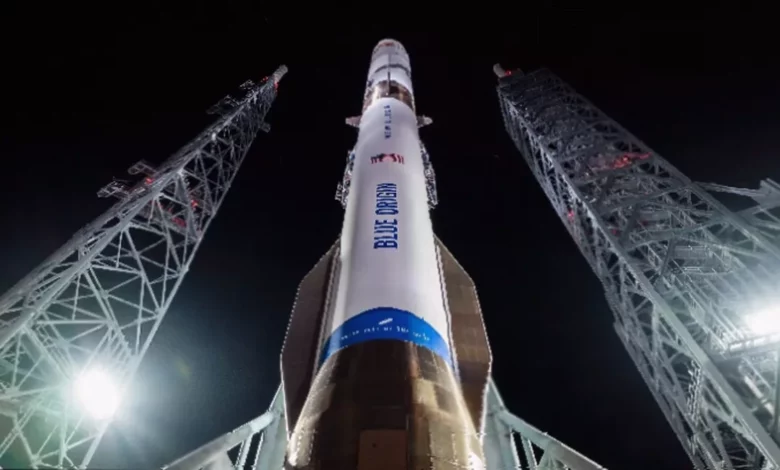
Blue Origin, the aerospace company founded by Jeff Bezos, is exploring its first external fundraising round as it seeks to compete with SpaceX’s dominance in the commercial space market, according to a Financial Times report citing an internal meeting with chief executive Dave Limp. The move marks a strategic shift for a company that has been funded almost entirely by Bezos’s personal wealth since its inception in 2000.
Fundraising shift
Dave Limp, who joined Blue Origin from Amazon in 2023, told employees during the internal meeting that the company may need outside capital to meet its ambitious launch goals. Scaling up rocket launches will “take a lot of capital,” more than what can be supported by a single backer, even one as wealthy as Bezos, according to the report. Limp said the company needs to be “ready for external funding” and predicted strong investor interest. He also hinted that an initial public offering could be possible in the future, though no formal plans have been announced.
Bezos has historically funded Blue Origin through annual sales of Amazon stock, estimated at around $1 billion per year, with his total investment by late 2025 estimated at between $10 billion and $20 billion. The company’s current phase, however, requires more aggressive investment, prompting the exploration of external funding. This consideration also follows reports of employee discontent over previous payout plans, which were perceived as less favourable compared to those offered by SpaceX.
While Blue Origin has raised some disclosed funding — including an $18 million round in January 2024 — it has largely been financed by Bezos. The company has secured significant government contracts, including a $3.4 billion award from NASA for its lunar lander and a $2.38 billion Department of Defense contract. Analysts estimate Blue Origin’s spending at roughly $4.8 billion this year, bringing its estimated total budget since inception close to $28 billion.
Competition with SpaceX
The fundraising considerations come at a time when SpaceX is preparing for a potential IPO that could value the company at over $1.75 trillion, with some estimates placing the valuation as high as $2 trillion. SpaceX already dominates the global launch market, holding over 60% of the market share and an estimated 80–85% of U.S. space launches in recent years, according to market data. Its reusable rocket technology, particularly the Falcon 9, has significantly reduced costs and increased launch frequency. The company generated an estimated $8 billion in revenue in 2023, with launch services contributing $3.5 billion. However, SpaceX reported a net loss in 2025, partly attributed to its acquisition of xAI, leading some analysts to warn that its IPO valuation may be overinflated.
Blue Origin is pursuing several initiatives to compete directly with SpaceX. The company successfully reached orbit with its heavy-lift New Glenn rocket in early 2025, a major milestone. The second New Glenn launch (NG-2) in November 2025 successfully delivered payloads, including NASA’s ESCAPADE mission, and achieved its first successful first-stage landing. The third launch (NG-3) in April 2026 experienced an issue where the payload was placed in an off-nominal orbit, though the booster successfully landed, marking the first re-use of a New Glenn booster.
In the lunar lander segment, Blue Origin is developing the Blue Moon Mark 2 crewed lander for NASA’s Artemis program, directly competing with SpaceX’s offering. A full-scale mockup of the crew cabin has been delivered to NASA’s Johnson Space Center for astronaut training. The Artemis III mission, which relies on these landers, has been delayed to no earlier than late 2027, with the first crewed lunar landing shifted to the Artemis IV mission, nominally scheduled for 2028. The uncrewed cargo variant, Blue Moon Mark 1, has completed environmental testing.
Blue Origin is also developing the TeraWave satellite network, designed to deliver symmetrical data speeds of up to 6 terabits per second for enterprise, data centre, and government users. The constellation will comprise 5,280 low-Earth orbit satellites and 128 medium-Earth orbit satellites, with deployment planned to begin in the fourth quarter of 2027. This initiative positions Blue Origin more directly against SpaceX’s Starlink, as well as Amazon’s own Project Kuiper (now Amazon Leo) and other competitors such as OneWeb and Chinese venture SpaceSail.
Additionally, Blue Origin has filed a Federal Communications Commission application for “Project Sunrise,” proposing up to 51,600 satellites to host data centres in orbit for processing AI workloads. The company argues this approach could leverage continuous solar power and avoid terrestrial infrastructure constraints, though critics question the technology’s viability. Blue Origin is also partnering with Sierra Space and others to develop “Orbital Reef,” a commercially owned and operated space station in low-Earth orbit, expected to begin operations in the latter half of this decade.
Ambitious launch goals and infrastructure needs
Blue Origin is targeting up to a dozen launches this year using the New Glenn rocket, with a long-term vision of reaching 100 launches annually. A large portion of these missions could support its planned satellite network, further positioning the company against Starlink. Achieving this launch cadence requires substantial capital investment in infrastructure, manufacturing capacity, and advanced rocket engines.
The company’s first stage is designed for a minimum of 25 flights, and it has successfully landed and is planning to re-fly boosters. Building new manufacturing facilities, expanding launch sites, and increasing engine production are all essential to meeting the target of 12 launches this year and the eventual goal of 100. Blue Origin is reportedly planning a significant industrial campus in Hutto, Texas, involving an investment of over $650 million, potentially reaching $1 billion, and creating over 2,000 jobs. This project, referred to as “Project Blue Hub,” aims to establish a manufacturing and logistics hub to support the company’s scaling ambitions.
The capital needed for such expansion exceeds what Bezos alone can provide, even with his substantial annual stock sales. Dave Limp’s internal message made clear that the company is now in a phase requiring more aggressive investment than its historical model allowed. The exploration of external funding — whether through private investment, an eventual IPO, or a combination — reflects the reality that competing with SpaceX’s scale and market share demands access to the same kind of capital markets that SpaceX itself is now leveraging through its planned public offering.