Cremation, the most common deathcare method in Australia and many Western countries, is also the most environmentally damaging. A typical gas cremation releases a plume of emissions equivalent to about 125 kg of carbon dioxide, according to sustainability certifiers PlanetMark, while in the United Kingdom a single cremation produces approximately 126 kg of CO₂ equivalent – comparable to driving from Brighton to Edinburgh. The plume contains methane, nitrous oxides, sulphur dioxide, volatile organic compounds and fine particles. Mercury from dental fillings is vaporised during the process; in the UK, crematoria accounted for 16 per cent of the country’s mercury emissions in 2005. Other industry figures suggest the actual emissions from cremation could be even higher. Modern crematoria are regulated and fitted with filtration systems, but the environmental cost remains significant.
Traditional burials, the other common choice, carry their own environmental burden. Embalming fluid containing formaldehyde can leach into the soil as bodies and treated timber coffins break down. The production of hardwood or metal coffins is energy-intensive, and ongoing cemetery maintenance – watering, mowing, pesticide use – releases greenhouse gases and consumes resources. Land taken up by cemeteries, particularly in urban areas, also raises concerns.
Cleaner alternatives
“Basically the entirety of our history as an Australian society, we’ve only really done two things and that was seen as entirely sufficient,” said Dr Kate Falconer, a death law researcher at University College Cork in Ireland. But Dr Domenic Trimboli, an architect and urban planner at Curtin University who has studied funerary practices, noted that Australians are increasingly open to alternative farewells. “Many people, regardless of age, had thought about what they wanted to have happen to them, and there was definitely a curiosity about alternatives,” he said.
Natural burials offer a gentler option. The deceased receives minimal preparation or embalming and is buried in a natural-fibre cloth shroud or biodegradable coffin at a shallow depth. Decomposition into the surrounding soil takes about a decade, releasing negligible greenhouse gases and returning the body to the earth. In the UK there are now around 300 natural burial grounds, each with its own regulations. The Natural Burial Company, for example, permits only environmentally friendly coffins and shrouds, and prohibits plastic flowers, vases and non-biodegradable decorations. Old Park Meadow similarly bans gardening of plots, artificial flowers and non-biodegradable memorials.
New cremation technologies are also gaining ground. Aquamation – also called resomation or alkaline hydrolysis – uses water and an alkaline solution rather than fire. The body breaks down within hours, leaving bone fragments that are powdered and returned to the family. The process is more energy-efficient than gas cremation and produces far fewer emissions. In the UK, water cremation became legal in Scotland in March 2026, making it the first nation in the UK to approve the method. It remains illegal in England, Wales and Northern Ireland, though legislative reviews are under way and facilities are being planned. The process is already available in parts of Australia, Canada and the United States.
Human composting, or terramation – the transformation of a body into nutrient-rich soil over several weeks – is not yet legal in England and Wales, but the Law Commission has consulted on legalising new funerary methods including this one. Terramation UK is actively campaigning for approval. In Australia, independent New South Wales MP Alex Greenwich this week introduced a bill to state parliament to allow the process. During terramation, the body is placed in a coffin-like vessel with organic materials such as wood chips and straw, allowing natural decomposition by microbes and fungi.
Sustainable coffins
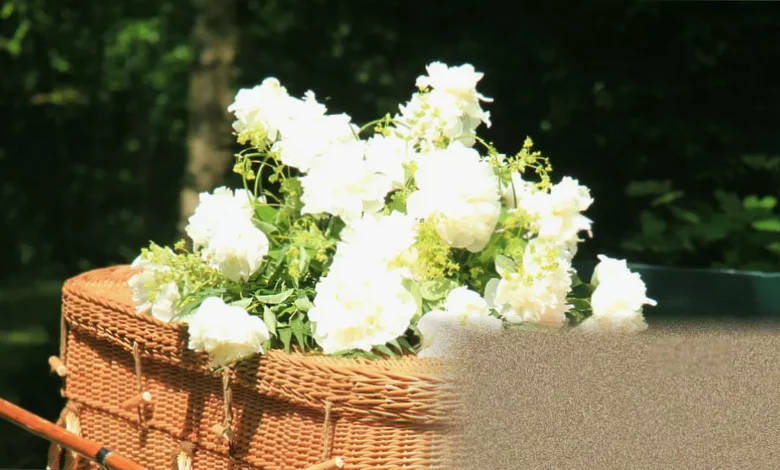
Even where traditional methods are chosen, smaller changes can make a difference. “I don’t think a lot of people realise how bad coffins are,” Falconer said. “A lot of coffins might be wood, but they’re often coated in lacquer, they’ve got plastic linings, the handles are all plastic … as a rule coffins are generally imported.” Swapping a lacquered coffin with plastic parts for untreated pine, cardboard or a wicker basket reduces emissions significantly. PlanetMark estimates a mahogany veneer coffin with plastic handles and lining leads to more than 170 kg of emissions if cremated, whereas a natural burial with a cardboard coffin and rope handles emits less than 10 kg. A biodegradable bag had the lowest emissions of any vessel in the analysis, at just 0.3 kg. A wide range of eco-friendly coffin materials is now available – willow, bamboo, banana leaf, cane, pandanus, seagrass and wool – many of which are biodegradable and sustainably sourced. In some cases a simple cotton shroud or woollen blanket can be used instead of a coffin.
Trimboli said some of the alternatives do not cost much more than cremation. “There’s no reason that over time that can’t become a lot more competitive, if it’s not already,” he said.
Industry changes and public awareness
The push for more sustainable deathcare is not only coming from consumers. Sharyn Moll, a former funeral director and national councillor for the industry peak body Funerals Australia, helped develop a “Better practice sustainability guide for funeral directors” that was published last year. “A lot of the call for sustainable practices is actually coming from the industry rather than from the public,” Moll said. “Every business needs to try and be more sustainable, so it’s just good business really.”
Falconer said regulatory ambiguity and inconsistency make it hard to achieve nationwide impact, but the biggest obstacle is that most Australians leave funeral decisions until after a loved one dies. “The tiniest of decisions has significant environmental impacts,” she said. Executors forced to make quick choices while grieving often default to traditional burials or cremations, she added. Moll agreed: “If people insist on having what they see as a ‘standard’ funeral, then that’s what we have to give them. What the industry would really like to see is people becoming more aware of what’s available, what’s out there, so they can think all that through, talk with family about it, so when the time comes, they already know what they would like.”