Donald Trump’s injection of $75m into a proposed coal export terminal in West Oakland has breathed new life into a decade-long battle, with local organisers and environmental groups mobilising to stop a project they say would inflict “generational harm” on one of California’s most pollution-burdened communities.
The funding, announced by the president on 4 June, is part of a wider $700m initiative to revive the US coal industry, using the Defense Production Act — a Cold War-era law that gives the president broad authority over industries deemed vital to national security. The money is earmarked for the West Gateway Terminal Project, a rail-served marine export facility at the Port of Oakland that the administration says will expand West Coast capacity for shipping coal to allied nations including Japan, South Korea, Taiwan, Vietnam and Malaysia.
Trump’s announcement has “accelerated everything”, said Veronica Eady, executive director of the West Oakland Environmental Indicators Project, a grassroots environmental justice group. “Now there is even more urgency, particularly since President Trump said he wants it to start this summer.” Since the announcement, the No Coal in Oakland and Keep Coal Out of the East Bay coalitions have held strategy meetings to discuss how to continue their fight against the terminal. “Our main strategy is about financing,” said Margaret Rossoff, a member of No Coal in Oakland. She pointed to estimates that the terminal will cost close to $400m to build. “$75m is not even a quarter of that. Some investors need to decide to sink a lot of money into this. And our goal is to prevent them from doing that, prevent anyone from doing that, by making it clear that it’s a bad idea.”
A decade of local opposition and evolving strategies
The plan to build a shipping terminal on city-owned land at the former Oakland Army Base — closed in 1999 and later bought by local developer Phil Tagami — has been in the works for more than a decade. Tagami initially assured the city that the multi-purpose facility would not handle coal. But in 2015 he pivoted after the state of Utah approached him with a deal to ship the state’s coal to overseas markets via the port — a contract worth $53m in project funding, according to an agreement with four Utah counties.
The Oakland City Council responded unanimously in June 2016 by banning the handling and storage of coal and petroleum coke within the city, citing health and safety concerns over coal dust and the contribution to climate change. That ban triggered a series of lawsuits from Tagami’s companies, which argued the city had breached its development contract. After years of litigation — including a ruling by an Alameda County Superior Court judge in 2023 that Oakland had improperly terminated its contract — the California supreme court declined in September 2025 to review an appellate ruling that favoured the developer, effectively ending the city’s legal opposition.
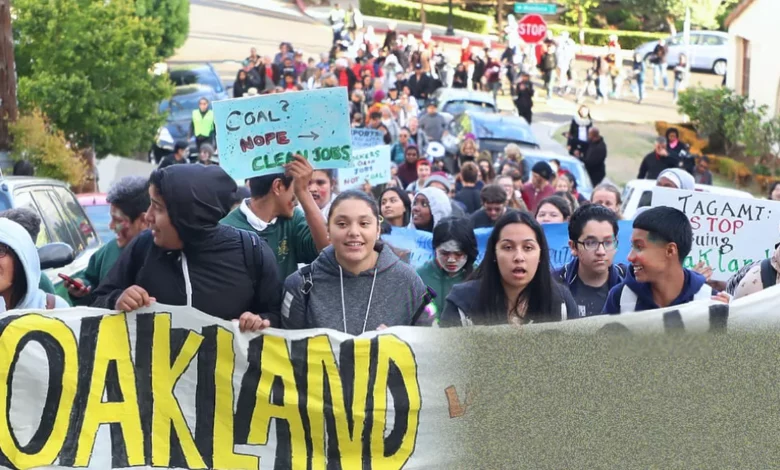
West Oakland, the neighbourhood that would host the terminal, has a rich history of Black activism, from the Pullman Porters’ union to the Black Panthers. But it is also one of the most environmentally degraded areas in the state, bordered by a major highway, the Port of Oakland and logistics hubs. According to an assessment for the Environmental Protection Agency, the area is filled with “pollutant-emitting industry and infrastructure”, with a history of redlining and systemic racism. Over the past decade, residents have fought issues from toxic waste buried under homes to childhood asthma rates caused by traffic-related air pollution. Local organisers have cited fears that trains delivering coal shipments will coat the neighbourhood in coal dust, exacerbating existing health problems such as high rates of asthma, cardiovascular disease and cancer.
Even after the California supreme court ruling, the opposition did not relent. “There may have been a misperception that once the city of Oakland lost, then it was over,” said Eady. “We were getting out there to let people know: Hey, it’s not over. There are all these permitting decisions.” In April, organisers petitioned the Bay Area air district to impose stricter air regulations on the terminal. The goal of community meetings — including one planned for 25 June in Berkeley — has become “to further our demand for action by state and local political and regulatory bodies”, the No Coal in Oakland coalition wrote in a blogpost.
Political opposition has also been vocal. California state assembly member Mia Bonta said in a statement: “By injecting millions of taxpayer dollars into a coal terminal that Oaklanders have fought for a decade to stop, this administration is sentencing West Oakland, one of the most pollution-burdened communities in California, to generational harm. The families who have fought the hardest to keep this terminal out of their neighborhood will bear the highest cost.” US representative Lateefah Simon said in an email: “The Trump administration does not have West Oakland’s best interests at heart. I am committed [to] using every tool in our toolbox to stop this coal terminal and fighting on behalf of our residents. Oaklanders and our bodies should not have to pay the price for the administration’s illogical, backwards policies.”
Newly elected Oakland mayor Barbara Lee — a trailblazing former congresswoman — has not yet released a statement on Trump’s announcement, but she signed a pledge during her 2025 campaign not to accept money from coal interests. “I strongly support Oakland’s ban on coal and will continue to fight against any attempts to bring coal shipments through our city,” she said at the time.
Future strategies: financing, permits and community pressure
While the federal funding has given the project a shot of momentum, organisers insist it is far from a done deal. Colin O’Brien, deputy managing attorney of Earthjustice’s California regional office, said in an email: “This bad idea to build a dirty, polluting coal facility in an already overburdened community emerged more than a decade ago, and yet we still do not yet have concrete details on facility design or operations. The federal funding announcement is far from the final word because the project still needs dozens of permits, meaning close scrutiny by local regulators and opportunities for the public to weigh in.” Earthjustice and San Francisco Baykeeper have stated they will use “every legal, regulatory, and advocacy tool” to block the terminal.
Tagami, whose company Oakland Bulk Oversized Terminal (OBOT) is behind the project, has indicated construction could begin as early as summer 2026, with the terminal operational by summer 2028. He has claimed the facility will feature “cutting-edge” safety systems and dust suppression technology, and that it would create hundreds of jobs — a claim opponents dispute, arguing the permanent job numbers are far lower and the health costs far higher.
There are also unresolved legal matters. A federal court case is ongoing in which Insight Terminal Solutions, a company that intended to operate the terminal, alleged that Oakland interfered with its development, leading to bankruptcy. Meanwhile, No Coal in Oakland has printed and distributed yard signs opposing the terminal in the past, “and we’re gonna distribute hundreds more”, said Rossoff. “So any potential investor who’s driving around the Bay Area is going to see evidence of the entrenched community opposition.”
The coalition’s 25 June meeting, to be held in Berkeley, aims to involve residents from across the East Bay — because while the terminal would be in Oakland, the trains that will transport coal to it are set to run through Martinez, Richmond, Berkeley and other cities. Sarah Ranney, director of the Sierra Club’s San Francisco Bay chapter, said in a press release: “Residents have fought for years to keep this terminal from being built in their back yard. Trump is using the [Defense Production Act], which is meant to mobilise industries during a genuine emergency, to override that opposition. This isn’t national defense; it’s an end run around local democracy.”