Blue Energy has raised $380 million to build factory-made nuclear plants, in a funding round led by VXI Capital with significant backing from Engine Ventures and participation from existing investors At One Ventures and Tamarack Global.
Funding led by VXI Capital
The US-based startup, founded in 2023 by Jake Jurewicz and Matt Slotkin out of MIT’s Nuclear Science and Engineering Department, will use the money to purchase key equipment, develop projects, and cover general corporate needs. VXI Capital, a venture firm based in Park City, Utah, that was founded in 2023, employs a “barbell” investment strategy, investing around Series A rounds before deploying larger capital at Series C or D. Engine Ventures, founded in 2017 and based in Cambridge, Massachusetts, focuses on “Tough Tech” founders in climate, human health and advanced systems, and had previously invested in Blue Energy. At One Ventures, established in 2020 in San Francisco, backs deep-tech climate companies with an emphasis on unit economics and environmental returns, and was also a prior investor. Tamarack Global, named as an existing investor, also participated.
Factory-built approach cuts construction time
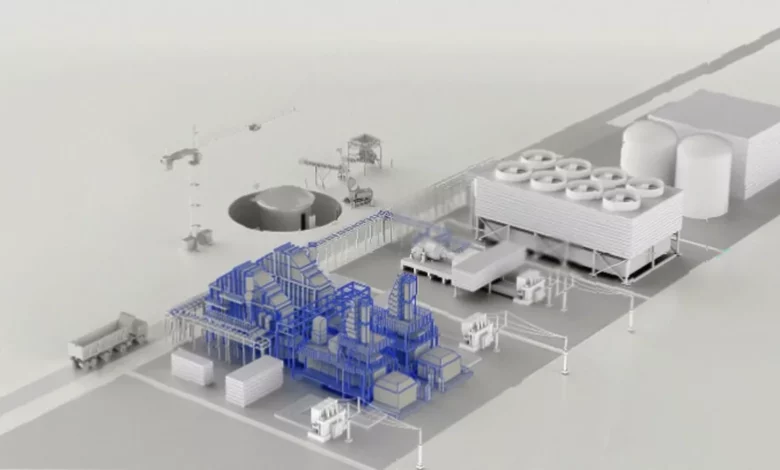
Blue Energy’s core innovation is a prefabricated, factory-built nuclear plant designed for project financing rather than government subsidy. Instead of building everything on-site, components are manufactured off-site in controlled factory conditions, reducing variability and shortening timelines. The company claims deployment in as little as 48 months, compared with an industry norm of decades.
A notable regulatory milestone is the US Nuclear Regulatory Commission’s (NRC) approval of Blue Energy’s approach to resequencing construction phases. This model separates nuclear and non-nuclear components, allowing the initial fabrication and installation of non-nuclear infrastructure while nuclear components undergo licensing and construction. The company’s licensing topical report, approved by the NRC, supports this streamlined deployment strategy, potentially reducing conventional nuclear timelines by at least five years. The pathway has been further strengthened by Blue Energy’s qualification under the ADVANCE Act, enacted in 2024 to streamline NRC licensing processes for next-generation nuclear technologies.
The company will initially power its turbines with natural gas before converting to nuclear power — a “gas-to-nuclear” bridge strategy that significantly reduces early-stage capital exposure and allows faster site energization. Blue Energy’s plant architecture also separates nuclear and non-nuclear systems, enabling the majority of the plant to be manufactured in commercial shipyards on fixed-cost contracts. This draws inspiration from the liquefied natural gas industry and leverages large-scale manufacturing capabilities.
By focusing on prefabrication, standardized delivery, and fixed-price contracting, the company aims to reduce the delays, cost overruns, and financing uncertainty that have historically hindered private investment in nuclear energy. The approach treats nuclear plants as private infrastructure investments rather than public works, thereby unlocking project financing.
First Texas plant and competitive landscape
Construction of Blue Energy’s first Texas plant is scheduled to start in the third quarter of 2026. The facility is designed to generate up to 1.5 gigawatts of capacity, primarily to supply AI data centres and advanced manufacturing operations. The company aims to provide affordable, reliable baseload power that is competitive with fossil fuels and renewables.
Blue Energy’s main competitors in the small modular reactor (SMR) and advanced nuclear field include NuScale Power, X-energy, and Kairos Power. The wider advanced nuclear sector also includes Oklo, backed by Sam Altman, which is developing fast-fission power plants for off-grid applications such as data centres, and Commonwealth Fusion Systems (CFS), an MIT spin-off that plans to build the world’s first grid-scale commercial fusion power plant in Virginia by the early 2030s. CFS utilises high-temperature superconducting magnets developed with MIT, and Google has signed a direct corporate power purchase agreement with CFS for power from its ARC project. What sets Blue Energy apart is its focus on project financeability, treating nuclear plants as private infrastructure investments instead of public works — an approach that aligns with broader trends in the advanced nuclear sector emphasising reduced costs, shorter timelines, and private capital deployment.
The development of advanced nuclear technologies, including SMRs and advanced modular reactors, is also a key focus for the UK government as part of its clean energy strategy. The UK’s Advanced Nuclear Framework aims to stimulate private investment by providing a clear route to market and support for credible projects, including an “Advanced Nuclear Pipeline” to help unlock private investment and build developer confidence. In the US, the Department of Energy is actively promoting advanced nuclear technologies, particularly for powering AI data centres.