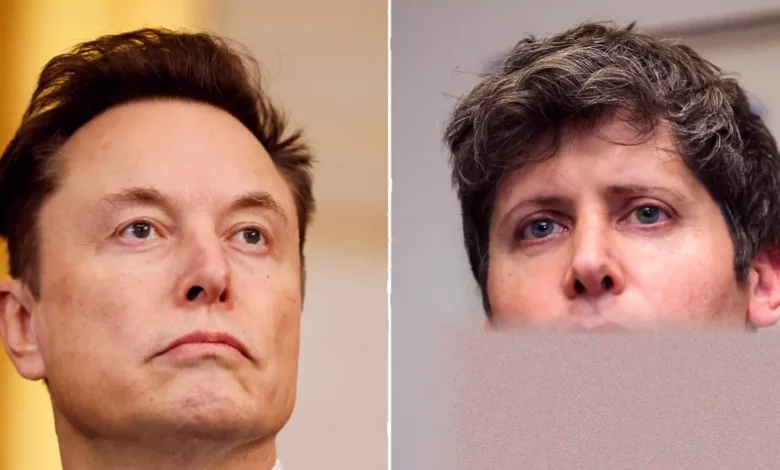
Elon Musk is suing Sam Altman and OpenAI for more than $134bn, bringing a bitter feud between two of Silicon Valley’s most powerful figures to a federal courtroom in Oakland, California, where jury selection begins on Monday.
The lawsuit, filed in 2024 and now heading to trial before Judge Yvonne Gonzalez Rogers, centres on the core accusation that Altman broke the founding agreement of the artificial intelligence company by abandoning its original nonprofit structure and converting the business into a for-profit enterprise. Musk alleges that Altman deceived him with promises that OpenAI would operate solely for the benefit of humanity, only to “cash in” through lucrative deals with Microsoft and the creation of for-profit affiliates once Musk’s money — about $38m — was secured. In court filings, Musk’s complaint opens with the claim that his case is “a textbook tale of altruism versus greed”, and describes the alleged deception as “the hook for Altman’s long con”.
The founding agreement
OpenAI was founded on December 8, 2015, as a nonprofit organisation by a group of tech entrepreneurs and researchers including Musk, Altman, Greg Brockman, Ilya Sutskever, and several others. The company’s original mission statement, published in late 2015, declared: “OpenAI is a non-profit artificial intelligence research company. Our goal is to advance digital intelligence in the way that is most likely to benefit humanity as a whole, unconstrained by a need to generate financial return.” A total of $1bn in capital was pledged by founders and supporters, though by 2021 the actual amount collected was significantly smaller, around $133.2m.
You stole a non-profit
— Elon Musk (@elonmusk) November 1, 2025
Musk’s suit alleges that Altman originally brought him into the project by email in May 2015, writing: “Been thinking a lot about whether it’s possible to stop humanity from developing AI. I think the answer is almost definitely not. If it’s going to happen anyway, it seems like it would be good for someone other than Google to do it first.” The relationship between the two men deteriorated around 2017 after Musk became impatient with progress and made a failed attempt to exert more control. He left OpenAI’s board in 2018 and stopped providing funding.
The dispute over the shift to for-profit
Musk’s case focuses on the company’s restructuring away from its nonprofit roots. In 2019, OpenAI established a “capped-profit” subsidiary under the control of the nonprofit, a move designed to attract investment and offer equity to employees. Then in 2024, the company announced plans to restructure further into a for-profit entity. That restructuring was completed in October 2025, converting the main business into a public benefit corporation called OpenAI Group PBC, with the original nonprofit becoming the OpenAI Foundation. Under this new structure, Microsoft holds a substantial stake valued at approximately $135bn, representing about 27% of the for-profit entity. The OpenAI Foundation retains control through its board, which also governs the for-profit arm.
Musk alleges that Altman’s dealmaking and the shift to a for-profit model break the fundamental mission of the company as a nonprofit to benefit humanity, amounting to a breach of charitable trust. The suit also claims Altman and Brockman unjustly enriched themselves through their control of the company. Musk is seeking the removal of Altman and Brockman from their leadership positions, the reversal of the restructuring as a for-profit entity — a move that would complicate OpenAI’s plans to go public at an expected valuation of about $1tn — and more than $134bn in damages, which Musk says would be redistributed to the nonprofit arm.
Altman and OpenAI have vehemently denied all allegations. They argue that Musk agreed in 2017 that establishing a for-profit entity would be a necessary next step, and that he is “motivated by jealousy” and “regret for walking away”. The company also contests that Musk’s $38m was an investment, stating it was a tax-deductible donation that does not entitle him to ownership. In a blogpost titled “The truth about Elon Musk and OpenAI”, the company called the lawsuit a “smear” and “harassment” campaign, and maintains a dedicated webpage filled with internal correspondence to support its position. “Elon has spent years harassing OpenAI through baseless lawsuits and public attacks,” the company said.
Can’t wait to start the trial. The discovery and testimony will blow your mind. https://t.co/bInBqVBlDf
— Elon Musk (@elonmusk) January 16, 2026
Legal developments and the trial ahead
On April 24, four days before the trial was due to start, Judge Yvonne Gonzalez Rogers dismissed Musk’s fraud and constructive fraud claims at Musk’s own request. The decision streamlines the case, allowing the trial to proceed solely on the remaining claims of breach of charitable trust and unjust enrichment. A nine-person jury will hear those claims over the course of two to three weeks. Musk is represented by Marc Toberoff, a Hollywood lawyer known for dramatic cases, while Altman and OpenAI have retained the white-shoe firm Wachtell, Lipton, Rosen & Katz — the same firm that represented Twitter in its legal battle against Musk.
The trial is expected to feature testimony from a who’s who of Silicon Valley, including Musk, Altman, and Microsoft CEO Satya Nadella. Unsealed depositions have already hinted at personal animosities and salacious details. OpenAI’s lawyers have questioned Musk about his attendance at Burning Man and his use of substances including ketamine. They also deposed Shivon Zilis, an executive at Musk’s brain implant company and mother of four of his children, about the nature of their romantic relationship during her time on OpenAI’s board from 2020 to 2023. Musk’s lawyers have sought to exclude that testimony as “inflammatory and highly irrelevant”, while OpenAI insists it highlights Musk’s “state of mind” during negotiations.
Court filings have already revealed a long history of public barbs between the two men. On X, Musk has called Altman a “liar”, “swindler” and “Scam Altman”. Altman has responded by calling Musk a “jerk” and taunting him over the cancellation of a Tesla purchase. The lawsuit has unearthed caustic internal communications, and both sides are expected to continue the mud-slinging in court. In a post on X in January, Musk promised entertainment: “Can’t wait to start the trial. The discovery and testimony will blow your mind.” Opening arguments are expected on April 28.