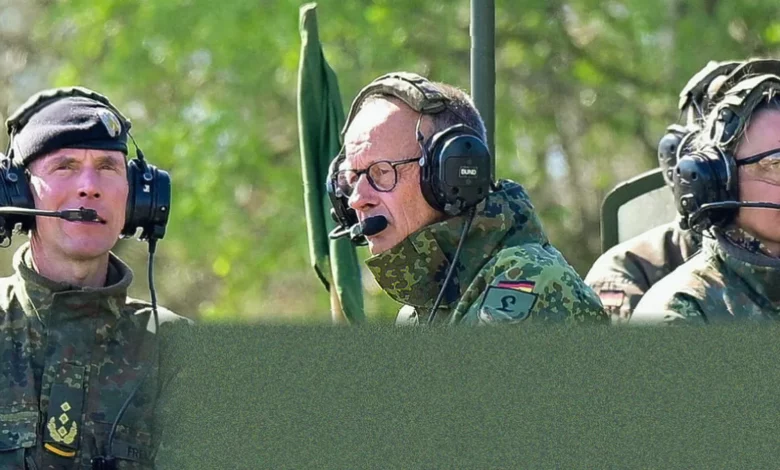
Next year, Germany’s defence spending will match that of France and Britain combined. By 2030 it is projected to be significantly larger, marking a historic shift in the balance of military power within Europe. The German government has declared its goal to become the continent’s strongest conventional army, a trajectory that raises a solemn question on the 81st anniversary of the end of the second world war in Europe: how can this growth of German military power be made a positive development for the whole of Europe?
The scale of the change is dramatic. In 2024 Germany’s defence budget reached €90.6 billion, already the largest in the European Union. Projections for the current year put spending at approximately $127 billion, compared with $84 billion for the UK and $70 billion for France. By 2029 Berlin aims to spend 3.5% of national income on defence, an estimated $189 billion annually. That represents a 24% year‑on‑year increase between 2025 and 2026, and marks the first time since 1990 that Germany has exceeded the NATO target of 2% of GDP. Its newly unveiled military strategy, the first standalone doctrine in the history of the Federal Republic, is titled Responsibility for Europe. It sets out a phased expansion of the Bundeswehr to 260,000 active personnel and 200,000 reservists by the mid‑2030s — a total of 460,000 combat‑ready troops — and aims for technological superiority by 2039, prioritising deep precision strike, air defence against hypersonic missiles and drone capabilities.
The drivers behind Germany’s military renaissance
Two factors have propelled this radical departure from Germany’s post‑war posture. The first is Russian aggression. In Berlin there is a growing consensus that President Vladimir Putin will not stop at Ukraine. The second is the changed American commitment. The United States has announced it will withdraw about 5,000 troops from Germany — 14% of the 36,000 stationed there — over the next six to twelve months. President Donald Trump has indicated this could be just the first step, and has questioned the entire American commitment to Europe’s defence through NATO since 1949. The announcement was triggered in part by Trump’s personal pique at Chancellor Friedrich Merz’s criticism of the US war against Iran, according to the original reporting. Some Republican lawmakers have expressed concern about the withdrawal, pointing to Germany’s increased defence spending and burden‑sharing. German Defence Minister Boris Pistorius called the move “foreseeable” and stressed that European allies must adjust their own defence postures.
The economic dimension also drives Berlin’s military build‑up. Germany’s export‑based business model is in crisis, and increased defence spending offers one of the few remedies available. Some of its famous car factories are already being converted to weapons production. The Bundestag’s budget committee, which must authorise any procurement project above €25 million, approved a record €52 billion for military purchases in December 2025. This included €22 billion for basic equipment, €4.2 billion for Puma infantry fighting vehicles, €3 billion for the Israeli Arrow‑3 air defence system and €1.6 billion for surveillance satellites. A separate €100 billion special fund was created after Russia’s full‑scale invasion of Ukraine. The approval process, however, is a recipe for pork‑barrel politics, with MPs and parties insisting on spending in their own electorally sensitive regions.
European anxieties and the threat of fragmentation
Germany’s military resurgence is already causing unease across Europe. France, the continent’s other major military power, is particularly worried about German defence‑industrial dominance. Paris interprets “European sovereignty” to mean buying French — or at least Franco‑German — equipment, yet the biggest joint project, the Future Combat Air System, is falling apart amid disagreements between Dassault Aviation and Airbus Defence. Poland’s right‑wing is described as “hysterical” about the prospect, and other European countries are also growing uncomfortable. That discomfort is sharpened by the possibility that the nationalist‑populist Alternative für Deutschland (AfD), which currently leads in some national opinion polls, could one day take charge of a powerful military — though the original analysis suggests the AfD would most likely revert to appeasement of Moscow.
The broader challenge is the fragmentation of Europe’s defence industry. Where the United States operates 33 main weapon systems, Europe has 174, including twelve different kinds of tank and fourteen kinds of combat jet. The European Union is trying to address this through initiatives such as the European Defence Fund, the European Defence Industrial Strategy and the European Defence Investment Programme, which aims for EU‑based suppliers to receive at least 50% of member states’ procurement budgets by 2030. But the reality is that if Germany channels its massively increased expenditure mainly into its own national industry — while gradually reducing purchases from the US — it could eventually overtake France as the world’s second‑largest arms exporter, a prospect that unsettles many capitals.
The war‑fighting dimension is equally daunting. At present the defence of Europe depends on the US‑led NATO machine, from satellite intelligence and heavy‑lift aircraft through integrated air defence and command‑and‑control, all the way to nuclear deterrence. Achieving even a halfway credible Europeanisation of this formidable apparatus is both essential and daunting. NATO has reinforced its eastern flank with forward deterrence, advanced air‑defence systems and long‑range strike capabilities, and countries such as Poland, Estonia, Latvia and Lithuania are building fortified border lines — the Baltic Defense Line and Poland’s Eastern Shield — to slow any incursion and buy time for reinforcements. But the old strategy of trading space for time is no longer considered viable.
How to ensure German power serves all of Europe
The key question, then, is how to make Germany’s growing military power a net benefit for the continent. The original analysis suggests a practical starting point: this summer, Chancellor Friedrich Merz should sit down for an informal working dinner with French President Emmanuel Macron, the British Prime Minister Keir Starmer (or his successor) and Polish Prime Minister Donald Tusk. They should discuss, frankly and practically, how to Europeanise the defence industry and how to enhance Europe’s own war‑fighting capability.
On the industry front, the sheer duplication of systems is “simply ridiculous”, as the original piece notes. On war‑fighting, the first step is simply to work out where and how to have that conversation — one that must include the extension of British and French nuclear deterrence eastwards. Macron has long advocated a credible European defence concept based on its own capabilities, including French nuclear weapons. Starmer has pledged to increase UK defence spending to 2.5% of GDP by 2027 and 3% by the end of the parliament, and has emphasised the UK’s role as a bridge between the US and Europe, but there is also a growing recognition that Britain must reduce its dependence on Washington.
Merz’s great predecessor, Helmut Kohl, embedded a newly united Germany in a European single market and monetary union in the 1990s. No country benefited more than Germany itself. Merz should aim to do the same for European security. The solutions will be nothing like as tidy as the single market and the currency — and will not even be mainly inside the EU. At the end of the day, the tests will be these: in the minds of Germany’s neighbours, will there be a genuinely integrated European defence industry or still just rival national ones? And will Europe‑alone military preparations, however messy and imperfect, prove a sufficient deterrent in the mind of Vladimir Putin?