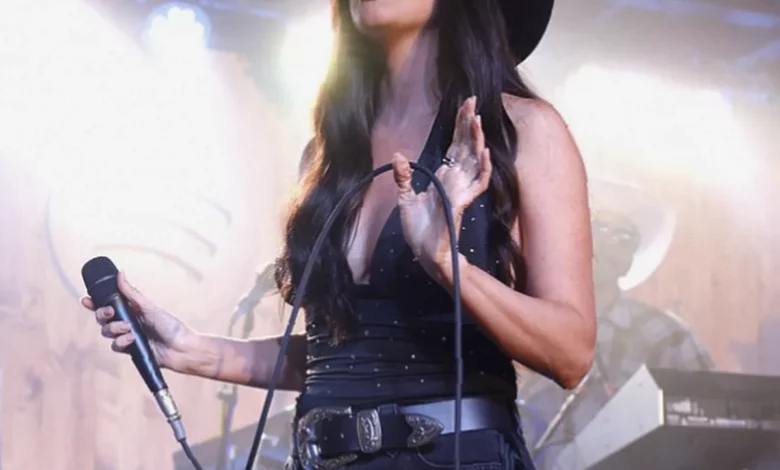
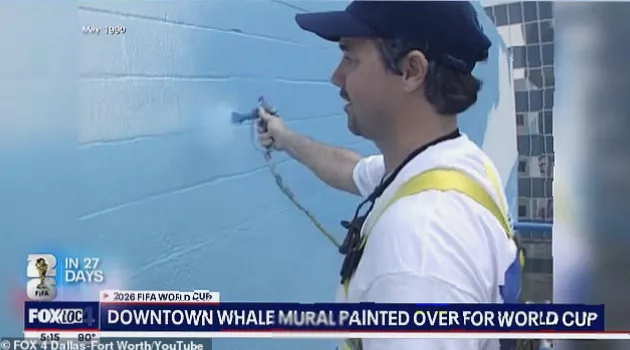
Kacey Musgraves has led the charge against FIFA after the world football governing body ordered the painting-over of a landmark whale mural in downtown Dallas, just weeks before the city is due to host matches in the 2026 World Cup.
The country singer, a native of Golden, Texas, expressed her dismay in a social media post that drew widespread attention to the decision. Sharing a link to local reporting on the incident, Musgraves wrote: “This makes me really sad. We suck the soul out of everything.” Her intervention amplified a growing chorus of anger among residents and conservationists who regard the artwork as an integral part of the city’s identity.
Musgraves’s reaction and the artist’s fury
The mural in question — officially titled “Ocean Life” but known as “Whaling Wall 82” — was an 82-foot-high, 164-foot-wide depiction of six humpback whales and dolphins, spanning two sides of the Texas Utilities Building at 505 N. Akard Street. It was created in 1999 by the environmental artist Robert Wyland as part of his worldwide “Whaling Walls” project, a series of 100 public murals intended to raise awareness for ocean conservation.
Wyland, who insists he was never consulted about the removal of his work, has reacted with fury. A member of the North Texas FIFA World Cup Organising Committee told local media that the committee had been in touch with him over the move — a claim the artist fiercely disputes. “A lie with a capital L,” Wyland told the reporting outlet. “They picked the wrong artist, I can tell you that.” He added: “I am going to go after them and go after them hard. I am going to ask the community of Dallas to stay with me. We are going to protect the other art in Dallas.”
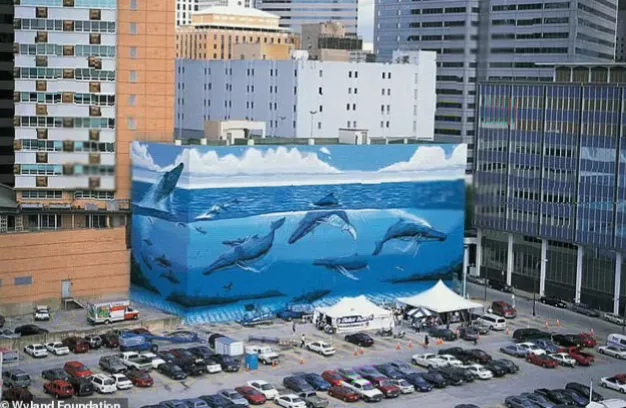
The artist believes the mural was worth in the region of $15 million. He has indicated he intends to pursue legal action under the Visual Artists Rights Act of 1990, a federal law that protects certain moral rights of artists in their works. Wyland also said that if he receives any settlement from FIFA, he will donate the money to a conservationist charity. He described the painting-over as “disrespectful” and “shameful” and vowed that the decision puts all public art in America at risk.
The mural’s history and significance
“Whaling Wall 82” was dedicated on 16 April 1999 by the former American football star Herschel Walker and the chief executive of J.C. Penney. It was gifted to the city of Dallas as a message of hope, conservation and respect for the oceans. For years, large outdoor advertisements obscured parts of the mural, but those were removed during the Covid-19 pandemic, allowing the full artwork to be visible once more. Many downtown workers and residents described it as a “beautiful piece of artwork” and a “fixture of the city’s landscape”.
Wyland’s foundation, the Wyland Foundation, was founded in 1993 and is dedicated to promoting, protecting and preserving the world’s oceans and marine life through art, science and education. The foundation noted that the mural was a “public gift about protecting our oceans and protecting what connects all of us” and that seeing it “casually covered over without even a conversation is heartbreaking for the community”.
FIFA’s justification and the committee’s claims
FIFA’s decision to paint over the mural came as Dallas prepares to host nine World Cup matches, more than any other host city, at the AT&T Stadium in Arlington — which will be temporarily renamed “Dallas Stadium” for the tournament due to FIFA’s strict sponsorship regulations prohibiting corporate branding. The North Texas FIFA World Cup Organising Committee said the mural was painted over to make way for a new piece of artwork that would “reflect the energy, unity, and global spirit surrounding the World Cup 2026 this summer”. The committee also claimed that a portion of the original mural would be preserved as a tribute.
Wyland has categorically denied that any consultation took place. The property owner, Slate Asset Management, granted the committee permission to cover the mural, and the project was completed in partnership with them. Downtown Dallas Inc. and FIFA have also been cited as parties involved in the decision. The artist said he was “blindsided” by the move, and his foundation described it as a “casual” destruction of a public gift.
Broader unpopularity of FIFA in the US
The controversy over the mural fits into a wider pattern of resentment toward FIFA’s handling of the World Cup in the United States. Ticket prices for all matches, from the group stage to the final, have been set at levels that critics say price out the vast majority of Americans. For the first USA match — against Paraguay in Los Angeles on 12 June — tickets are around $1,000. So steep are the prices that even President Donald Trump acknowledged he would like to attend but would not pay that much to do so.
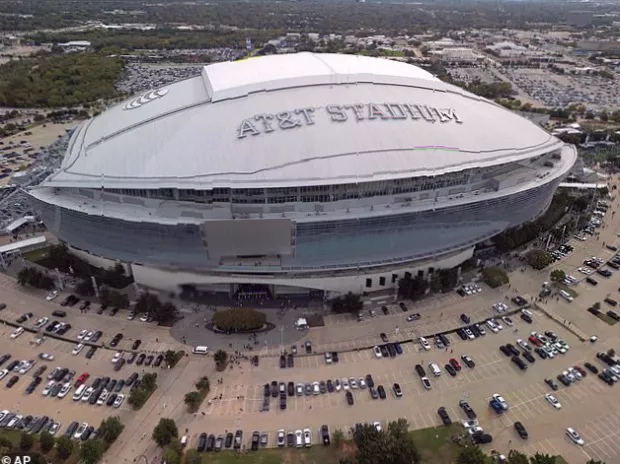
The renaming of AT&T Stadium to “Dallas Stadium” has also caused friction, with some residents of Arlington, where the stadium is actually located, feeling the city has been overlooked. Dallas will host nine games during the competition, beginning with the Netherlands versus Japan on 14 June — the first World Cup match ever played in the city — and including standout group fixtures such as England versus Croatia, Argentina versus Austria, and culminating with a semi-final on 14 July. The city is also preparing to serve as an operational hub, including hosting the International Broadcast Center.
The fury in the community was underlined by a column in the Dallas Morning News by Robert Wilonsky, which Musgraves shared. “It has been drowned in blue paint from which it will likely never be rescued,” he wrote. “World Cup rolls into town and suddenly the whole city belongs to FIFA. Including that mural, which didn’t sell anything except for the idea that maybe it is a good thing not to foul up everything.”
For a month of soccer games, a mural that had stood for nearly 30 years will almost certainly never be seen again.