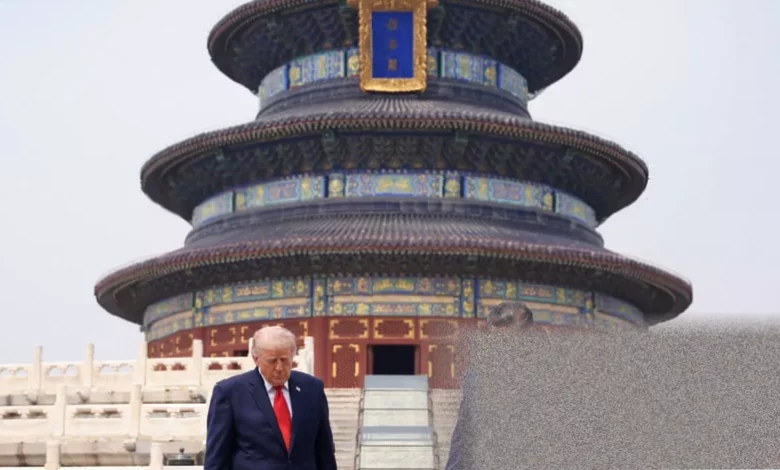
Donald Trump’s visit to China this week was marked by warm words and presidential flattery, but yielded no major announcements on the critical issues that had been expected to dominate the summit. Walking in the Zhongnanhai Garden in Beijing, the US president was overheard saying that Xi Jinping, the Chinese president, was giving him roses for the White House Rose Garden, according to a pool report. Yet behind the cordiality, there was no breakthrough on Taiwan’s future, and an accord on the war in Iran remained elusive.
Trump’s China Visit
Trump departed Beijing on Friday claiming that “a lot of good” had come from the visit and that “we’ve settled a lot of different problems that other people wouldn’t have been able to solve.” He said the US and China “feel very similar” about ending the war in Iran, but offered no details about a possible breakthrough. “We did discuss Iran,” Trump said on the final day of the meeting. “We feel very similar about [how] we want it to end. We don’t want them to have a nuclear weapon. We want the straits open.” The president also stated that Xi had assured him China would not provide military equipment to Iran, calling it a “big statement,” and that Xi expressed interest in purchasing more American oil to reduce China’s dependence on the Strait of Hormuz in the future.
Numerous commercial deals were touted by Trump, including China buying 200 Boeing jets as well as US oil and soya beans. However, this deal has not been confirmed by either China or Boeing.
On Iran, China’s foreign ministry on Friday repeated its call for a ceasefire and for the Strait of Hormuz to be opened “as soon as possible”. Beijing has publicly reaffirmed its longstanding position, with diplomatic sources dismissing claims of a policy shift following the US-China talks as “media hype” intended to present Washington as a political winner. China continues to oppose the spread of nuclear weapons while backing Iran’s right to peaceful uranium enrichment and civilian nuclear technology, and recognises Iran as a key coastal state in the region. China’s energy imports from Iran and the Strait of Hormuz constitute 45% of its energy needs, and no other source can replace them.
Ahead of the summit, there was speculation the US might appeal to China, the biggest buyer of Iranian oil, to use its leverage to encourage Iran to reopen the strait. US secretary of state Marco Rubio had stated that Washington hoped to convince Beijing to play a “more active role” in resolving the Iran crisis. Yet on Thursday Rubio walked back that expectation, saying, “We don’t need their help.”
Talks over Taiwan were barely mentioned. Xi took a firm tone, declaring that “Taiwan independence” and peace in the Taiwan strait were “incompatible”. Trump sidestepped questions on Taiwan, and the White House readout of the meeting published later also omitted mention of the country.
Deadly Russian Strike on Kyiv
At least 24 people, including three children, were reported killed in yesterday’s Russian attacks on Kyiv, Ukraine’s president Volodymyr Zelenskyy said. “The Russians practically demolished an entire section of the building with their missile,” Zelenskyy said after visiting the site. The Ukrainian ministry of foreign affairs described the strike as “one of the deadliest attacks on Kyiv since the start of Russia’s full-scale war”.
Zelenskyy also called for more painful sanctions against Russia, noting that Moscow continues to purchase components for missiles and circumvent global restrictions.
Separately, on Thursday the UN nuclear watchdog warned of “intensified” military activities near several Ukraine nuclear sites that posed significant safety risks.
Friedrich Merz, the German chancellor, said on Thursday that Russia’s heavy bombardment of Kyiv showed Moscow was “banking on escalation rather than negotiation”. “Kyiv and its partners are ready for negotiations aimed at a just peace,” Merz said. “Russia, for its part, is continuing the war.”
US Voting Rights in Turmoil After Supreme Court Ruling
Southern states are rushing to redraw congressional maps to eliminate Democratic districts and dilute the influence of Black voters in electing candidates, a bare-knuckled blitz occurring even in some states where voting in congressional primaries has already begun. The redrawing has been prompted by the US supreme court’s decision gutting section 2 of the Voting Rights Act.
“This is a five-alarm fire for Black representation in the south,” said Michael Li, a redistricting expert at the Brennan Center for Justice. “The [supreme] court has signaled it’s going to be a redistricting wild west, and there will be no sheriff around.”
The court’s ruling in Louisiana v. Callais (May 2026) altered the standards for evaluating the use of race in redistricting. Previously, section 2 of the Voting Rights Act prohibited any voting practice that resulted in racial discrimination, even without proof of intentional bias. States could not draw maps that made it harder for minority voters to elect candidates of their choice. The supreme court’s decision effectively removed that protection, forcing challengers to prove intentional discrimination — a far higher legal bar. With the “sheriff” gone, southern states now face few federal constraints as they redraw political boundaries.
Tennessee Republicans have already enacted a new map that divides the majority-Black city of Memphis. Louisiana is on the verge of implementing a map that could eliminate a seat held by a Black Democrat. Alabama has successfully petitioned the US supreme court to allow it to eliminate a district currently represented by a Black Democrat — a district that a previous court-drawn map had created after Alabama’s 2021 map was found to violate section 2 in Allen v. Milligan. In South Carolina, the Republican governor is reportedly poised to call a special session to draw a new congressional map. States such as Texas, Missouri, Florida and North Carolina, which already redrew their maps to add Republican districts, could also draw maps again before the 2028 elections.
Other Developments
Jerusalem Day march. Israeli nationalists chanted “death to the Arabs”, “may your villages burn” and “Gaza is a graveyard” during a state-sponsored march through Jerusalem to mark the anniversary of the city’s capture and annexation. Many Palestinian residents stayed indoors and shops were shuttered. Israel’s annexation of East Jerusalem in 1967 is not recognised by the United Nations. The march has a history of descending into violence, with ultranationalists targeting Palestinians.
Abortion medication access. The US supreme court upheld nationwide access to mail-order mifepristone, an abortion medication, in a shadow-docket decision on Thursday. The ruling temporarily pauses a decision by the Fifth Circuit Court of Appeals that would have required in-person dispensing. Justices Clarence Thomas and Samuel Alito dissented, with Thomas describing the mailing of mifepristone as a “criminal enterprise”. The case will return to the Fifth Circuit for further review. Medication abortion accounts for more than 60% of abortions in the United States.
Musk v. OpenAI trial. Closing arguments began on Thursday in Elon Musk’s lawsuit against Sam Altman and OpenAI, bringing the weeks-long courtroom battle nearer to a decision. Musk alleges that OpenAI broke its founding agreement to remain a non-profit and accuses them of financial misconduct. OpenAI denies the claims, arguing that Musk is motivated by jealousy and was aware of plans to create a for-profit entity. A key issue has been Altman’s credibility, with Musk’s attorney calling him a “liar” based on witness testimony. The jury will also consider whether the lawsuit was filed within the statute of limitations.
Record internal displacement. The number of internal displacements triggered by conflict or violence around the world reached a record high in 2025 — reaching 32.3 million people — which was 60% higher than the previous year, according to a report from the Internal Displacement Monitoring Centre. For the first time, conflict-driven displacements surpassed those caused by disasters. In total, 82.2 million people were displaced internally in 2025, double the figure of a decade ago. The largest numbers of internally displaced people are in Sudan, Colombia, Syria, Yemen and Afghanistan. An estimated 13 million children were displaced in 2025.
Cannes film festival. When the lineup for the 2026 Cannes film festival was announced last month, one aspect immediately stood out: the near-total absence of major Hollywood studio films. Studios including Universal, Disney, Warner, Sony and Paramount, as well as streaming platforms Netflix and Amazon, opted out. The shift is attributed to changing industry practices, a wariness of festival premiere risks, and a desire for greater control over film launches. The festival’s focus has reverted to international auteur cinema.
Brazil’s Atlantic forest. Brazil’s Atlantic forest, the country’s most threatened biome, last year recorded its lowest level of deforestation since monitoring began 40 years ago, a new report shows. In 2025, it recorded 8,658 hectares of deforestation, marking the first time it has fallen below 10,000 hectares since 1985. Environmentalists attribute the improvement to public pressure, environmental policies and enforcement, but warn that weakened laws and the potential return of a far-right government could reverse the progress.
King penguin colony in Chile. When the birds started nesting on her land at Useless Bay in southern Chile’s Tierra del Fuego region, Cecilia Durán Gafo, a local landowner and former kindergarten teacher now aged 72, decided she would protect them from people and predators. Today, she runs a reserve that oversees the world’s only continental king penguin colony. “Last year, 23 chicks survived – a record,” she said.