A privately funded whale rescue mission costing £1.3 million has ended in farce after the creature’s GPS tracker failed and the young humpback, nicknamed Timmy, is now presumed dead.
Timmy, a juvenile male humpback whale (Megaptera novaeangliae) measuring 12.35 metres and weighing around 12 tonnes, became a global cause célèbre after repeated strandings on the Baltic coast of Germany. Millions followed his plight online after he was first spotted in March 2026, having likely entered the low-salinity Baltic Sea from the North Sea — an environment that experts at the Oceanographic Museum in Stralsund described as unusual and unsustainable for the species. He stranded multiple times on sandbanks near Timmendorfer Strand, Lübeck Bay and the island of Poel, suffering a weakened state and a skin condition linked to the low salinity.
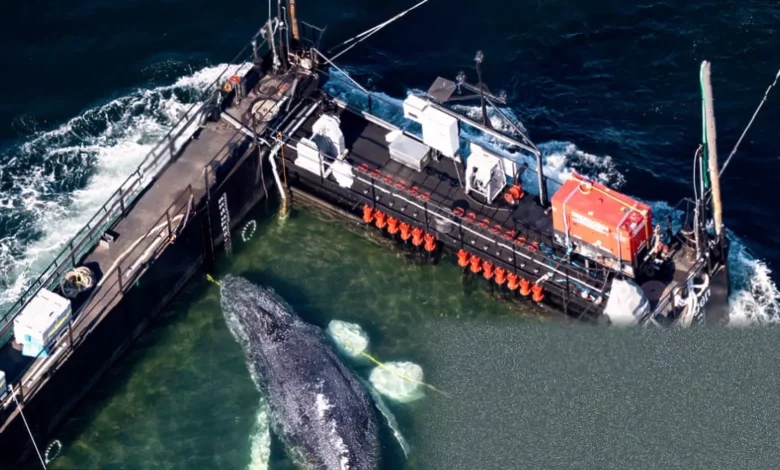
Initial attempts to free Timmy using excavators to dig trenches and efforts to create waves failed. Last week, a privately financed operation — believed to have cost about €1.5 million (£1.3 million) — loaded the whale onto a specially designed water-filled barge and towed it towards the North Sea. Photographs of Timmy on the barge appeared to offer a moment of hope. Yet the rescue unravelled when the GPS tracker fitted to monitor his progress into deeper waters stopped working. His whereabouts and condition after release remain unknown.
Marine biologists and conservationists had warned against the intervention from the start. The International Whaling Commission (IWC) deemed the final rescue attempt “inadvisable”, stating that it imposed “considerable additional stress upon a creature that is already gravely ill, to little ultimate benefit”. Experts at the Oceanographic Museum in Stralsund went further, describing the repeated intervention as “animal cruelty”. Some even suggested euthanasia would have been the most humane outcome.
A clash of priorities
The case of Timmy the whale has exposed a deep tension between animal rights activism and the hard-nosed realities of wildlife conservation — and raised uncomfortable questions about the role of social media in driving expensive, high-stakes interventions.
The International Fund for Animal Welfare said the rescue should “give us all pause”, highlighting it as an example of the challenges posed by online pressure. “As attention intensified, so did expectations that something must be done,” the organisation said. “Marine mammal biologists advising on the case faced hostility online, despite working in the whale’s best interests. Though global stranding experts and the International Whaling Commission expressed concerns about the welfare impacts of additional rescue attempts, the decision to proceed with the rescue was ultimately approved.”
Professor Amy Dickman, a professor of wildlife conservation at the University of Oxford, said the focus on one animal reflected a troubling trend. “It’s really striking that there’s been such a focus on this individual animal at such great cost during a time of great crisis for wildlife funding around the world,” she said. “It is really questionable whether it was a good use of funds, particularly compared with issues that impact much greater numbers of whales, such as collisions with vessels and entanglements with fishing gear.”
Humpback whales have made a strong recovery from centuries of commercial whaling; the species is listed as “least concern” on the IUCN Red List of Threatened Species. While they still face threats from climate breakdown, ocean pollution, vessel strikes and fishing gear, many conservationists argue the resources spent on Timmy could have had a far greater impact elsewhere — protecting habitats or reducing mortality from human activity on a population scale.
“What feels good for the public might not actually be what’s best for the animal,” Professor Dickman said. “The case demonstrates the movement towards more social media-driven wildlife management, which is alarming. There’s a huge pressure to move rapidly and that doesn’t necessarily give experts the time to carefully consider what the best course of action should be, including things such as euthanasia, which might not be popular with the public but might be the best course of action for the animal’s welfare.”
Expert warnings
Timmy’s ordeal has become what Professor Dickman called a “teachable moment” for conservation, underscoring the need for evidence-based decisions that balance individual animal welfare with the broader needs of species and ecosystems. The International Fund for Animal Welfare noted: “In complex cases like Timmy’s, the most compassionate choice is not always the most dramatic one.”
As of early May 2026, Timmy’s fate remains uncertain, though the German Oceanographic Museum suggested a high probability that he died shortly after release due to his weakened state. A whale carcass matching Timmy’s dimensions was later sighted off the coast of Denmark, although confirmation is pending. One scientist involved in the case described the entire operation as “an all-round catastrophe”.