Eleven foreign far-right activists have been blocked from entering the United Kingdom before Saturday’s “Unite the Kingdom” rally, the Home Office has confirmed. The government used its exclusion powers to refuse or cancel electronic travel authorisations (ETAs) for the individuals, whom Home Secretary Shabana Mahmood said were “not conducive to the public good.”
Among those barred are Valentina Gomez, a US-based anti-Islam influencer who burned a Quran and has called Muslims “rapists”; Eva Vlaardingerbroek, a Dutch commentator who promotes the “great replacement” conspiracy theory; and Dominik Tarczyński, a Polish MEP from the Law and Justice party who has said he is proud that Poland takes in “zero illegal Muslim migrants.” Tarczyński has described the ban as “communism” and threatened legal action against the prime minister. Also excluded are Belgian politician Filip Dewinter, who has been criticised for posing with a flag of a fascist organisation and using a Nazi slogan; Spanish influencer Ada Lluch, who has defended the Franco regime; and US-based figures Joey Mannarino and Don Keith. The Home Office said the ETAs of seven of the eleven had been cancelled or refused outright, with the remainder believed to have been turned away at the border.
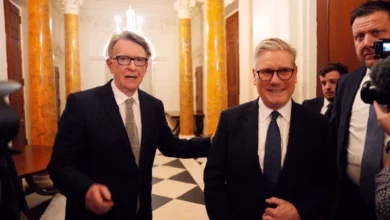
The bans come as Keir Starmer accused the rally’s organisers of “peddling hatred and division.” Visiting the Metropolitan Police’s command and control special operations room, the prime minister said: “We’re in a fight for the soul of this country, and the Unite the Kingdom march this weekend is a stark reminder of exactly what we are up against. Its organisers are peddling hatred and division, plain and simple.” He added: “We will block those coming into the UK who seek to incite hatred and violence. For anyone who sets out to wreak havoc on our streets, to intimidate or threaten anyone, you can expect to face the full force of the law.” Downing Street later issued a statement saying Starmer recognised that “the majority expected to attend are law-abiding citizens, who want to protest peacefully,” and urged everyone to “act with decency and respect.” The prime minister also appeared in a social media video in which he described the rally’s organisers as “convicted thugs and racists” and said the event was “a reminder of what we’re up against in the battle of our values.”
Faith leaders urge hope as counter-events planned
Against the backdrop of the rally, which calls for a general election and marks a strategic shift by Tommy Robinson – whose real name is Stephen Yaxley-Lennon – towards encouraging political campaigning and voting, faith leaders have issued a call for unity. The Archbishop of Canterbury, Sarah Mullally, urged people to “choose hope” during a week-long initiative called A Million Acts of Hope, running from 13 to 20 May and intended as a direct counter to Robinson’s event. Mullally, who became the first woman to lead the Anglican church in March, said: “When we watch the news or scroll through our phones it can feel as though our country is more divided than ever. But this is not the whole story. When I visit churches and communities, I see people serving one another and looking out for those in need. This gives me hope.”
The initiative is backed by the Muslim Council of Britain, the UK Muslim Network and Rabbi Jonathan Wittenberg, senior rabbi of Masorti Judaism UK. Wittenberg spoke of the solidarity he has received from Muslims and Christians after a recent spate of attacks on Jewish people and sites in London. “Every day we remember in our prayers that ‘acts of kindness are immeasurable’,” he said. “I witness them constantly within my community, like taking food to families in mourning. I experience them between communities, like the solidarity of many Muslim and Christian colleagues during this spate of antisemitism. I see them in sustained support for refugees, despite the ugly slogans. I’m conscious of them across the community of all life, like the woman who travels 50 miles to fill the bird feeders on the hillside she loves. These acts of kindness express the true heart of our country.”
Large pro-Palestinian marches are also scheduled for Saturday to mark Nakba Day – the 78th anniversary of the mass displacement of Palestinians in 1948 – organised by the Palestine Solidarity Campaign, Stop the War and Stand Up To Racism. Anti-racist counter-demonstrations will take place, and tens of thousands of football fans are expected in London for the FA Cup final, with police concerned that hooligans may head to the Robinson-backed rally afterwards. The Muslim Council of Britain has issued safety advice urging people to stay away from central London and remain vigilant.
Live facial recognition deployed for the first time at a protest
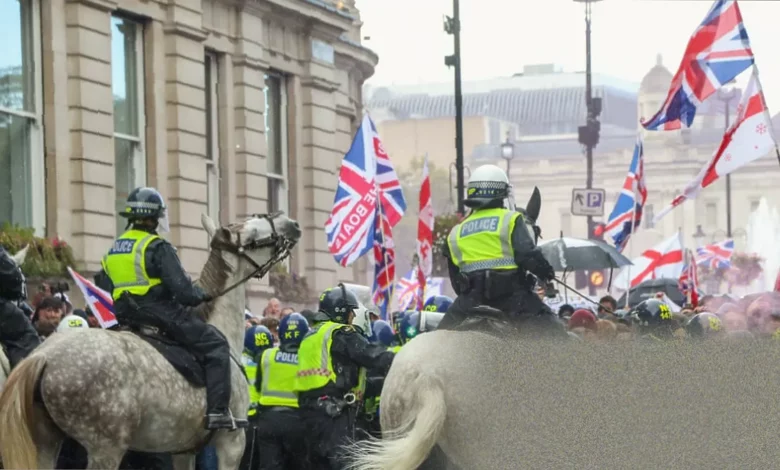
The Metropolitan Police are mounting what they describe as an unprecedented operation, likely one of the largest and most complex public order policing exercises in recent years. Around 4,000 officers will be on duty, including 660 drafted in from other forces, at an estimated cost of £4.5 million. But the most significant development is the use of live facial recognition (LFR) technology for the first time in a protest policing context.
Cameras will be deployed in the Camden area, which is expected to be used by attendees of the “Unite the Kingdom” march, though not directly on the route itself. Civil liberties groups have raised serious concerns about the technology’s potential to chill free speech and assembly. LFR works by scanning faces in real time and comparing them against watchlists of wanted individuals, but critics argue that it can capture thousands of innocent passers-by without their consent, creating a database of movement that could be misused. The move marks a significant escalation in the police’s surveillance capability at public demonstrations, and observers note that its introduction at a politically charged event is likely to test both the technology’s effectiveness and the legal boundaries of its use.
Alongside LFR, strict Public Order Act conditions have been imposed on both the “Unite the Kingdom” rally and the pro-Palestinian march. The far-right event will gather from 11am, with the march beginning around 1pm along Kingsway, Aldwych, the Strand, Trafalgar Square, Whitehall and finishing in Parliament Square. Speeches and music are due to end by 5.30pm, with the assembly concluded by 6pm. The Nakba Day protest will start at Exhibition Road from midday, following a route through Knightsbridge and Piccadilly to Pall Mall, with assembly ending at 5.30pm.
Organisers and speakers at both rallies face prosecution if the events are used as a platform for extremism or hate speech, under new powers being used for the first time to target hate speech directly. The Metropolitan Police are also still seeking outstanding and unidentified suspects from violent clashes at the previous “Unite the Kingdom” event in September 2025, which drew between 110,000 and 150,000 attendees and resulted in officer injuries and arrests.
The rally’s advertised speakers include Siobhan Whyte, the mother of Rhiannon Whyte, a 27-year-old hotel worker who was stabbed 23 times – 19 of those in the head – with a screwdriver by Deng Chol Majek, a Sudanese asylum seeker who followed her from the Park Inn Hotel in Walsall to Bescot Stadium station in October 2024. Majek was later seen laughing and dancing, and was jailed for life with a minimum term of 29 years. The rally is also being promoted with AI-generated content, including a rapper named Danny Bones whose lyrics target London’s Muslim mayor, Sadiq Khan.
Saturday is expected to be one of the busiest days of the year for policing in London, with the Met balancing the far-right march, the pro-Palestine demonstration, FA Cup final crowds and anti-fascist counter-protesters organised by Stand Up to Racism. The Home Office’s exclusion powers allow the Home Secretary to refuse entry if an individual’s actions threaten public order or national security; an ETA is a pre-clearance and does not guarantee admission.