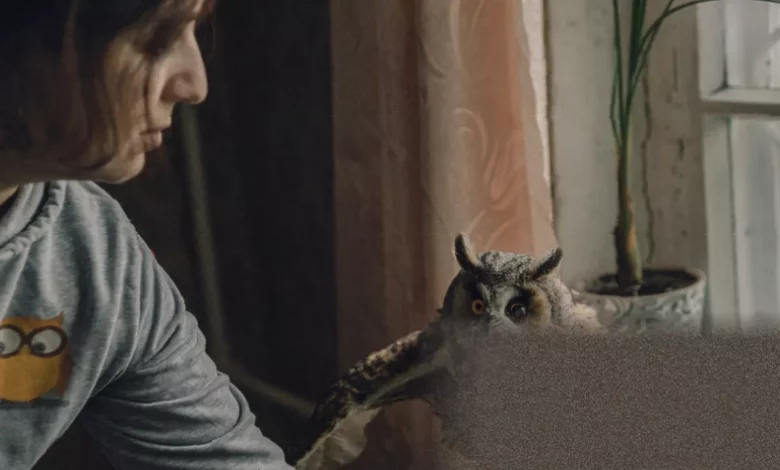
A long-eared owl named Sunny, struck down by a Russian drone attack in Zaporizhzhia and left with a shattered wing and one blind eye, is now recovering in the home of a volunteer biologist in Dnipro. The male owl’s left wing had to be amputated, and the attending vet also diagnosed brain trauma — Sunny no longer reacts normally to light, according to Veronica Konkova, the biologist caring for him. A passerby found the stunned bird on the ground after the February bombardment, placed him in a box and took him hundreds of kilometres north to safety.
Sunny now hops around a small room, unable to fly or hunt. He will remain with Konkova for several more weeks before being transferred to a rehabilitation centre in Kyiv. Alongside him in a corner of the room is a screech owl named Plushka, perched at the back of an open cage. Neither bird can ever be released into the wild, Konkova said, but both should survive with continued treatment — which includes daily anti-worm medicine syringed into Sunny’s beak, a diet of dead lab rats stored in a downstairs freezer, and live cockroaches for Plushka, kept in a plastic box in the kitchen.
Konkova, a biologist who has been rescuing wounded birds since 2015 — a year after the Kremlin launched its then covert war in the eastern Donbas — is no stranger to such casualties. Over the years she has treated a rare imperial eagle, peregrine falcons, buzzards, kestrels, black kites and a variety of owls: little, short-eared and tawny. But the scale of the current conflict, she said, has brought a relentless stream of injured wildlife.
How the war is killing birds
Russia’s aerial war has had a devastating impact on Ukraine’s birds, with thousands caught in anti-drone nets strung up to protect roads near the frontline. Owls, which hunt at night, are especially vulnerable to entanglement. According to Konkova, “The birds die from dehydration or from heart attacks if they get stuck upside down for a long time.” Others fall victim to explosions, fires and pollution. In addition to nets, the thin fibre-optic cables used by Russian drones pose a major hazard; in some areas of the battlefield these wires can carpet fields hundreds of metres wide, ensnaring any bird that lands or hunts there. Konkova said: “Sometimes we can save these birds. Other times they arrive in such bad condition there’s nothing we can do.”
The destruction of habitats is compounding the direct toll. Moscow has repeatedly targeted six hydroelectric power stations and reservoirs along the Dnipro river. In June 2023, the Russian military blew up the Kakhovka dam at the bottom of the Soviet-built cascade, causing massive flooding. Ukrainian engineers have since kept reservoir water levels low. The ornithologist Oleksandr Ponomarenko, a senior researcher at the Dnipro-Oril nature reserve, explained that the floodplains have dried up as a result: “We’re losing the birds’ feeding grounds. The area is shrinking. In summer, it gets really hot here, 30 or 35 degrees. And so instead of there being water, there’s just bare mud. It heats up terribly. The molluscs in it die, the algae dies. A huge part of the birds’ food supply is being destroyed. The species that used to fly in don’t visit.”
Ponomarenko said a range of waterfowl and waders have already disappeared from the reserve. He listed two types of teal, ferruginous ducks, goldeneye and white-fronted geese. The research briefing confirms that approximately 20% of Ukraine’s nature conservation areas are affected by the war, with some national parks — such as Dzharylhach National Nature Park — reported as completely destroyed, occupied by Russian forces or land-mined.
Migratory birds are being forced to change their routes. Studies of Greater Spotted Eagles have shown they now fly longer distances and make fewer stopovers to avoid conflict zones, exhausting themselves and potentially suffering sublethal effects that increase their risk of death. White-fronted geese, Ponomarenko noted, are particularly cautious. “The goose is a very intelligent and cautious bird. They hear shooting, realise what’s going on and simply take a wide detour around the frontline. Now there’s almost no spring migration.”
White storks — a national symbol in Ukraine — have suffered heavily. A third of their nests are empty, Ponomarenko said, because “the stork sees its foraging area is dry, with no frogs, no snakes, nothing. So it doesn’t settle.” Some storks have adapted by breeding on landfill sites, where they feast on mice and rats. Dozens of storks can now be seen in rubbish dumps outside Kharkiv and near the riverside town of Samar.
Fires, cables and changing behaviour
Fires caused by artillery shells have wiped out the habitats of many woodpeckers, according to Ponomarenko. Swifts and swallows, by contrast, continue to breed in some frontline areas, even nesting in semi-destroyed houses. Jay populations have turned inventive, using discarded fibre-optic cables as nest lining. The picture, Ponomarenko said, is “complicated”: “Different species react differently.”
A scientific study carried out by soldier and birdwatcher Dmytro Medovnyk while fighting in a village in the eastern Luhansk oblast in 2024 found that goldfinches and greenfinches obtained food from destroyed grain warehouses, while ravens and robins declined because of reduced food availability and noise pollution. Herons and mallards flew off entirely.
Signs of recovery — and deep concern
Despite the destruction, there are some positive signs. After Vladimir Putin’s full‑scale invasion in 2022, Ukraine’s government banned hunting. Gamekeepers released thousands of pheasants, and they are now calling from yellow feather grass not only in the countryside but in city gardens. Quail, partridge, roe deer and badgers have also benefited from the ban. At the Dnipro-Oril reserve, caretaker Mykhailo Petronko recently saw about 60 swans. “You don’t notice as many geese any more but in the autumn there are plenty of ducks,” he said. On a cold and windy day last week, three or four grebes were visible, their numbers increasing, along with yellow-legged gulls, a wood sandpiper and a newly returned swallow swooping low over the water.
Yet conservationists warn that the underlying environmental damage will last for decades. The deliberate destruction of the Kakhovka dam exposed lakebed sediments containing heavy metals and released pollutants into waterways; while some habitats are beginning to recover, the long-term consequences remain severe. Ring ouzels and black storks have returned to Chornobyl, offering a narrow silver lining, but many rare species — particularly wetland birds — are at greatest risk, Ponomarenko said.
Ukraine’s environment ministry was abolished last year and rolled into the ministry of industry and agriculture. Conservationists say protecting nature is regarded as a low priority. “The government doesn’t help. But nor does it create problems for us either,” Konkova said. She noted that birdwatching was popular in Ukraine, citing a livestream of a white stork sitting on a nest in the Poltava region. The NGO UAnimals has expanded its efforts to evacuate animals from conflict zones and rebuild shelters, and is raising international awareness for what many advocates are now calling ecocide — a crime they want to see prosecutable under international law.
Konkova, who originally hails from occupied Crimea, reflected on the destruction: “They destroy their own environment and our environment as well. Overall, I’m an optimist because nature will win anyway. Birds lived for millions of years before people. They will live, I guess, millions of years after people.”