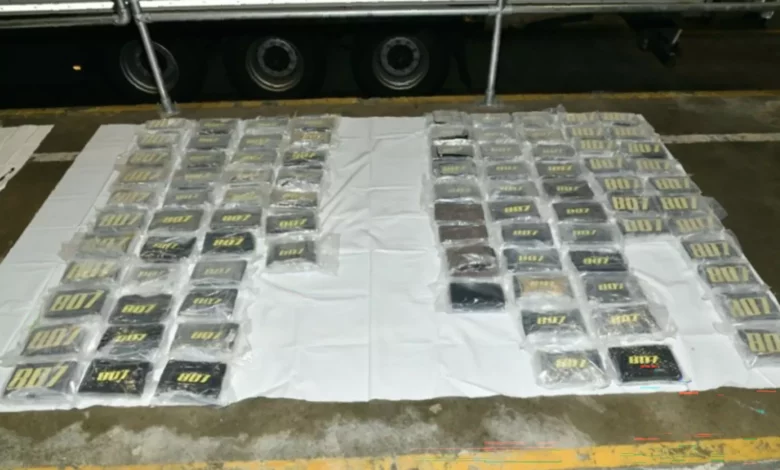
Jakub Jan Konkel, a 40-year-old Polish lorry driver, was jailed for 13-and-a-half years at Chelmsford Crown Court on Monday for smuggling cocaine worth up to £7.2 million while hauling a legitimate load of Kim Kardashian’s Skims underwear and clothing.
The sentence and the seizure
Konkel was stopped by Border Force officers at Harwich port in Essex on September 5 last year after travelling from the Netherlands on a ferry. The lorry was carrying 28 pallets of Skims garments — a cargo that had no connection to the smuggling operation, the brand later confirmed. Unbeknownst to the exporter and importer, Konkel had collected 90kg of cocaine during an undeclared 16-minute stop on his route, according to tachograph data analysed by investigators.
The class A drug was wrapped in 1kg packages and concealed in a specially constructed compartment within the skin of the rear trailer doors — separate from the clothing load. The compartment was not visible during a routine check, but an X-ray scanner used by Border Force officers revealed irregularities in the doors, prompting a closer search that uncovered the hidden stash. Investigators estimate the cocaine had a street value of between £7 million and £7.2 million (approximately $8.4 million to $9.4 million USD).
Konkel initially denied any knowledge of the drugs but later admitted he had agreed to transport the cocaine for a payment of €4,500, equivalent to about £3,914 or $5,200 USD. Border Force assistant director Jason Thorn said: “These drugs destroy lives and inflict misery on our communities. This significant interception is testament to the brilliant work of Border Force, depriving criminal networks of millions in profit.”
The method of concealment
The sophistication of the smuggling attempt lay in the modification of the HGV’s rear doors. A compartment was built into the metal skin of the trailer, allowing the cocaine to be hidden entirely outside the main cargo area. This technique — using modified vehicles with concealed compartments — is a known tactic of organised crime groups, who exploit legitimate shipping routes and recognisable brand names to evade detection. The X-ray scanner at Harwich was critical in detecting the irregularity that ordinary visual checks would have missed. National Crime Agency (NCA) operations manager Paul Orchard said: “Organised crime groups use corrupt drivers like Konkel to move class A drugs, often hidden on entirely legitimate loads such as this. The detection and investigation have removed a significant amount of cocaine whose profits are lost to the crime group behind the smuggling attempt, and with Konkel, they’ve lost an important enabler.”

Konkel’s journey originated in the Netherlands, a country identified as a major hub for cocaine trafficking into Europe. The Port of Rotterdam, a key entry point for South American cocaine, is used by criminal networks to route drugs northwards, often alongside preparations for people smuggling to the UK. The NCA works with partners in transit countries, including the Netherlands and Belgium, to disrupt the entire supply chain.
The impact of drug trafficking
Harwich port has been a target for smugglers before. In April 2020, Border Force officers there seized about 54kg of cocaine with a potential street value of £4.86 million, hidden in metal-lined containers within the trailer doors of a lorry arriving from the Hook of Holland. A British man was arrested. In April 2013, about 430kg of cannabis worth over £1.7 million was found in a trailer arriving from the same Dutch port, leading to the arrest of two Dutch men. In January 2011, UK Border Agency officers intercepted marijuana valued at over $3.1 million and amphetamines concealed within a cover load of heating equipment.
The scale of the global cocaine trade is illustrated by operations far beyond Britain’s shores. Earlier this year, an American coast guard crew brought ashore more than 1.7 tonnes of cocaine worth more than £21 million after two interceptions in the Eastern Pacific Ocean as part of Operation Pacific Viper — a US Coast Guard campaign launched in August 2025 to combat cartel smuggling from Latin America to North America. The operation has seized over 215,000 pounds of cocaine as of April 2026, denying criminal organisations billions in illicit revenue. Individual hauls include the largest single-patrol seizure by a Coast Guard cutter — more than 22,226 kilograms of narcotics valued at $362 million brought in by the USCGC Stone in November 2025 — and the Coast Guard’s largest-ever drug offload in August 2025, when the USCGC Hamilton offloaded over 34,473 kilograms of illegal drugs worth $473 million. The amount of cocaine seized under the operation is enough to kill millions of people, according to the Coast Guard.
Skims, the brand whose clothing was used as cover, issued a statement confirming it had no prior knowledge of the criminal activity and no connection to the smuggling operation, the driver, or the truck. The company, valued at $4 billion as of May 2025, launched in the UK in October 2020 through Selfridges and later expanded to Harrods. It plans to open its first standalone UK store on London’s Regent Street in summer 2025.