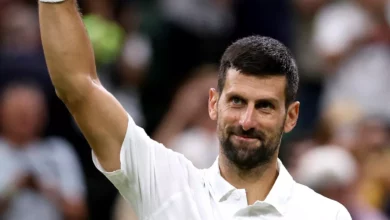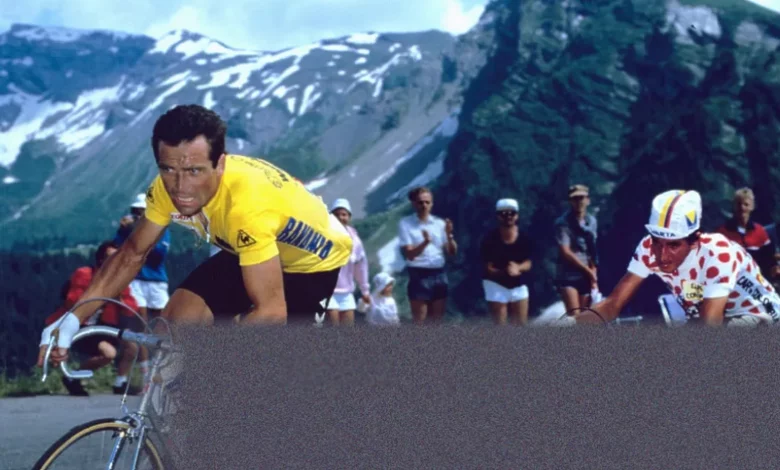
French cycling’s long search for a Tour de France winner may finally be over with 19-year-old Paul Seixas. At an age when most riders are still learning their trade, the Decathlon CMA CGM Team rider has already produced performances that recall the sport’s greats – and has placed himself at the centre of a narrative that has defined French cycling for four decades: the quest for a successor to Bernard Hinault, who last won the Tour in 1985.
The hope
Seixas’s emergence has been marked by a series of moments that have made even hardened observers sit up. On 7 March in the Strade Bianche classic, he managed to cling to the wheel of Tadej Pogacar, the dominant rider of his generation. On 22 April, he became the youngest ever winner of La Flèche Wallonne, dislodging the field in the final metres. On 12 June, after a heavy crash during the Tour Auvergne Rhône Alpes left him trailing by minutes, he spent hours fighting his way back to the front. Then, in stage four of the Tour of the Basque Country, with a healthy overall lead and convention dictating caution, he attacked on a descent – gaining 20 seconds on his rivals in a move described as “gratuitous attacking, racing for fun”.
It is this style, reminiscent of Hinault’s own brand of fearless aggression, that has drawn comparisons to the Badger’s early career. Hinault, after all, once steered his bike into a ravine during the 1977 Dauphiné and still got out to win classics. Cyrille Guimard, the 79-year-old French guru who nurtured Hinault, Laurent Fignon and Greg LeMond, and who has long maintained that Tour winners “are born, not made”, has never seen a French rider shred a mountain climb the way Seixas can. “Young and carefree,” as Fignon would have put it.
Seixas, born on 24 September 2006, stands 1.86m tall and weighs 64kg. He won the junior time trial at the 2024 UCI Road World Championships and the 2025 Tour de l’Avenir. At the 2025 Critérium du Dauphiné he became the youngest rider to finish in the top ten of a UCI WorldTour stage race. Now he arrives at his first Tour de France as co-captain alongside sprinter Olav Kooij, and at 19 years, nine months and ten days old he will be the youngest participant in the race since 1937.
Forty years of false dawns
The weight of expectation on Seixas is immense, and it is rooted in a history that has been painful for French cycling. Since Hinault retired at the end of the 1986 season, a succession of riders have been hailed as the next champion only to fall short. Jean-François Bernard finished third in the 1987 Tour and won two time trial stages, but never took the final step. Laurent Fignon, a two-time winner in 1983 and 1984, began the 1990 Tour as a favourite but suffered the start of his decline when he “put foot to tarmac in the feed zone somewhere in the bocage between Avranches and Rouen”. Fignon, known as “the Professor”, died of cancer in 2010 at the age of 50, having admitted to using banned substances.
Richard Virenque, a climbing specialist who still holds the record for the most King of the Mountains titles in Tour history with seven, finished third in 1996 and second in 1997 but was also a central figure in the Festina doping scandal. Laurent Jalabert won the 1995 Vuelta a España and was world number one for several years, but a French Senate investigation in 2013 proved his use of EPO. Romain Bardet and Warren Barguil were both mentioned as potential champions who ultimately crumbled under the spotlight; Barguil won two mountain stages and the mountains classification in the 2017 Tour. Thibaut Pinot, who finished third overall and won the young rider classification in 2014, came closest to breaking the drought in 2019. He was in effervescent climbing form and lying fifth overall when a torn muscle forced him to abandon. He retired at the end of the 2023 season.
By 2014, the French Cycling Federation was reduced to launching its own professional team – modelled on Great Britain’s Team Sky – in an effort to focus minds and uncover a champion. The project went nowhere. Guimard’s mantra – “Tour winners are born, not made” – was echoed by Hinault when he met a journalist in 1993. “Super champions are difficult entities, you don’t get many of them, perhaps 10 a century,” Hinault said. “You don’t just build them.”
For 40 years, the only Tour stage when a Frenchman raced like a potential winner was 2019, when Pinot’s form lit up the mountains. The vignette – high hopes, high drama, tears – summed up the post-Hinault era.
The razor’s edge
Seixas’s talent is undeniable, but so are the warning signs. The crash at the Tour Auvergne Rhône Alpes showed how youthful insouciance can almost undo him. In the next three weeks he will pivot on a razor’s edge: if he curbs his exuberance it will be an anticlimax, but if he lets his emotions run free he could be undone. And he faces the two most accomplished Tour champions of the 21st century – Tadej Pogacar, winner of the 2025 Tour, and Jonas Vingegaard, winner in 2022 and 2023.
“The dramatic, tragic story of a Frenchman who has captivated the home crowd and is forced out by ill fortune and great physical suffering is a plot-line the Tour has written many times,” the article noted of Pinot in 2019. This July, the ending could be different – but the warnings from recent history are there for all to see.