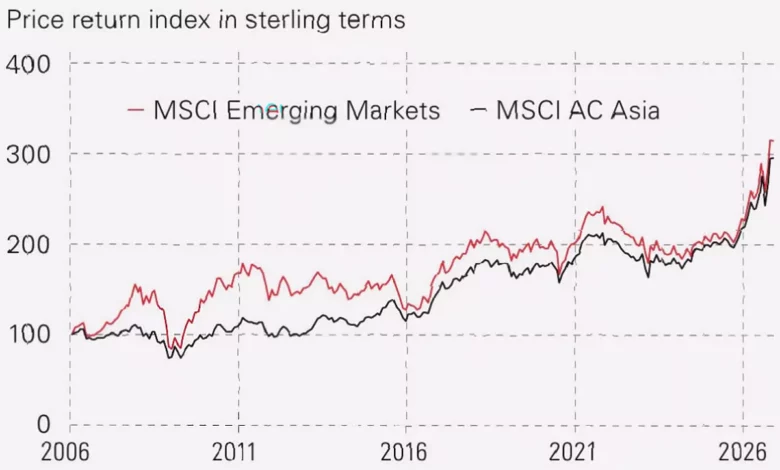
The artificial intelligence boom has thrown into sharp relief a long-simmering anomaly at the heart of the MSCI Emerging Markets (EM) index: the two largest country weightings, South Korea and Taiwan, are plainly advanced economies by any economic measure. Together they account for nearly half the benchmark, yet they remain classified as “emerging” under MSCI’s market-access criteria. The index’s technology weighting has ballooned to 43 per cent, driven by the semiconductor giants that power AI infrastructure, making the mismatch between economic reality and financial classification impossible to ignore.
The AI-driven transformation of an index
The MSCI EM index was once a play on commodities and industrialisation. In 2008, natural resources and commodity-linked sectors – Materials and Energy – accounted for 29 per cent of the benchmark, while technology stocks made up just 13 per cent. Today those proportions have reversed. The information technology sector now represents 43 per cent of the index, and the shift is overwhelmingly the result of the global buildout in artificial intelligence.
Three semiconductor companies now dominate: Taiwan Semiconductor Manufacturing Company (TSMC) alone accounts for nearly 15 per cent of the MSCI EM index, while Samsung Electronics and SK Hynix together add roughly another 16 per cent. This means that about a third of the entire benchmark is tied to the fortunes of just three AI chipmakers. South Korea and Taiwan together form the largest regional block, and the performance of the index has become heavily dependent on the semiconductor cycle and the AI infrastructure spending that drives it.
The consequences for investors have been stark. So far in 2026, the MSCI EM index has returned an average of 26.42 per cent. In May it had surged 14 per cent year-to-date, outperforming the S&P 500. By June 22, emerging market stocks had risen approximately 30 per cent for the year. Over half of the year-to-date return for EM equities in 2025 came from AI and related technology themes. Yet this narrow engine of growth carries risks. If the AI capex boom falters – whether through a downturn in the semiconductor cycle or geopolitical disruption in East Asia – the index would be acutely exposed. The more the MSCI EM behaves like a tech stock, the less diversification benefit it offers relative to US equities. Despite faster earnings growth, emerging market companies still trade at roughly a quarter of US valuations, underscoring the valuation discount but also the concentration risk.
The economic standing of South Korea and Taiwan makes the classification increasingly odd. South Korea’s GDP per capita now stands at $36,239, and its GDP per capita in purchasing power parity (PPP) terms is $61,051 – having overtaken the United Kingdom in PPP terms as far back as October 2020. Taiwan’s GDP per capita is $34,238, with a PPP figure of $50,500. Both are comfortably within the range of developed economies. MSCI continues to treat them as “emerging” based on market-access criteria – restrictions on foreign ownership, capital controls, and settlement systems – but in an economic sense they have fully emerged for some time.
Rethinking the China question
China remains the third largest component of the MSCI EM index, at about 20 per cent, but its weight has fallen sharply from nearly 40 per cent at the end of 2020. The decline reflects both the weaker relative performance of Chinese equities and a broader shift in investor preference toward markets more directly linked to AI infrastructure spending.

China’s economic profile is more ambiguous. Its GDP per capita in PPP terms is roughly half that of the UK – $27,105 compared with the UK’s $62,009 – which places it firmly in emerging market territory. China’s nominal GDP, however, is the second-largest in the world, and the country’s enormous internal variation means that its wealthy coastal provinces look nothing like its inland regions. The question of whether China should still be treated as a traditional emerging market is increasingly contested.
What is undeniable is that the three economies – South Korea, Taiwan and China – together account for nearly 70 per cent of the entire MSCI EM index, and all are in East Asia. The index has come to resemble the little-used MSCI AC Asia index, which simply adds Japan into the mix. For a benchmark that is supposed to offer exposure to the developing world, the geographic and sectoral concentration is striking.
Seeking genuine diversification
The practical investor may be satisfied so long as returns are strong, but understanding where those returns come from is essential – and the options for those who want a more traditional spread of emerging markets are limited but growing.
Two funds already mentioned in this context are Barings EMEA Opportunities (BEMO) and BlackRock Frontiers (BRFI). Neither offers a broad solution: BEMO focuses solely on Eastern Europe, the Middle East and Africa, while BRFI excludes the eight largest emerging markets entirely.
A more targeted alternative is a relatively new exchange traded fund: WisdomTree True Emerging Markets (LSE: WEMP). This ETF deliberately excludes China, South Korea and Taiwan. Its largest positions are in India, at 20.7 per cent, and Brazil, at 19.4 per cent, followed by South Africa at 10.5 per cent. Technology exposure is minimal; the portfolio allocates more than 35 per cent to financials, giving it the classic shape of an emerging markets portfolio from a decade ago.
For most investors, holding WEMP as a standalone core position may go too far. It might be preferable simply to cap exposure to the three largest East Asian economies within a conventional EM fund. Still, owning this ETF alongside a standard MSCI EM tracker could provide a useful counterbalance, tempering the index’s current reliance on AI-driven semiconductor stocks and reintroducing genuine geographic and sectoral diversity. As the AI cycle evolves, that kind of balance may prove valuable.