Pope Leo has used his first major address to his home country to implicitly rebuke Donald Trump, praising the United States’ history of welcoming migrants and urging Americans to live up to the ideals of the Declaration of Independence. In a video speech from the Vatican after receiving the National Constitution Center’s Liberty Medal on 3 July 2026, the first American-born pontiff said the word “America” had become a global “byword for freedom” precisely because of the way the nation had welcomed immigrants.
Liberty Medal address
Speaking live to the Center in Philadelphia, Pope Leo said he hoped the founding ideals of “unity, justice and peace” would guide the United States as it marked its 250th anniversary. “This historic anniversary presents us with the opportunity to reflect once again on the nation’s founding principles in the hope that America will remain ever true to the dream that has earned it the title of land of the free and home of the brave,” he said. The ceremony was moved indoors because of extreme heat in Philadelphia. The medal recognised the Pope’s “lifelong work promoting religious liberty and freedom of conscience and expression around the world”, the National Constitution Center said.
The Pope’s remarks come amid deepening tension between the Vatican and the Trump administration over immigration. Vice-President JD Vance, a Catholic, has publicly described the Vatican’s views on immigration as “troubling” and said he disagreed with them. Vance has argued that while the Church’s concern for migrants is noted, governments have a duty to protect their own citizens and consider the broader impact of mass migration. He has also suggested that Catholic leadership should learn from the Trump administration’s approach, emphasising the dignity of native-born workers. Pope Leo, in turn, has previously called for a “deep reflection” in the United States on the treatment of migrants, characterising the administration’s approach as “extremely disrespectful” and “inhuman”. Relations worsened further after the pontiff strongly condemned the US-Israeli war in Iran.
Pope Leo has yet to accept Trump’s invitation to the White House, extended by Vance during a meeting at the Vatican the day after the Pope’s inaugural papal mass in May last year. The United States is not on Leo’s overseas itinerary for 2026, the Vatican has stated, although there were reportedly expectations among some in the Trump administration that he would attend the Fourth of July celebrations.
Lampedusa visit
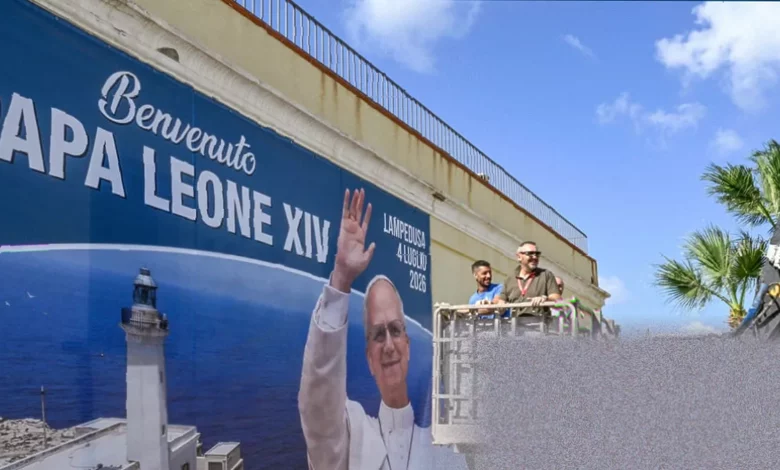
On 4 July, the Pope chose to mark America’s 250th anniversary in a dramatically different way: a brief visit to the southern Italian island of Lampedusa, one of the main entry points to Europe for people making the perilous sea crossing from north Africa. The island, home to roughly 6,000 residents and located closer to Tunisia than to mainland Italy, has for decades been the first port of call for migrants travelling in flimsy boats. More than 182,000 people have transited the island’s reception centre in the past three years, Vatican News reported this week, citing data from the Italian Red Cross. Since 2014, the International Organization for Migration (IOM) has recorded tens of thousands of deaths of people who set off from Tunisia or Libya. Despite a sharp drop in arrivals along Italy’s southern shores in recent years, the fatalities continue. Between January and early April 2026, the IOM reported nearly 1,000 people either dead or missing in the Mediterranean, describing it as one of the deadliest starts to a year since record-keeping began in 2014. In the Central Mediterranean alone, approximately 765 people had died in 2026, a substantial increase compared with the same period in the previous year, the IOM said.
Pope Leo will arrive in Lampedusa by helicopter early on Saturday morning. His first stop will be a cemetery where many unmarked graves hold the remains of people who died during the Mediterranean journey. He will then visit the Porta d’Europa (Gateway to Europe), a migrant memorial monument, before blessing a plaque on a pier named after his late predecessor, Pope Francis, who visited the island in July 2013 on his first official papal trip and denounced the “globalisation of indifference”. Like Francis, Leo has repeatedly clashed with Trump over immigration, calling in November for “deep reflection” in the United States about the treatment of people held in detention.
The Pope will celebrate mass and speak to people who have survived the journey as well as humanitarian workers in Lampedusa before leaving shortly after midday. The International Rescue Committee (IRC) has highlighted the dire conditions faced by migrants arriving on the island, noting that reception centres are frequently overwhelmed and lack adequate infrastructure. Kandeh Abdourahman, a cultural mediator who works on the island for the IRC, said: “I was one of those thousands who crossed the Mediterranean and landed in Lampedusa in 2015, exhausted and uncertain. The pope’s visit speaks to every one of us – a reminder that our stories are seen, that ‘welcome’ is not just a word but an act of humanity that can help us reach all 118 million people displaced in the world today.”
Expert analysis
Marco Politi, a Vatican journalist and author, said: “Leo’s trip to Lampedusa is strongly symbolic and is also a political sign. He is focusing on the theme of immigration. This means reaffirming what he recently said in Spain about the dignity of every human being, but the trip is also a political message against the persecution of immigrants and what is being done by ICE agents in the US. Furthermore, it is a strong political message against all the parties in Europe who sow hatred and polarise.”
Andrea Vreede, the Vatican correspondent for the Dutch broadcaster NOS, described the trip as partly a homage to Francis but also a pointed gesture towards Trump. “The pope is telling Trump what is important to him, and that is migrants. He chose 4 July to make this point.”
Pope Leo’s 2026 itinerary has included an extensive tour of Africa from 13 to 23 April, visiting Algeria, Cameroon, Angola and Equatorial Guinea, and an apostolic journey to Spain from 6 to 12 June, during which he addressed the immigration crisis and inaugurated the Tower of Jesus Christ of the Sagrada Família in Barcelona.