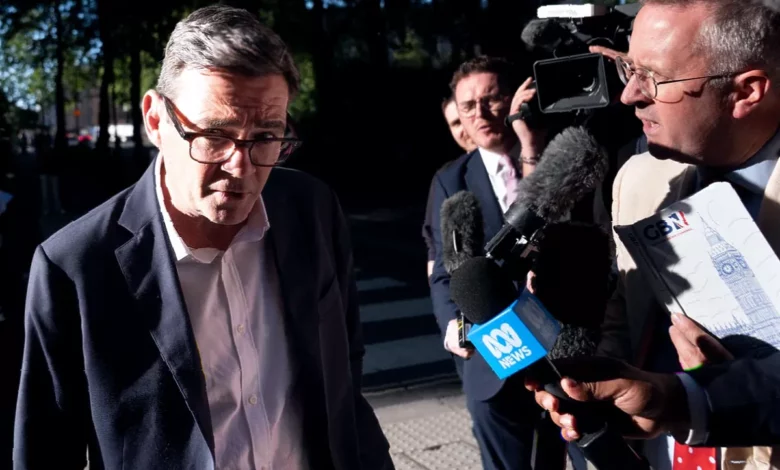
Andy Burnham has declared his strong support for electoral reform, arguing that a shift to proportional representation would pave the way for a more collaborative style of politics. In comments made on Reddit, the Greater Manchester mayor said he backs the change “partly because I believe it will enable the change to a more collaborative politics, and one that is less about point-scoring and more about problem-solving.”
Burnham’s position is not new. He has said he “came round to” the idea in 2021 and has consistently reaffirmed his support since then. The mayor, who recently won the Makerfield by-election and is seen by some as a frontrunner to challenge for the Labour leadership, has outlined a clear path for reform. Should he become prime minister, he has suggested he would launch a national commission on electoral reform to determine the best voting system and would push for a commitment to introduce proportional representation in Labour’s manifesto. He favours a manifesto commitment over a standalone referendum, citing his father’s advice against committing to referendums.
From point-scoring to problem-solving
The core of Burnham’s argument is that Westminster’s current first-past-the-post system encourages adversarial, zero-sum politics. He envisions a proportional representation model that would force parties to negotiate, compromise and work together – a fundamental shift away from the “point-scoring” that, in his view, dominates the House of Commons. Under PR, parties would need to build coalitions or at least seek consensus to govern, making it harder for any single party to ram through legislation without broader input. This, Burnham believes, would redirect political energy toward solving long-term challenges such as housing, health and regional inequality, rather than scoring short-term tactical victories against opponents.
The shift from confrontation to collaboration is not just a theoretical benefit. Proportional representation is already used in the devolved assemblies in Scotland, Wales and Northern Ireland, as well as for European Parliament elections before Brexit. Proponents argue that these bodies have developed a more consensual culture, even if coalition governments have at times been unstable. Burnham’s proposal to bring that approach to Westminster would represent the most significant change to UK general elections in a century.
The broader reform landscape
Public opinion appears to be moving in his direction. A YouGov poll conducted in February 2025 found that 49% of respondents favoured proportional representation for general elections, compared with 26% who preferred the current first-past-the-post system. Support for PR is particularly strong among voters for the Green Party, Reform UK and the Liberal Democrats, and a majority of Labour voters also back the change.
Within Labour, the push for PR has been gaining momentum. The Labour Campaign for Electoral Reform (LCER) has long argued that the party should reject FPTP and commit to a broadly proportional system. At the 2022 Labour Party conference, delegates voted overwhelmingly in favour of adopting PR, although the motion was not binding on the leadership at the time. A growing number of Constituency Labour Parties have passed motions supporting the change, and several affiliated trade unions now back the policy.
The broader electoral reform debate is not limited to voting systems. The UK government recently introduced the Representation of the People Bill, which includes measures to lower the voting age to 16, introduce more automated voter registration and expand the list of accepted voter ID. Crucially, the bill does not include a shift to proportional representation for general elections, leaving that fight for another day.
Criticisms and sticking points
Not everyone is convinced. Critics of PR argue that it can lead to chaotic government, with unstable coalitions that struggle to pass legislation. Some warn that it could empower smaller, more extreme parties and make it harder for any government to deliver a clear mandate. A significant point of contention is the desire to retain a local MP constituency link, which many voters value. Under many PR systems, that link is weakened or replaced by larger regional or national party lists.
Burnham and other reformers counter that the existing system already produces distortions. The 2024 general election saw Labour win a landslide majority in seats while securing the lowest vote share for any governing party on record. The Electoral Reform Society described that result as the “least proportional in British history”, noting that millions of votes effectively counted for nothing because they were cast in safe seats or for parties that fell just short of winning. For Burnham, that outcome underscores the case for a system that ensures every vote matters and that encourages the collaborative, problem-solving politics he has championed.