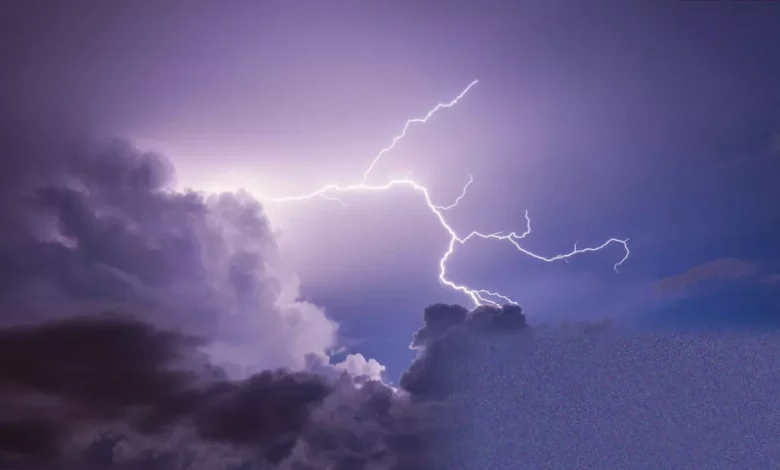
A bolt of lightning heats the air almost instantly to as high as 30,000°C, triggering an explosive expansion that creates a supersonic shock wave. That shock wave is what we call thunder — but what a listener actually hears depends largely on where they stand.
The sound of thunder changes dramatically with distance. Close to the strike, the ear registers a sharp snap or crack, or a startling explosive boom. Large, complex lightning channels with multiple segments can generate a peal of thunder — a series of booms at different pitches as the sound from each segment arrives in turn. Meteorologists classify these close-range sounds as claps (loud, short, higher-pitched), peals (varying loudness and pitch), rolls (irregular mixtures) and rumbles (less loud, longer, low-pitch). The shape of the lightning channel also plays a role: a vertical strike often produces a single rumble, while a forked bolt creates a series of continuous grumbles as shock waves from different forks bounce off each other and surrounding surfaces.
Distant thunder is an entirely different phenomenon. The atmosphere muffles sound, and higher frequencies are absorbed more effectively as distance increases. Over just a few miles, the high-pitched elements are stripped away, leaving only a low-frequency rumble. This rumble tends to persist far longer than the initial peal because the sound bounces off clouds and hills, echoing and re-echoing repeatedly. Even those low-frequency sounds are absorbed after travelling roughly ten miles of air, but the lightning itself may remain visible from much further away. Atmospheric conditions such as temperature inversions can refract sound waves back towards the ground, sometimes amplifying thunder and making it sound louder; conversely, snow inside a thunderstorm can dampen the sound so severely that thunder may only be audible within two to three miles of the strike.
This contrast between near and distant thunder gave rise to a persistent misconception. An observer on an open plain or at sea can watch a distant thunderstorm flicker repeatedly with no audible sound — especially on warm summer evenings, when the storm is far enough away that the atmosphere has absorbed all the noise. This phenomenon is often called “heat lightning,” a name that wrongly suggests it is a different kind of lightning caused by heat itself. In reality, it is nothing more than ordinary lightning from a thunderstorm too far away for its thunder to be heard. The light from the bolt travels far further than the sound, and hazy, humid conditions on summer nights scatter and reflect that light, making the flashes visible across great distances.
The science behind the flash
Lightning and thunder originate from electrical charge separation inside thunderstorms. Ice crystals and water droplets collide and rub against one another, knocking off electrons. This process leaves the top of the cloud positively charged and the base negatively charged, creating a strong electrical potential difference. When that difference becomes large enough to overcome the insulating properties of the air, a discharge occurs — the lightning bolt. The most common type is cloud-to-ground lightning, in which negative charges from the cloud are attracted to positive charges on the ground.
The extreme heating along the lightning channel — up to 30,000°C, far hotter than the surface of the sun — causes the air to expand explosively and rapidly, generating the shock wave that becomes thunder. Because light travels much faster than sound, the flash is always seen before the thunder is heard. The time delay can be used to estimate distance: roughly five seconds per mile, or three seconds per kilometre.
Thunderstorms in the UK
Thunderstorms can occur at any time of year in the UK, but they are most severe and common in the summer, particularly after hot, humid weather. The East Midlands and Southeast England see the highest frequency. In 2024, the UK experienced approximately 17,000 cloud-to-ground lightning flashes, with September being a particularly active month. In June 2026, more than 29,000 lightning strikes were recorded across Southern England in a single 24-hour period.
The UK has a history of severe thunderstorms. August 1, 1846, holds the record for the most widespread and damaging thunderstorms in a single day, causing significant damage, flooding and fatalities. The July 1968 storms, which involved dust from the Sahara, led to widespread damage, flooding and four deaths. Beyond lightning itself, thunderstorms bring heavy rain, hail, strong winds, flooding and power cuts. Lightning strikes can cause fires, as seen in Streatham, London, in June 2026. Historically, lightning has caused fatalities, injuries and significant property damage.
Safety and impact
While thunder itself cannot hurt people, lightning is dangerous and can be fatal. On average, two people a year are killed by lightning in the UK. The safest place during a thunderstorm is inside a sturdy building or a car with windows closed, avoiding contact with plumbing and metal fittings. If caught outside, experts advise seeking low-lying open spaces away from trees, poles and metal objects, crouching in a ball-like position with minimal ground contact — never lying flat, as that increases danger. Water conducts electricity, so swimming, boating and using plumbing should be avoided. If driving, pull over, wind up windows and stay inside a hard-topped vehicle; soft-top cars offer less protection. A widely recommended rule is to wait at least 30 minutes after the last flash of lightning or sound of thunder before leaving safety.
Animals often react fearfully to thunder. Dogs may whimper and hide, while livestock can stampede due to fright, posing risks to nearby humans. In rare cases, very close lightning strikes have caused injury and property damage; the immense pressure can even cause trees to explode if the shock wave passes through their capillaries.
Emerging research
Scientists are still trying to fully understand how lightning starts. Recent research suggests cosmic-ray showers may play a role in triggering lightning by creating pathways in thunderclouds. Other work indicates that ice exhibits a flexoelectric property that amplifies charge separation during collisions, contributing to lightning’s origin. New laboratory experiments aim to recreate lightning-like phenomena, which could advance understanding of the process and improve technologies such as X-ray detectors. Meanwhile, scientists have documented weak electrical discharges — called coronae — around treetops during thunderstorms, usually invisible to the naked eye but emitting ultraviolet light. These discharges may affect forest air quality and tree health.