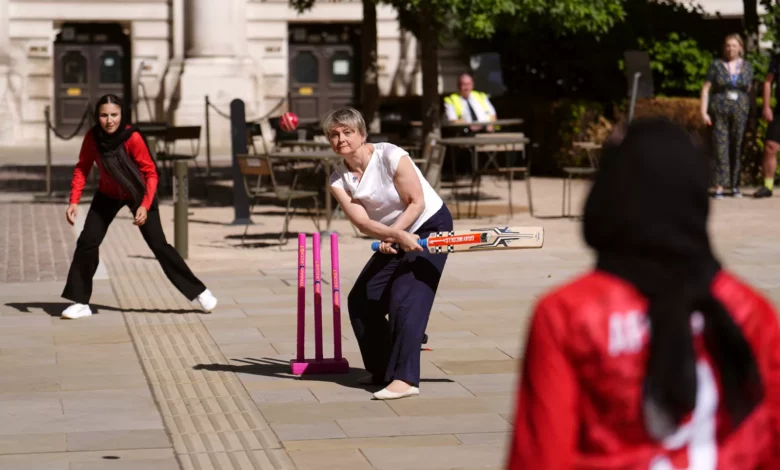
Afghan women cricketers, exiled in Australia and barred from representing their homeland under Taliban rule, are intensifying their campaign for international recognition as they seek to compete under a refugee banner. The team, most of whose members are now settled in Melbourne and Canberra, has reformed as the Afghan Women’s XI and is pressing the International Cricket Council (ICC) to grant them official status, a move that would allow them to play as a national side in exile.
The players brought their case to the heart of the British government this week when the Foreign Secretary, Yvette Cooper, hosted them at the Foreign, Commonwealth and Development Office (FCDO) in central London for a friendly cricket match. During the event, Cooper expressed outrage that Afghan women are banned from playing cricket in their homeland under the Taliban’s restrictions, describing their treatment as “barbarous.” She called on the ICC to show solidarity with the team. Foreign Office minister Hamish Falconer also took part in the game. The team presented Cooper with a bat they had decorated, and she signed a cricket ball for them. Their visit to London coincided with the ICC Women’s T20 World Cup semi-final between England and South Africa.
A decade of struggle for Afghan women’s cricket
The team’s roots stretch back to 2010, when the first national women’s side was established in Afghanistan during the Afghan Republic. From the outset, players faced cultural opposition and security threats. A renewal of hope came in 2020, when the Afghanistan Cricket Board (ACB) awarded central contracts to 25 women. But that progress was shattered in August 2021, when the Taliban’s return to power led to the immediate disbanding of the team and a blanket ban on women’s sports.
Most members of the side fled the country. Some initially sought refuge in Pakistan before being granted emergency visas for Australia, where the majority are now rebuilding their lives as refugees. The escapes were aided by Australian cricketer Mel Jones and Dr Catherine Ordway, a sports integrity expert who assisted in the players’ evacuation and resettlement. Since arriving in Australia, the team has reformed as the Afghan Women’s XI and has been actively campaigning for recognition.
Refugee status and the fight for ICC recognition
The players’ refugee status has placed them in a legal and sporting limbo. They have been unable to secure official backing from the ICC, which continues to recognise the ACB under Taliban control despite the governing body’s own regulations requiring member nations to maintain a women’s national team. The Afghan Women’s XI has written to the ICC requesting permission to form an international refugee team, but the players have expressed deep disappointment at the lack of response and what they see as a failure of meaningful action from the world cricket body.
Amnesty International and Human Rights Watch have supported their calls. Human Rights Watch has described the situation as a “form of gender apartheid,” highlighting the systemic exclusion of women from sport and public life under the Taliban. The players themselves have spoken of the profound personal cost. Some have described the sadness of not being able to represent their country in the way their male counterparts can, and the loss of their homeland weighs heavily. Yet they remain determined: they aim to use their platform to advocate for the rights of women and girls in Afghanistan and to inspire future generations.
The team has taken their campaign onto the pitch as well as into conference rooms. In January 2025, they played their first match as the Afghan Women’s XI against the Cricket Without Borders Charity XI in Melbourne. They have also toured England, taking on the UK Armed Forces Women’s Cricket Team and Cambridge University Women’s Cricket Club. A significant moment during the English tour was an official meeting with King Charles III at Clarence House, seen by the players as a gesture of international recognition. They are also scheduled to be guests at the Women’s T20 World Cup final at Lord’s.
For Yvette Cooper, the message was clear. “The ICC needs to show solidarity,” she said after the FCDO fixture, emphasising that it is unacceptable for Afghan women to be denied the right to play cricket simply because of where they were born. The team, meanwhile, continues to balance the practicalities of life as refugees with a relentless push for the recognition they believe is their due. As one player put it, they are determined to keep playing and keep fighting, not only for themselves but for every woman and girl in Afghanistan who dreams of taking up a bat and ball.