Global Politics and Diplomacy Explained
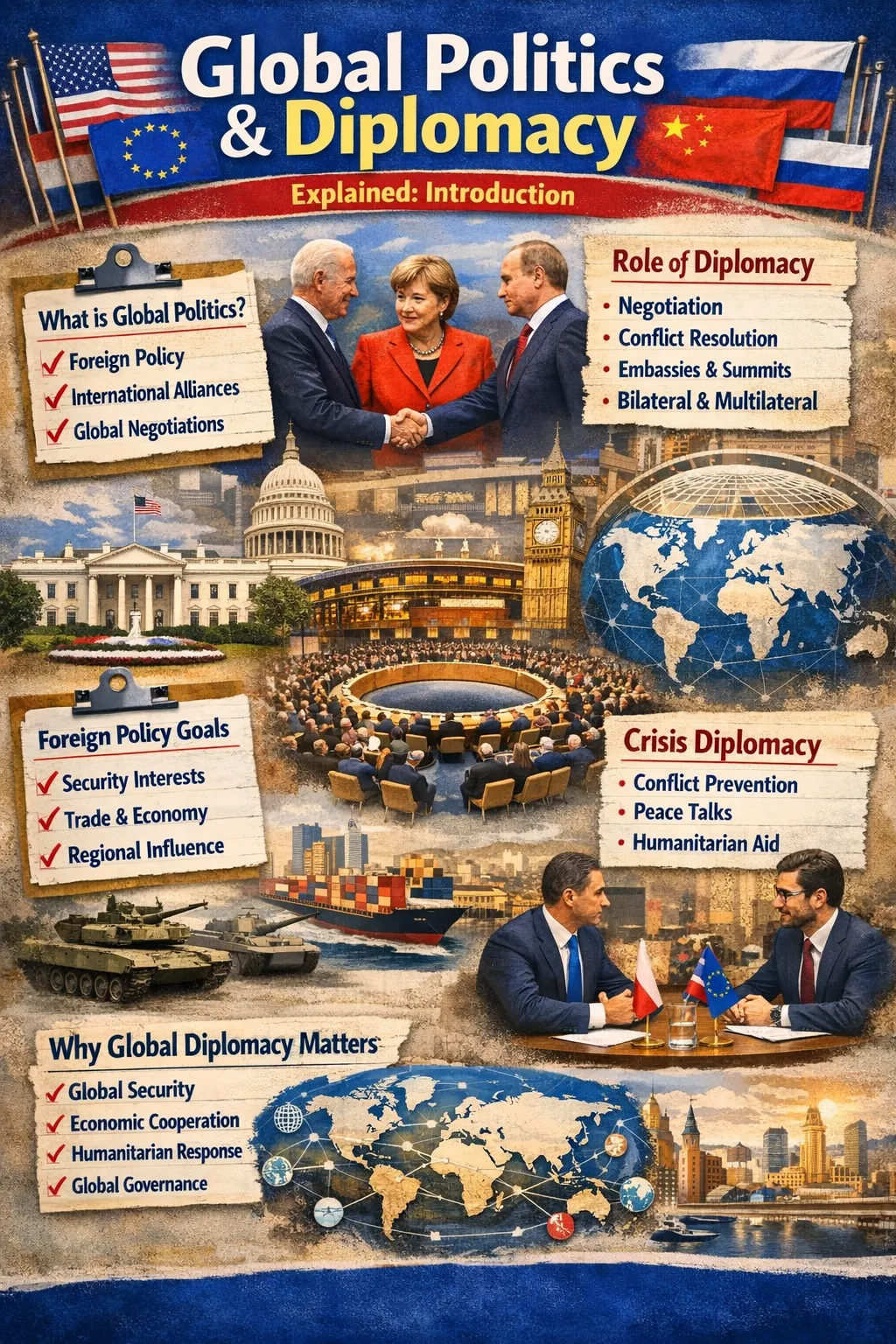
Global politics and diplomacy shape the relationships between nations, determine how international disputes are resolved and influence the peace, security and prosperity of people around the world. The United Kingdom plays a significant role in global affairs as a permanent member of the United Nations Security Council, a leading member of NATO, the G7 and the Commonwealth, and one of the world’s largest economies and military powers.
This guide explains how global politics and diplomacy work, what the main structures of international relations are, how the UK engages with the world and why understanding global affairs matters.
What is international diplomacy?
Diplomacy is the practice of managing relationships between countries through negotiation, dialogue and formal agreements. It is conducted through embassies and consulates, multilateral institutions such as the United Nations, regional organisations, international summits and direct communication between heads of state and government. Diplomacy covers a vast range of issues including trade, security, human rights, climate change, migration, public health, arms control, cultural relations and development assistance.
The UK’s diplomatic service is managed by the Foreign, Commonwealth and Development Office (FCDO), which operates a global network of over 280 posts in more than 170 countries. The FCDO is responsible for promoting UK interests abroad, protecting British nationals overseas, advancing UK foreign policy objectives, managing international development programmes and coordinating the UK’s response to international crises. The department was created in 2020 through the merger of the Foreign and Commonwealth Office and the Department for International Development.
Modern diplomacy extends well beyond traditional state-to-state relations. Public diplomacy — the use of cultural programmes, educational exchanges, media engagement and digital communication to influence foreign publics — has become increasingly important. The British Council promotes educational and cultural relations, the BBC World Service provides independent journalism to a global audience, and the Chevening Scholarship programme brings future leaders from around the world to study in the UK. Soft power — the ability to influence others through attraction rather than coercion — is considered a significant UK asset in global affairs.
How does the international system work?
The international system is based on the principle of state sovereignty — the idea that each state has the right to govern its own affairs without external interference. However, this principle coexists with a dense network of international organisations, treaties, norms and institutions that constrain and shape state behaviour. The United Nations, founded in 1945, is the centrepiece of the multilateral system, providing a forum for international negotiation and cooperation on issues ranging from peacekeeping and human rights to development and environmental protection.
International relations are shaped by the distribution of power between states. The post-Cold War era, in which the United States was the dominant global power, is giving way to a more contested and multipolar world in which China, Russia, India, regional powers and non-state actors all exercise significant influence. This shift is affecting the functioning of international institutions, the dynamics of trade and economic relations, the nature of security threats and the prospects for cooperation on global challenges such as climate change and pandemic preparedness.
International law — including treaties, conventions, customary international law and the rulings of international courts — provides a framework of rules governing state behaviour. Key areas of international law include the law of armed conflict (the Geneva Conventions and their protocols), human rights law (the Universal Declaration of Human Rights, the European Convention on Human Rights), international trade law (administered through the World Trade Organisation), maritime law (the UN Convention on the Law of the Sea) and environmental law (including the Paris Agreement on climate change). Compliance with international law is enforced through a combination of diplomatic pressure, economic sanctions, international courts and, in extreme cases, military intervention.
What is the UK’s role in global politics?
The United Kingdom is one of the five permanent members (P5) of the UN Security Council, alongside the United States, France, Russia and China. This status gives the UK a veto over Security Council resolutions and a central role in decisions about international peace and security, including the authorisation of peacekeeping missions, the imposition of sanctions and responses to threats to international peace. The UK is also a leading member of NATO, the military alliance that provides collective defence for its members, and hosts major NATO facilities.
The UK’s foreign policy since Brexit has been described by the government as “Global Britain” — an ambition to play a more active and independent role in world affairs outside the European Union. This has involved pursuing new trade agreements, strengthening relationships with Indo-Pacific nations through the AUKUS security partnership (with Australia and the United States) and accession to the Comprehensive and Progressive Agreement for Trans-Pacific Partnership (CPTPP), and maintaining close security and intelligence relationships with the Five Eyes allies.
The UK’s relationship with the European Union remains one of the most significant aspects of its foreign policy. Despite leaving the EU, the UK continues to cooperate with European partners on security, defence, research, climate and other issues, though the relationship has been reshaped by the Trade and Cooperation Agreement and ongoing negotiations about the practical implementation of post-Brexit arrangements, including the Windsor Framework governing Northern Ireland.
What are the major geopolitical challenges?
The current geopolitical landscape is marked by several major challenges. The war in Ukraine, launched by Russia’s full-scale invasion in February 2022, has transformed European security, led to a significant increase in defence spending across NATO, reshaped energy markets and tested the resilience of the rules-based international order. The UK has been one of the strongest supporters of Ukraine, providing military equipment, training, financial support and diplomatic leadership in building the international coalition supporting Ukraine’s resistance.
The rise of China as a global economic and military power presents complex challenges for the UK and its allies. The UK’s Integrated Review describes China as a “systemic challenge” — an important economic partner but also a competitor in technology, a strategic rival in certain domains and a state whose values and governance model differ fundamentally from the UK’s. Managing this relationship — balancing economic engagement with security concerns about areas such as technology supply chains, intellectual property, human rights and influence operations — is one of the most significant foreign policy challenges of the current era.
Other major geopolitical issues include conflicts and instability in the Middle East, the Sahel and the Horn of Africa, the threat of nuclear proliferation, the impact of climate change on international security, the governance of cyberspace and emerging technologies, and the pressures on the multilateral system from great power competition and populist nationalism.
How does the UK’s development and aid policy work?
International development assistance is an important tool of UK foreign policy and diplomacy. The UK has historically been one of the world’s largest providers of official development assistance (ODA), contributing to poverty reduction, health, education, humanitarian response, climate adaptation and governance reform in developing countries. The merger of the Department for International Development (DFID) with the Foreign and Commonwealth Office in 2020, creating the FCDO, reflected a policy decision to integrate development more closely with diplomatic and strategic objectives.
The UK’s commitment to spend 0.7 per cent of gross national income on ODA was enshrined in law in 2015 but was reduced to 0.5 per cent in 2021 due to fiscal pressures from the pandemic. This reduction was controversial, prompting legal challenges, parliamentary debate and criticism from development organisations and former prime ministers. UK aid priorities include global health (the UK is a major funder of Gavi, the Global Fund to Fight AIDS, Tuberculosis and Malaria, and the WHO), climate finance, girls’ education, humanitarian crisis response and conflict prevention.
The effectiveness and accountability of UK aid are scrutinised by the Independent Commission for Aid Impact (ICAI), parliamentary committees and civil society organisations. Debates about aid policy encompass questions about whether aid should be tied to UK commercial interests, the balance between bilateral and multilateral channels, the relationship between development and migration, and the extent to which aid can address the root causes of poverty and instability in fragile and conflict-affected states.
How does sanctions and economic statecraft work?
Economic sanctions — restrictions on trade, finance, travel and other economic activities imposed on states, entities or individuals — have become one of the most important tools of UK foreign policy. Since leaving the EU, the UK has operated its own independent sanctions regime under the Sanctions and Anti-Money Laundering Act 2018, allowing the government to designate targets and impose sanctions autonomously, while continuing to coordinate closely with allies including the United States and the EU.
The most significant UK sanctions programme is directed at Russia, imposed in response to the invasion of Ukraine. UK sanctions on Russia include asset freezes on designated individuals and entities, trade restrictions on key sectors including energy, financial services, technology and luxury goods, travel bans on sanctioned persons and restrictions on Russian access to UK financial markets. The UK has also imposed sanctions programmes relating to Iran, North Korea, Myanmar, Syria, Belarus, Libya and other situations involving human rights abuses, terrorism and threats to international peace and security.
The Office of Financial Sanctions Implementation (OFSI), part of HM Treasury, administers and enforces financial sanctions in the UK. The effectiveness of sanctions as a foreign policy tool is debated — supporters argue that they impose costs on hostile actors and signal international disapproval, while critics question whether sanctions achieve their stated objectives, highlight the humanitarian impact on civilian populations and note that enforcement is often incomplete due to sanctions evasion and the complexity of global financial networks.
How does the UK engage with Asia and the Indo-Pacific?
The UK government has identified the Indo-Pacific as a region of increasing strategic importance and has pursued a “tilt” towards greater engagement with the countries of Asia, Australasia and the Pacific. This strategy reflects the growing economic weight of the region, the strategic significance of the Indo-Pacific for global security and the UK’s desire to diversify its international partnerships beyond Europe.
Key elements of the Indo-Pacific tilt include the AUKUS security partnership with Australia and the United States (focused on nuclear-powered submarine technology and advanced capabilities), accession to the CPTPP trade agreement, enhanced defence engagement with Japan, South Korea, India and ASEAN countries, deployment of the carrier strike group to the region, and investment in diplomatic capacity across the Indo-Pacific. The UK’s relationship with China — balancing economic engagement with security concerns about technology, human rights and territorial assertiveness — remains one of the most complex and consequential aspects of the Indo-Pacific strategy.
How does the UK approach human rights in foreign policy?
Human rights are a stated priority of UK foreign policy, though the implementation of this commitment involves balancing values with strategic and economic interests. The UK supports human rights through diplomatic engagement, the UN Human Rights Council, targeted sanctions against individuals and entities responsible for human rights violations (the UK’s Global Human Rights sanctions regime, known as the “Magnitsky” regime), development programmes and support for civil society organisations in countries where human rights are under threat.
The UK has taken prominent positions on human rights issues including the treatment of Uyghurs in China’s Xinjiang province, the suppression of democratic freedoms in Hong Kong, the persecution of Rohingya Muslims in Myanmar, the repression of civil society in Russia and Belarus, and violations of international humanitarian law in armed conflicts. However, the UK’s credibility on human rights is sometimes questioned in relation to its own domestic record (including the Rwanda asylum policy, restrictions on protest rights and conditions in immigration detention) and its relationships with states that have poor human rights records but are important commercial or security partners.
Why does global politics matter?
Global politics directly affects the security, prosperity and daily life of people in the United Kingdom. Trade relationships determine the availability and price of goods and services, security alliances protect against military threats, international cooperation is essential to addressing climate change and pandemics, and the stability of the international order affects migration, investment and the UK’s ability to project its values and interests abroad. Understanding how global politics and diplomacy work helps citizens engage with the decisions their government makes about the UK’s place in the world.
Related guides
- International Organisations and Global Governance Explained
- Global Security, Conflicts and Defence Explained
- Global Economy and International Trade Explained
- How the UK Government Works
- How the UK Economy Works
Related coverage:
Read our latest world news
Prepared by: