
International Organisations and Global Governance Explained
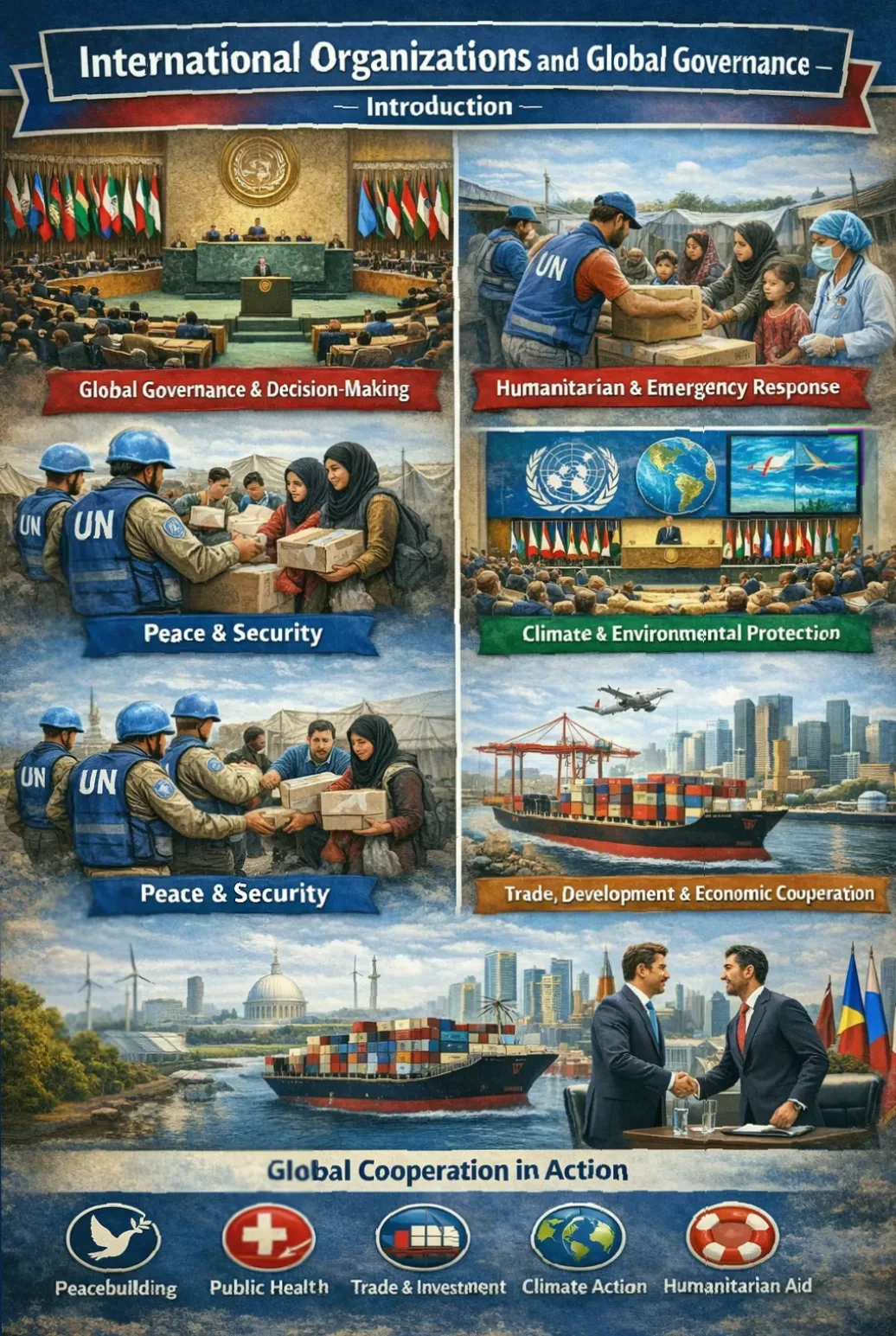
International organisations provide the institutional framework through which countries cooperate on shared challenges, from maintaining peace and security to regulating trade, protecting human rights and addressing climate change. The United Kingdom is a founding or leading member of many of the world’s most important multilateral institutions, giving it significant influence over global governance and international policy-making.
This guide explains the main international organisations, how global governance works, the UK’s role in these institutions and why multilateral cooperation matters.
What is the United Nations?
The United Nations (UN) is the world’s principal multilateral organisation, with 193 member states. Founded in 1945 after the Second World War, the UN’s purposes are to maintain international peace and security, develop friendly relations among nations, achieve international cooperation on economic, social, cultural and humanitarian problems, and promote respect for human rights. The UK is one of the five permanent members of the UN Security Council, alongside the United States, France, Russia and China, giving it the power to veto Security Council resolutions.
The UN system includes numerous specialised agencies and programmes, including the World Health Organisation (WHO), which coordinates international public health responses; UNICEF, which works on child welfare; UNHCR, which provides protection and assistance to refugees; the World Food Programme (WFP), which delivers food assistance in emergencies; and the UN Development Programme (UNDP), which supports sustainable development in over 170 countries. The UK is a major financial contributor to the UN system and participates actively in UN peacekeeping, mediation and humanitarian operations.
How do NATO and security alliances work?
The North Atlantic Treaty Organisation (NATO) is the military alliance that provides collective defence for its 32 member states. The core commitment is Article 5 of the North Atlantic Treaty, which states that an armed attack against one member shall be considered an attack against all. NATO was founded in 1949 and has evolved to address security challenges including terrorism, cyber threats, hybrid warfare and the resurgence of Russian military aggression. The UK is one of NATO’s most capable military powers, contributing significant forces, intelligence, nuclear deterrence and leadership to the alliance.
What are the G7, G20 and the Commonwealth?
The G7 is an informal forum of seven leading industrialised economies — the UK, US, Canada, France, Germany, Italy and Japan — plus the EU. The G7 meets annually at leaders’ level and coordinates policy on economic, foreign policy, security, climate and development issues. The G20 brings together the world’s largest economies and has become the premier forum for international economic cooperation since the 2008 financial crisis.
The Commonwealth is a voluntary association of 56 countries, most former territories of the British Empire, headed by King Charles III. It promotes democracy, human rights, good governance and sustainable development and provides a network for diplomatic, educational, cultural and trade cooperation. The Commonwealth Secretariat, based in London, coordinates activities and Heads of Government Meetings (CHOGMs) are held every two years.
How does the United Nations Security Council work?
The UN Security Council is the most powerful body in the international system, with primary responsibility for maintaining international peace and security. It has 15 members — five permanent members (the P5: the United States, the United Kingdom, France, Russia and China) with veto power, and 10 non-permanent members elected for two-year terms by the UN General Assembly. Security Council resolutions are legally binding on all UN member states.
The Council can authorise peacekeeping operations, impose economic sanctions, establish arms embargoes, refer situations to the International Criminal Court and authorise the use of military force. However, the veto power of the P5 means that the Council is frequently unable to act on the most politically contentious issues — Russia and China have used their vetoes to block resolutions on Syria, Ukraine and other crises. Reform of the Security Council has been debated for decades but remains politically intractable.
What role do international courts and human rights bodies play?
International courts play a growing role in global governance. The International Court of Justice (ICJ) settles legal disputes between states. The International Criminal Court (ICC) prosecutes individuals for genocide, war crimes, crimes against humanity and the crime of aggression. The UK is a state party to the ICC and has historically been a strong supporter of international justice.
The UN Human Rights Council promotes human rights worldwide through reviews, special procedures and resolutions. The European Court of Human Rights hears cases brought by individuals against Council of Europe member states, including the UK. The UK’s relationship with the European Court of Human Rights has been the subject of political debate. Other important bodies include the International Labour Organization (ILO), which sets standards for workers’ rights, and the UN Environment Programme (UNEP), which coordinates international environmental action.
How do international environmental and health organisations work?
The UNFCCC provides the framework for international climate negotiations, including the annual COP meetings. The Paris Agreement commits signatories to limiting global warming to well below 2°C. The UK hosted COP26 in Glasgow in 2021. The World Health Organisation (WHO) coordinates international public health, setting standards for disease surveillance and health emergencies. The COVID-19 pandemic exposed both the WHO’s importance and its limitations, prompting negotiations for a Pandemic Treaty to strengthen preparedness.
How do international economic institutions work?
The World Trade Organisation (WTO), the International Monetary Fund (IMF) and the World Bank are the three pillars of the post-war international economic order. The WTO sets rules for international trade and operates a dispute settlement system. The IMF monitors global economic stability and provides financial assistance to countries in crisis. The World Bank provides loans, grants and technical assistance to developing countries. The UK is a significant shareholder and contributor to all three institutions.
Regional organisations also play important roles in global governance. The European Union, the African Union, ASEAN (the Association of Southeast Asian Nations), the Organisation of American States and the Arab League all coordinate policy and cooperation among their members. The UK’s relationship with the EU remains one of the most significant aspects of its engagement with international institutions, despite having left the bloc in 2020.
How do regional organisations shape global governance?
Regional organisations play crucial roles in international governance alongside global institutions. The European Union, with 27 member states, is the world’s most advanced supranational organisation, with legislative, executive and judicial institutions that create binding law in areas including trade, competition, agriculture, environmental protection and migration. Despite the UK’s departure, the EU remains the UK’s closest geographical partner and its largest collective trading partner, and EU regulatory decisions continue to influence UK policy in many areas.
The African Union (AU), with 55 member states, coordinates political, economic and security cooperation across Africa, including through its Peace and Security Council and the African Continental Free Trade Area (AfCFTA), which aims to create a single market for goods and services across the continent. The Association of Southeast Asian Nations (ASEAN), comprising 10 member states in Southeast Asia, promotes economic integration, political cooperation and regional stability in one of the world’s fastest-growing regions. The Organisation of American States (OAS) and the Arab League fulfil similar functions in the Americas and the Middle East respectively.
The UK engages with regional organisations through dialogue partnerships, trade negotiations and diplomatic channels. As a member of the CPTPP and an ASEAN Dialogue Partner, the UK has strengthened its institutional relationships in the Asia-Pacific. The UK also works with the African Union on peace and security, development and climate issues, and maintains observer status or engagement with several other regional bodies. The growing assertiveness of regional organisations reflects a broader trend towards a more decentralised and multipolar international order.
How do international development institutions work?
International development institutions provide financial and technical assistance to developing countries, supporting economic growth, poverty reduction, infrastructure development and institutional capacity. The World Bank Group — comprising the International Bank for Reconstruction and Development (IBRD), the International Development Association (IDA), the International Finance Corporation (IFC) and other entities — is the largest multilateral development institution, providing over $70 billion in annual financing to developing countries.
Regional development banks — including the Asian Development Bank (ADB), the African Development Bank (AfDB), the Inter-American Development Bank (IDB) and the European Bank for Reconstruction and Development (EBRD) — provide development finance tailored to the needs of their respective regions. The UK is a shareholder in all major multilateral development banks and plays an active role in their governance, policy development and replenishment negotiations.
The Sustainable Development Goals (SDGs), adopted by the UN General Assembly in 2015, provide the overarching framework for international development cooperation. The 17 SDGs — covering poverty, hunger, health, education, gender equality, clean water, energy, economic growth, innovation, inequality, sustainable cities, responsible consumption, climate action, ocean conservation, biodiversity, peace and justice, and partnerships — set ambitious targets for 2030. Progress towards the SDGs has been uneven, with the COVID-19 pandemic reversing gains in several areas, and many goals are not on track to be achieved by the target date.
What are the challenges facing the multilateral system?
The multilateral system — the network of international organisations, treaties and norms that has underpinned global governance since 1945 — faces significant challenges. Great power competition between the United States, China and Russia has paralysed the UN Security Council on major issues and created rival visions of international order. Rising nationalism and populism in many countries have fuelled scepticism about international institutions and multilateral commitments. The legitimacy of institutions designed in the post-war era is questioned by countries that feel underrepresented in their governance structures.
Reform of the multilateral system is widely recognised as necessary but difficult to achieve. Proposals include expansion of the UN Security Council, reform of voting weights at the IMF and World Bank to reflect the growing economic power of emerging markets, strengthening of the WHO’s pandemic preparedness authority, and the creation of new institutions to govern emerging challenges such as artificial intelligence, cyberspace and outer space. The UK has advocated for reform of multilateral institutions while emphasising the importance of maintaining and strengthening the rules-based international order.
How does the UK influence international organisations?
The UK exercises influence in international organisations through several channels: its permanent seat on the UN Security Council, its voting power in the IMF and World Bank, its financial contributions to multilateral bodies, the placement of British nationals in senior international positions, its alliance relationships (particularly with the United States and EU member states), its convening power as host of major summits and conferences, and its diplomatic network and expertise.
Post-Brexit, the UK has sought to demonstrate that it remains a leading player in multilateral institutions despite no longer being part of the EU’s collective voice. The UK’s hosting of the G7 summit in 2021, the COP26 climate conference in Glasgow, the AI Safety Summit at Bletchley Park and its leadership of international responses to the Ukraine crisis have all been cited as evidence of continued global influence. However, the loss of the EU amplifier for UK positions in multilateral forums, the reduction in the aid budget and constraints on diplomatic resources have raised questions about the UK’s long-term capacity to maintain its international influence at the same level.
The UK has traditionally been well-represented in senior positions at international organisations, including Secretary-General of NATO, heads of UN agencies and senior roles at the World Bank and IMF. Maintaining this presence requires active diplomatic campaigning and coalition-building, and the competition for such positions — from emerging powers, EU member states and other countries — has intensified. The UK’s approach to multilateral engagement emphasises reform and modernisation of institutions to reflect contemporary realities while preserving the core principles of the rules-based international order.
Why does global governance matter?
Global governance provides the framework through which countries address challenges that no single nation can solve alone — from climate change and pandemics to terrorism, nuclear proliferation and financial instability. For the UK, active engagement in global governance is essential to protecting national interests, projecting values and maintaining influence in a changing world. The effectiveness of international organisations and the willingness of states to cooperate through them directly affects the security, prosperity and wellbeing of people in every country.
Related guides
- Global Politics and Diplomacy Explained
- Global Security, Conflicts and Defence Explained
- Global Economy and International Trade Explained
- How the UK Government Works
Related coverage:
Read our latest world news
Prepared by:
