
Global Economy and International Trade Explained
Global inflation, driven by energy price shocks, supply chain disruptions and expansionary fiscal policies during the pandemic, has posed significant challenges for central banks and governments worldwide. The response — sharp increases in interest rates by the US Federal Reserve, the European Central Bank, the Bank of England and other central banks — has tightened financial conditions, increased borrowing costs and slowed economic growth. The management of the transition from high inflation to stable growth without triggering recession is one of the most significant macroeconomic challenges of the current period.
Global debt levels — both sovereign and corporate — have risen to historic highs, raising concerns about fiscal sustainability, particularly in developing countries where debt servicing costs consume a growing share of government revenue. The climate transition presents both economic risks (from the physical impacts of climate change and the costs of adaptation) and opportunities (from the growth of green industries, renewable energy and sustainable finance). The digital transformation of the global economy, including the rise of e-commerce, digital currencies, platform businesses and artificial intelligence, is reshaping industries, labour markets and the nature of international competition.
The global economy connects nations through trade, investment, financial flows, supply chains and the movement of people. The United Kingdom, as one of the world’s largest economies and a major trading nation, is deeply integrated into the international economic system. Understanding how the global economy works and how the UK fits within it is essential context for making sense of domestic economic events.
How does the global economy work?
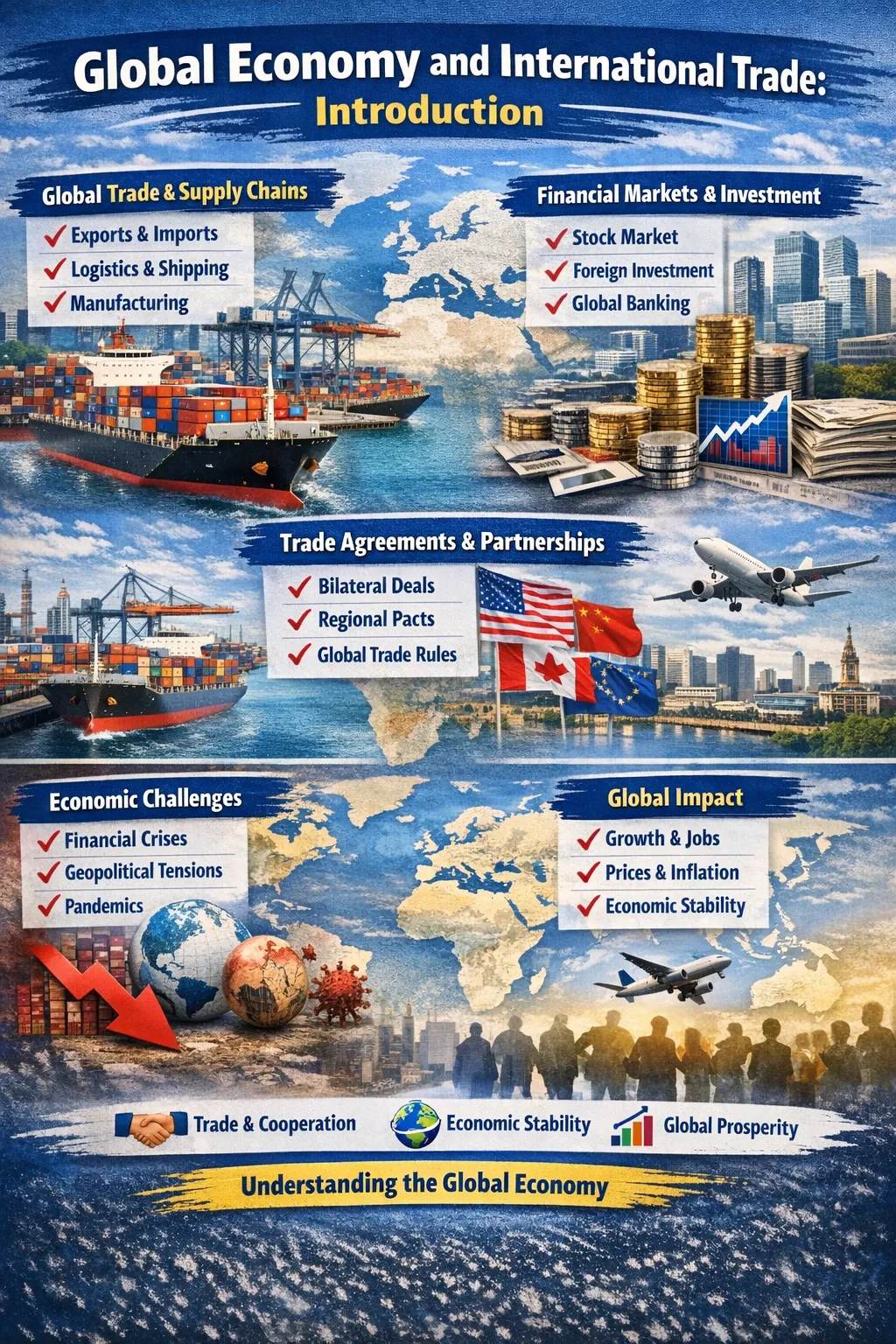
The global economy consists of the interconnected economic activities of approximately 200 countries, generating a total GDP of over $100 trillion per year. The largest economies — the United States, China, Japan, Germany, India and the UK — account for the majority of global output, but emerging economies play increasingly important roles. International trade exceeds $30 trillion per year and encompasses goods, services, intellectual property and digital services. Global supply chains mean that the production of many goods involves multiple countries, creating deep interdependencies that were exposed during the COVID-19 pandemic.
How does international trade work?
International trade is governed by the World Trade Organisation (WTO), which sets rules through multilateral agreements, provides a forum for trade negotiations and operates a dispute settlement system. Countries also negotiate bilateral and regional free trade agreements (FTAs). Since leaving the EU, the UK has pursued an independent trade policy, negotiating FTAs with Australia, New Zealand, Japan and Singapore, and acceding to the CPTPP. The UK’s largest trading relationship remains with the EU under the Trade and Cooperation Agreement.
The UK is a major exporter of services — particularly financial services, professional services, education, creative industries and technology — which account for approximately half of total UK exports. The UK economy is highly open and trade-dependent, with total trade equivalent to approximately 60 per cent of GDP. The Department for Business and Trade manages trade policy, export promotion and inward investment.
What are the major global economic challenges?
Geopolitical fragmentation threatens global trade efficiency. The US-China trade and technology rivalry, comprehensive sanctions against Russia and the securitisation of supply chains all reflect a shift towards economic relationships shaped by political alliances. Global inflation, driven by energy shocks, supply disruptions and expansionary fiscal policies during the pandemic, has posed challenges for central banks worldwide. The management of the transition from high inflation to stable growth is one of the most significant macroeconomic challenges of the current period.
Global debt levels have risen to historic highs, raising concerns about fiscal sustainability, particularly in developing countries. The climate transition presents both risks and opportunities — from the physical impacts of climate change to the growth of green industries and sustainable finance. The digital transformation of the global economy, including the rise of e-commerce, digital currencies and artificial intelligence, is reshaping industries and international competition.
How do international financial markets work?
International financial markets facilitate the flow of capital across borders through foreign exchange markets, bond markets, equity markets, commodity markets and derivatives markets. The foreign exchange market is the largest financial market in the world, with daily turnover exceeding $7 trillion. London is the world’s leading centre for foreign exchange trading, international bond issuance, insurance and cross-border banking, giving the UK a central role in the global financial system.
The stability of the international financial system is overseen by institutions including the IMF, the Financial Stability Board (FSB), the Bank for International Settlements (BIS) and national regulators. The 2008 global financial crisis demonstrated the systemic risks created by interconnected financial markets and led to major reforms in banking regulation, including higher capital requirements, stress testing and the creation of resolution frameworks for failing banks. The Bank of England and the Financial Conduct Authority play leading roles in both domestic and international financial regulation.
How does international development and aid work?
International development — efforts to reduce poverty, improve health and education, promote economic growth and build institutional capacity in lower-income countries — is a significant component of the UK’s engagement with the global economy. The UK has historically been one of the world’s largest providers of official development assistance (ODA), and the commitment to spend 0.7 per cent of gross national income on aid was enshrined in law by the International Development Act 2015.
The UK reduced its ODA commitment to 0.5 per cent of GNI in 2021, citing the fiscal pressures of the pandemic, a decision that was controversial and has not yet been reversed. UK aid is managed by the FCDO and is directed towards priorities including global health (the UK is a major contributor to Gavi, the Global Fund and the WHO), education, climate finance, humanitarian response and conflict prevention. The effectiveness, value for money and strategic alignment of UK aid spending are regularly scrutinised by the Independent Commission for Aid Impact (ICAI) and parliamentary committees.
How does the global energy market work?
Energy markets are a critical component of the global economy, and energy security — reliable access to affordable energy — is a fundamental concern for all nations. The global energy system is undergoing a historic transition from fossil fuels (oil, gas and coal) towards renewable and low-carbon energy sources (solar, wind, nuclear, hydrogen and other technologies). This transition is driven by the need to reduce greenhouse gas emissions to limit climate change, as well as by falling costs of renewable energy technologies, concerns about energy security and the growing economic opportunity in clean energy industries.
The war in Ukraine has had a transformative impact on global energy markets. Russia’s use of energy supplies as a geopolitical weapon — including the reduction of gas flows to Europe — exposed the vulnerability of countries dependent on Russian energy and prompted an accelerated diversification of energy sources. European countries, including the UK, have invested heavily in LNG import capacity, renewable energy, energy efficiency and nuclear power as alternatives to Russian gas. Oil prices spiked in 2022, contributing to global inflation, though they have since moderated.
OPEC (the Organisation of the Petroleum Exporting Countries) and its wider alliance OPEC+ continue to influence global oil prices through coordinated production decisions. The International Energy Agency (IEA), of which the UK is a member, monitors global energy markets, provides policy advice and coordinates responses to energy supply disruptions. The transition to a net-zero economy will require unprecedented investment in clean energy infrastructure globally — the IEA estimates that annual clean energy investment must approximately triple from current levels to meet climate targets.
How do global supply chains affect the economy?
Global supply chains — the networks of companies, factories, logistics providers and transportation systems that produce and deliver goods worldwide — are the backbone of the modern economy. The globalisation of supply chains over recent decades has driven down costs, increased consumer choice and enabled rapid economic growth, but has also created vulnerabilities that became starkly apparent during the COVID-19 pandemic, when factory closures, shipping disruptions and component shortages led to widespread product shortages and price increases.
Governments around the world, including the UK government, have responded by pursuing strategies to improve supply chain resilience — including diversifying sources of critical inputs, building strategic reserves, investing in domestic manufacturing capacity (particularly in sectors such as semiconductors, pharmaceuticals, electric vehicle batteries and critical minerals) and strengthening trade relationships with reliable partners. The concept of “friend-shoring” — redirecting supply chains towards politically aligned countries — has gained prominence, particularly in the context of US-China strategic competition.
Critical minerals — including lithium, cobalt, rare earth elements, nickel and graphite — are essential for the technologies that underpin the green transition and the digital economy, from electric vehicle batteries and wind turbines to smartphones and semiconductors. The concentration of critical mineral production and processing in a small number of countries (particularly China, the Democratic Republic of Congo and Australia) creates supply chain risks that the UK and its allies are seeking to address through new mining partnerships, recycling technologies and international coordination frameworks such as the Minerals Security Partnership.
How does international taxation and finance governance work?
The governance of international taxation has undergone significant reform in recent years. The OECD/G20 Inclusive Framework on Base Erosion and Profit Shifting (BEPS) has produced a landmark agreement on international tax reform, including the introduction of a global minimum corporate tax rate of 15 per cent (Pillar Two) and new rules for allocating taxing rights to the countries where multinational companies earn their profits (Pillar One). The UK has implemented the global minimum tax and has been an active participant in the negotiations.
International financial governance also encompasses anti-money laundering (AML) and counter-terrorist financing (CTF) standards, set by the Financial Action Task Force (FATF) and implemented through national legislation. The UK has strengthened its AML framework through the creation of a register of beneficial ownership of companies (the People with Significant Control register), reforms to Companies House to verify the identity of company directors and shareholders, and the Economic Crime and Corporate Transparency Act 2023. However, the UK has also faced criticism for the role of its financial system, including its Crown Dependencies and Overseas Territories, in facilitating international money laundering and tax avoidance.
How does sustainable finance and ESG investing work globally?
Sustainable finance — the integration of environmental, social and governance (ESG) factors into financial decision-making — has grown rapidly to become a major force in global capital markets. Green bonds, sustainability-linked loans, ESG-rated investment funds and impact investment vehicles now represent trillions of dollars in assets under management globally. The UK has positioned itself as a leader in sustainable finance, with the government issuing sovereign green bonds (green gilts), the FCA introducing climate-related disclosure requirements for listed companies and the creation of the Green Finance Institute to accelerate green investment.
The Task Force on Climate-related Financial Disclosures (TCFD), which originated from the Financial Stability Board chaired by the then-Governor of the Bank of England Mark Carney, has established a framework for companies and financial institutions to report on climate risks and opportunities. The UK was one of the first countries to mandate TCFD-aligned reporting for large companies and financial institutions. The International Sustainability Standards Board (ISSB) is developing global baseline sustainability disclosure standards that aim to create consistency and comparability in corporate ESG reporting worldwide.
Why does the global economy matter?
The global economy shapes the prices people pay for goods and services, the availability of jobs and investment, the stability of the financial system and the UK’s ability to fund public services through tax revenue and economic growth. Trade agreements, exchange rate movements, commodity prices, global supply chains and international financial flows all affect daily life in the United Kingdom. Understanding how the global economy works — and how geopolitical developments and international institutions shape economic outcomes — is essential for informed engagement with the economic decisions that affect the country’s prosperity.
Related guides
- Global Politics and Diplomacy Explained
- International Organisations and Global Governance Explained
- Global Security, Conflicts and Defence Explained
- How the UK Economy Works
- UK Public Finances and Government Spending Explained
Related coverage:
Read our latest world news and global economy coverage
Prepared by:
